Introduction
The strength and stability of a pre-engineered building depend heavily on the quality of its primary structural members. PEB columns manufacturing involves a series of engineering, fabrication, welding, and inspection processes that transform raw steel into structural components designed to support industrial buildings.
For factory owners, warehouse developers, and industrial investors in Noida, understanding how PEB columns are manufactured helps in evaluating structural quality, fabrication standards, and project requirements. Every stage, from selecting the steel to checking the finished column, contributes to the performance of the final building.
At Sumiraj, PEB columns are an important part of the structural system used in industrial sheds, factories, and warehouses. Their manufacturing process must follow approved engineering drawings, material specifications, and applicable quality requirements to ensure that the fabricated components are suitable for their intended application.
What Are PEB Columns?
PEB columns are vertical structural members that form part of the primary steel frame of a pre-engineered building. They transfer loads from the roof and connected structural members through the frame and towards the foundations.
Unlike conventional buildings that may use standard rolled steel sections, many PEB systems use built-up steel sections fabricated from individual steel plates. These sections can be designed with varying depths and thicknesses to suit the structural demands of different parts of the building.
The design of a PEB column depends on several factors, including:
Building height and column spacing.
Structural frame arrangement and building span.
Wind loads and other applicable design loads.
Roof loads and loads from connected structural members.
Crane loads or other specialised operational requirements, where applicable.
Steel grade and connection requirements.
Foundation and base-plate arrangements.
These factors determine the column's dimensions, plate thicknesses, connection details, and fabrication requirements.
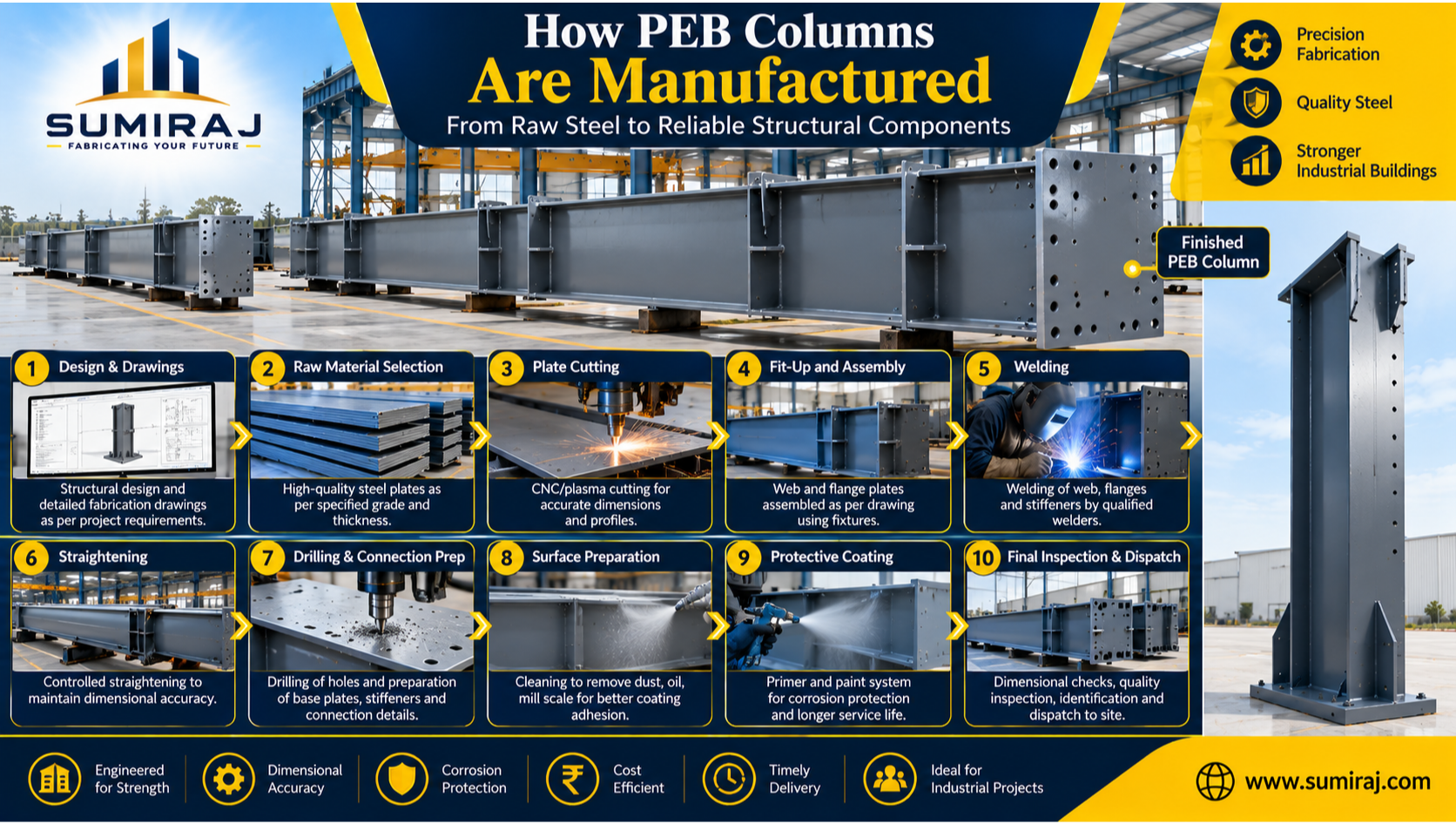
Step-by-Step Process of PEB Columns Manufacturing
PEB column manufacturing involves more than cutting and joining steel plates. Each stage must be coordinated with the structural design to produce an accurate component ready for installation.
1. Structural Design and Fabrication Drawings
The process begins with structural engineering. Engineers determine the column configuration based on the building's dimensions, loading conditions, and structural requirements.
Once the design is finalised, fabrication drawings specify the dimensions, plate thicknesses, connection locations, weld details, and other manufacturing information.
These drawings serve as the primary reference for the fabrication team. Accurate drawings help ensure that columns fit correctly with rafters, base plates, and other connected components during site erection.
Any revision to the approved design should be communicated through the appropriate drawing and document-control process before fabrication continues.
2. Raw Material Selection and Inspection
The next stage involves selecting steel plates that meet the specified material grade, thickness, and quality requirements.
Material verification is important because the mechanical properties and dimensions of the steel influence the performance of the finished column.
Depending on the project's quality plan, incoming inspection may include:
Checking material identification and documentation.
Verifying plate thickness and dimensions.
Reviewing material test certificates where required.
Inspecting the steel for visible damage or surface defects.
Confirming traceability between the supplied material and the fabrication records.
Steel should be released for production only after the required checks have been completed.
3. Steel Plate Cutting
After material approval, steel plates are cut according to the dimensions specified in the fabrication drawings.
Depending on the plate thickness, production requirements, and available equipment, cutting may be performed using CNC plasma cutting, oxy-fuel cutting, or another suitable method.
Accurate cutting is essential because dimensional errors can affect the column's overall length, flange alignment, connection positions, and fit-up during assembly.
Cut edges should be checked for dimensional accuracy and unacceptable defects. Where necessary, edges are prepared or finished according to the specified welding requirements.
4. Plate Assembly and Fit-Up
Many PEB columns are manufactured as built-up sections consisting of a web plate and flange plates. The web forms the main vertical plate, while the flanges contribute to the section's strength and stiffness.
During assembly, the cut plates are positioned according to the fabrication drawings. Suitable fixtures or alignment arrangements help maintain the required geometry.
The fabrication team checks important dimensions, including:
Overall column length and depth.
Web and flange alignment.
Plate positioning and orientation.
Squareness and straightness.
Locations of stiffeners and connection plates, where specified.
Correct fit-up helps reduce distortion during welding and supports consistent fabrication quality.
5. Welding of Column Components
Welding joins the web and flange plates to form the built-up column section. Additional components, such as stiffeners and connection plates, may also require welding according to the approved drawings.
The welding process must be appropriate for the material thickness, joint configuration, and required structural performance.
Quality controls may include approved welding procedures, suitable consumables, welder qualification where required, and checks on welding parameters.
Visual inspection is commonly used to identify surface defects such as visible cracks, undercut, incomplete weld profiles, or other unacceptable conditions. Additional non-destructive testing may be required for specified welds or projects.
Weld quality is important because the connections between the web and flanges help the section act as an integrated structural member.
6. Straightening and Dimensional Correction
Heat generated during welding can cause distortion, particularly in long built-up steel sections. The finished column may require controlled straightening or dimensional correction to meet the specified tolerances.
The inspection team checks the column's straightness, alignment, dimensions, and overall geometry against the approved drawings and applicable acceptance criteria.
Correction methods must be suitable for the material and fabrication procedure. Uncontrolled heating or forceful correction can damage the component or affect its properties.
Dimensional accuracy at this stage helps prevent installation problems when columns are connected to base plates, rafters, and other structural members.
7. Drilling and Connection Preparation
PEB columns require connection details that allow them to be assembled with the rest of the structural frame.
Depending on the design, these may include base plates, end plates, cleats, stiffeners, and holes for bolts or other specified fasteners.
Drilling and connection preparation must follow the fabrication drawings. Hole diameter, spacing, edge distance, and alignment are important because errors can prevent proper assembly or affect the intended connection behaviour.
The location and dimensions of base plates must also be checked carefully. These plates form the interface between the steel column and the foundation anchorage system.
8. Surface Preparation and Protective Coating
After fabrication and the required inspections, the column may undergo surface preparation before receiving the specified protective coating.
Surface preparation removes contaminants such as oil, grease, loose rust, and mill scale as required by the selected coating system. The preparation method depends on the coating specification and project requirements.
Protective systems may include suitable primers, paint systems, or other specified treatments. The choice depends on environmental exposure, durability requirements, and the intended service conditions.
Coating inspection may include checks for surface cleanliness, coverage, visible defects, and dry film thickness where specified.
Appropriate surface preparation and coating help protect the steel against corrosion and support the building's maintenance requirements.
9. Final Quality Inspection
Before dispatch, the completed PEB columns undergo final checks to confirm that they meet the applicable fabrication and project requirements.
The inspection process may include:
Dimensional verification.
Visual inspection of welds.
Review of connection locations and hole dimensions.
Verification of stiffeners and attached plates.
Coating inspection where applicable.
Identification and traceability checks.
Review of required inspection and test records.
Additional testing may be required depending on the project specification and quality plan.
Components that do not meet the acceptance criteria should be assessed and corrected through an approved process before release.
10. Identification, Packing and Dispatch
Once approved, columns are identified and prepared for transportation. Markings help the erection team identify the correct component and match it with the erection drawings.
Packing and loading arrangements should reduce the risk of damage, excessive bending, coating damage, or loss of identification during transport.
Components should be handled using suitable lifting methods and stored on appropriate supports when necessary.
Proper identification and dispatch coordination help the site team organise deliveries and install the structural frame according to the construction sequence.
Benefits of a Controlled PEB Column Manufacturing Process
A well-managed manufacturing process provides several benefits for industrial building projects.
1. Dimensional Accuracy
Accurate cutting, fit-up, welding, and inspection help ensure that columns match the approved drawings and connect properly with other structural members.
2. Reliable Structural Performance
Using specified materials and controlling fabrication quality help produce columns suitable for their intended structural role.
3. Improved Erection Efficiency
Correctly fabricated components can reduce avoidable adjustments at the construction site and support smoother steel-frame assembly.
4. Better Corrosion Protection
Appropriate surface preparation and coating application help protect steel against environmental exposure when the specified system is correctly selected and maintained.
5. Reduced Material Waste
Accurate cutting plans and controlled fabrication can help reduce unnecessary material waste and rework.
6. Traceability and Quality Assurance
Material identification, inspection records, and component markings help establish traceability and provide a basis for quality verification.
Applications of PEB Columns
PEB columns are used in many types of steel-framed industrial buildings, including:
Manufacturing plants: Supporting structural frames around production areas.
Warehouses: Providing vertical support for large storage and distribution buildings.
Industrial sheds: Forming the primary frame for fabrication and workshop facilities.
Logistics centres: Supporting buildings with loading areas and material-handling operations.
Automotive facilities: Used in workshops, assembly buildings, and related industrial structures.
Engineering units: Supporting structures designed for machinery and industrial processes.
Each application has its own loading and operational requirements. Columns must be designed for the specific building rather than selected solely on the basis of their external dimensions.
PEB Column Manufacturing in Noida
Industrial projects in Noida require fabrication and engineering decisions that reflect the building's intended use, site conditions, and structural requirements.
Before manufacturing begins, project owners should confirm the approved structural drawings, material specifications, column dimensions, connection details, protective coating requirements, and inspection criteria.
Coordination between the PEB manufacturer, structural engineer, civil contractor, and installation team is particularly important. Foundation anchor bolts and base-plate details must match the approved design to avoid alignment problems during erection.
For buildings involving cranes, specialised machinery, or other significant operational loads, these requirements must be included in the engineering design before fabrication.
Applicable Indian standards and project-specific specifications should guide structural design, material selection, fabrication, welding, and inspection.
Why Choose Sumiraj for PEB Columns?
Selecting a PEB manufacturer involves evaluating engineering coordination, material control, fabrication capability, and quality procedures.
Sumiraj focuses on the key considerations involved in manufacturing structural components for industrial buildings.
Engineering expertise: Working from project-specific structural and fabrication requirements.
Quality steel: Using materials according to approved grades and specifications.
Customized designs: Supporting column configurations based on building dimensions and loading requirements.
Cost efficiency: Considering material utilisation, fabrication planning, and the avoidance of unnecessary rework.
Timely delivery: Coordinating fabrication and dispatch requirements with project schedules.
Indian standards: Considering applicable Indian standards and project-specific engineering requirements.
Technical support: Helping clients understand component specifications and fabrication-related requirements.
For industrial buyers, clear communication and coordinated documentation are important parts of achieving a successful PEB project.
Frequently Asked Questions
1. How are PEB columns manufactured?
PEB columns are manufactured through a sequence that typically includes structural design, material inspection, plate cutting, fit-up, welding, straightening, connection preparation, surface protection, final inspection, and dispatch.
2. Which steel sections are used to manufacture PEB columns?
Many PEB columns use built-up sections made from web and flange plates. The exact configuration depends on the structural design, loading requirements, and approved fabrication drawings.
3. Why is welding quality important in PEB column manufacturing?
Welding joins the plates that form the built-up section and helps the component perform as designed. Weld quality must meet the specified procedures and acceptance criteria.
4. How is the quality of a fabricated PEB column checked?
Quality checks may include material verification, dimensional inspection, visual weld inspection, connection checks, coating inspection, and additional testing where required by the project specification.
5. Why is surface preparation necessary before painting PEB columns?
Surface preparation removes contaminants and prepares the steel for the specified coating system. Suitable preparation helps the coating adhere properly and provides the intended corrosion protection.
6. Can PEB columns be customized for different buildings?
Yes. Column dimensions, plate thicknesses, stiffeners, and connection details can be designed according to the building's span, height, loading conditions, and structural requirements.
7. What causes delays during PEB column fabrication?
Potential causes include late design changes, material availability issues, dimensional errors, welding rework, inspection failures, and poor coordination between fabrication and dispatch schedules. Effective planning and quality control help manage these risks.
Conclusion
PEB columns manufacturing is a controlled engineering and fabrication process that transforms specified steel plates into structural members for industrial buildings. From material selection and cutting to welding, dimensional checks, surface protection, and final inspection, every stage contributes to the quality of the finished column.
For factory owners, warehouse developers, and contractors in Noida, understanding this process helps them assess fabrication requirements and coordinate their projects more effectively. Accurate drawings, suitable materials, controlled welding, and thorough inspection are essential to producing columns that meet their intended structural specifications.
Sumiraj supports industrial building projects by focusing on coordinated engineering requirements, specified materials, fabrication planning, and component quality.
Discuss Your Project With Sumiraj
Planning a new factory, warehouse, or industrial shed? Contact Sumiraj via WhatsApp or phone to discuss your PEB column requirements, structural specifications, and project needs.
Subscribe to our updates and stay informed about the latest trends, innovations, and cost-saving solutions in PEB construction, industrial buildings, and warehouse development.