

C Purlin in Pre-Engineered Buildings
Introduction
Every successful Pre-Engineered Building (PEB) depends on more than just columns and rafters. While primary structural members carry major building loads, secondary members play an equally important role in ensuring overall stability and performance. Among these secondary components, the C Purlin is one of the most widely used structural elements in industrial buildings.
C Purlins provide support to roofing and wall cladding systems while efficiently transferring loads to the primary structural frame. From warehouses and factories to logistics parks and commercial buildings, C Purlins contribute significantly to the strength, durability, and cost-efficiency of modern steel structures.
At Sumiraj, we understand that selecting the right secondary framing system is critical for long-term building performance. This comprehensive guide explains everything industrial buyers need to know about C Purlins in PEB construction.
What is a C Purlin?
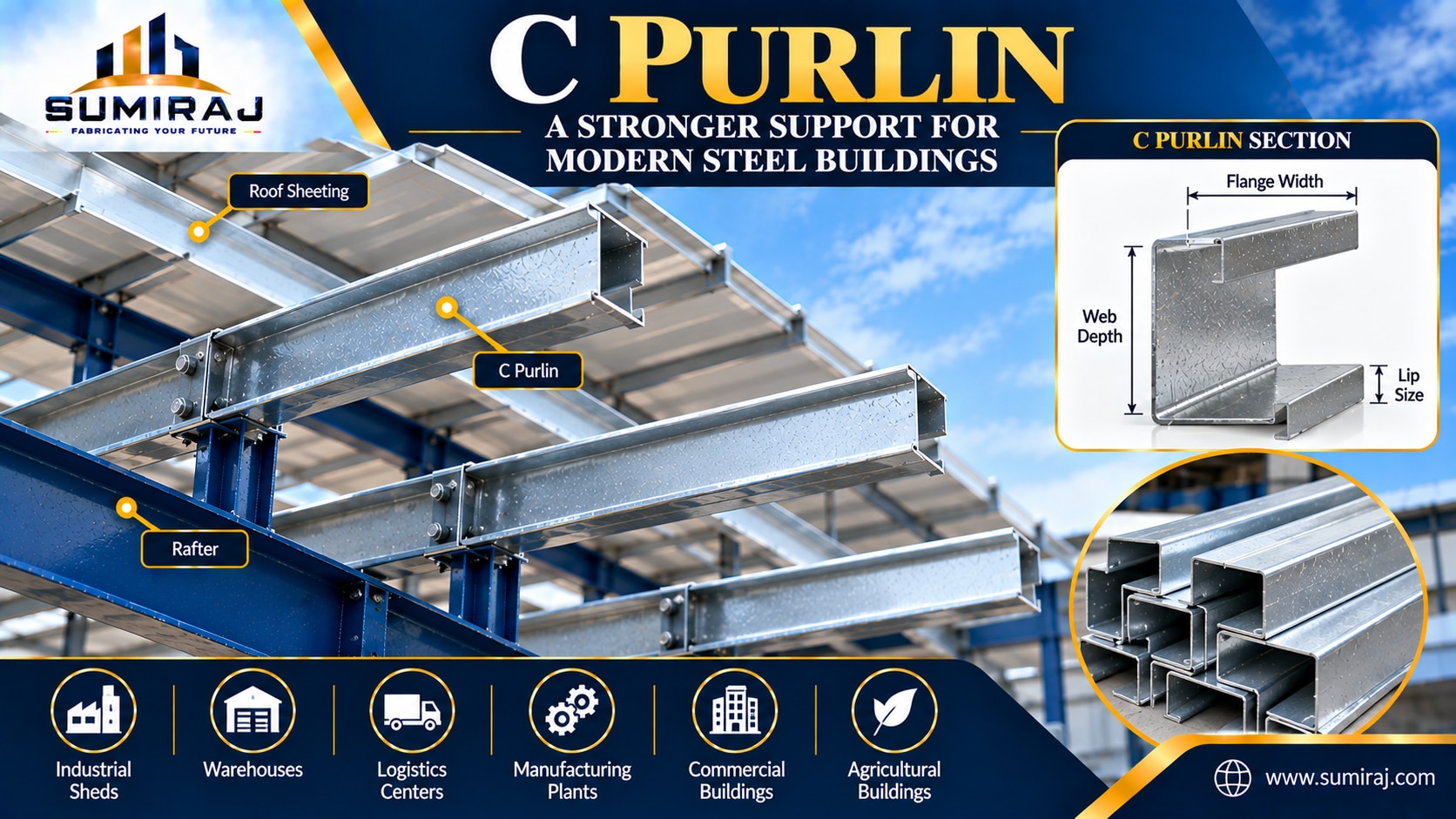
A C Purlin is a cold-formed steel section shaped like the letter "C." It is primarily used as a secondary structural member in Pre-Engineered Buildings.
These members are installed horizontally between primary structural frames and serve as support systems for roof sheets and wall cladding panels.
The primary role of a C Purlin is to distribute loads from roofing and wall systems to the main structural framework.
Anatomy of a C Purlin
Understanding the basic parts of a C Purlin helps in appreciating its structural efficiency.
Web
The vertical portion of the section is known as the web. It carries shear forces and contributes significantly to the strength of the member.
Flanges
The horizontal extensions on either side are called flanges. These improve bending resistance and structural stability.
Lips
Small return bends at the flange edges are called lips. These increase stiffness and reduce the risk of local buckling.
Role of C Purlins in PEB Structures
C Purlins perform multiple critical functions within a steel building.
Supporting Roof Cladding
Roof sheets are directly fixed onto purlins. The purlins distribute the loads evenly to the rafters.
Supporting Wall Cladding
When installed vertically along walls, C sections often function as girts, supporting wall panels and transferring loads to columns.
Load Transfer
They form an important part of the structural load path:
Roof Sheet → C Purlin → Rafter → Column → Foundation
Structural Stability
Properly designed purlins help prevent excessive deflection and maintain the integrity of roofing systems.
Types of C Purlins Used in PEB Buildings
Roof C Purlins
Installed on rafters to support roofing sheets and insulation systems.
Wall C Purlins
Used as girts to support wall cladding and transfer wind loads to primary framing.
Heavy-Duty C Purlins
Designed for projects requiring higher load-carrying capacity due to increased spans or environmental loads.
Galvanized C Purlins
Manufactured with protective coatings for enhanced corrosion resistance and longer service life.
How C Purlins Are Manufactured
Modern C Purlins are produced using advanced roll-forming technology.
Steel Coil Selection
High-quality steel coils are selected according to project specifications.
Roll Forming Process
The steel passes through multiple rollers that gradually shape it into a C profile.
Hole Punching
Connection holes are punched with precision during manufacturing.
Quality Inspection
Dimensional accuracy, thickness, and surface quality are verified before dispatch.
Protective Coating
Galvanization or other coatings improve corrosion resistance and durability.
Benefits of C Purlins in Industrial Buildings
Lightweight Construction
C Purlins offer excellent strength while minimizing structural weight.
Faster Installation
Factory-fabricated components reduce site work and accelerate project schedules.
Cost Optimization
Efficient use of steel helps reduce overall construction costs.
High Structural Efficiency
The profile is engineered to maximize strength with minimal material usage.
Long Service Life
Protective coatings and quality steel provide long-term durability.
Easy Integration
C Purlins integrate seamlessly with modern roofing and cladding systems.
Factors Affecting C Purlin Selection
Selecting the right purlin requires careful engineering evaluation.
Building Span
Larger buildings may require stronger or more closely spaced purlins.
Roof Load Requirements
Dead loads, live loads, maintenance loads, and equipment loads influence design.
Wind Conditions
Wind uplift and lateral forces significantly impact purlin selection.
Roofing Material
Different cladding systems create different loading requirements.
Environmental Exposure
Coastal and industrial environments may require enhanced corrosion protection.
Building Usage
Warehouses, factories, logistics centers, and commercial facilities each have unique design requirements.
C Purlin vs Z Purlin
Both profiles are commonly used in PEB construction, but they serve different purposes.
| Features | C Purlin | Z Purlin |
|---|---|---|
| Shape | C-Shaped | Z-Shaped |
| Installation | Simple | Suitable for overlapping systems |
| Typical Use | Walls and shorter spans | Roof systems and longer spans |
| Connection Arrangement | Straightforward | Continuous overlapping possible |
| Structural Continuity | Moderate | Higher continuity |
Common Applications of C Purlins
Industrial Sheds
Manufacturing facilities rely on C Purlins to support roofing and wall systems.
Warehouses
Storage buildings use C Purlins for economical secondary framing.
Logistics Parks
Large logistics hubs require durable framing systems capable of handling extensive roof areas.
Commercial Buildings
Retail centers and commercial facilities frequently incorporate C Purlins.
Agricultural Buildings
Poultry sheds, storage facilities, and processing units often use C Purlin systems.
Infrastructure Projects
Workshops, utility buildings, and service facilities benefit from their versatility.
Common Design Considerations
Engineers evaluate several technical factors while designing C Purlins.
Deflection Control
Excessive deflection can affect roofing performance and aesthetics.
Buckling Resistance
Proper section design prevents local and global buckling failures.
Connection Strength
Connections must safely transfer loads between purlins and primary framing.
Serviceability Requirements
Long-term performance is evaluated alongside structural strength.
Future Expansion
Industrial projects often consider future building modifications during design.
Why Choose Sumiraj
At Sumiraj, we provide engineered PEB solutions designed to meet the practical requirements of modern industrial construction.
Our strengths include:
Engineering expertise in PEB design
High-quality steel materials
Customized structural solutions
Cost-efficient building systems
Compliance with Indian standards
Timely project execution
Dedicated technical support
Focus on long-term structural performance
We work closely with industrial clients to ensure every component contributes to a safe, durable, and efficient building.
FAQs
What is the main purpose of a C Purlin?
A C Purlin supports roof and wall cladding systems while transferring loads to the primary structural frame.
Are C Purlins suitable for warehouses?
Yes. C Purlins are widely used in warehouse buildings because they provide efficient load distribution and cost-effective construction.
What material is used for manufacturing C Purlins?
They are generally manufactured from high-strength cold-formed steel.
Can C Purlins be used as wall girts?
Yes. C sections are commonly used as wall girts in industrial and commercial buildings.
How do engineers select the right C Purlin?
Selection depends on span length, loading conditions, building geometry, environmental exposure, and structural requirements.
Are galvanized C Purlins better for industrial buildings?
Galvanized C Purlins offer improved corrosion resistance and are often preferred in demanding environments.
Conclusion
C Purlins are among the most important secondary structural members in modern Pre-Engineered Buildings. They support roof and wall systems, distribute loads efficiently, improve structural stability, and contribute significantly to overall building performance.
From warehouses and factories to logistics parks and commercial developments, properly designed C Purlins help create stronger, safer, and more cost-effective steel buildings. By understanding their design, applications, benefits, and selection criteria, industrial buyers can make informed decisions that improve project outcomes and long-term value.
Discuss Your Project
Planning a warehouse, factory, logistics facility, or industrial shed? Connect with Sumiraj today to discuss your project requirements and explore customized PEB solutions designed for performance, durability, and cost efficiency.
