Introduction
Choosing the right roofing system is one of the most important decisions when constructing an industrial shed, factory, or warehouse. The roof must provide reliable weather protection, withstand wind loads, and support the building's operational requirements. Standing seam roofing vs trapezoidal roofing sheets is a common consideration in Pre-Engineered Building (PEB) projects because both systems offer different advantages in terms of installation, water resistance, durability, and cost.
For industrial businesses in Noida, selecting the right roofing system requires consideration of the building's roof slope, rainfall exposure, structural design, maintenance requirements, and budget.
At Sumiraj, roofing selection is an important part of planning a suitable PEB solution. Understanding the differences between these two systems helps factory owners and warehouse developers choose a roof that matches their project requirements.
What Is Standing Seam Roofing?
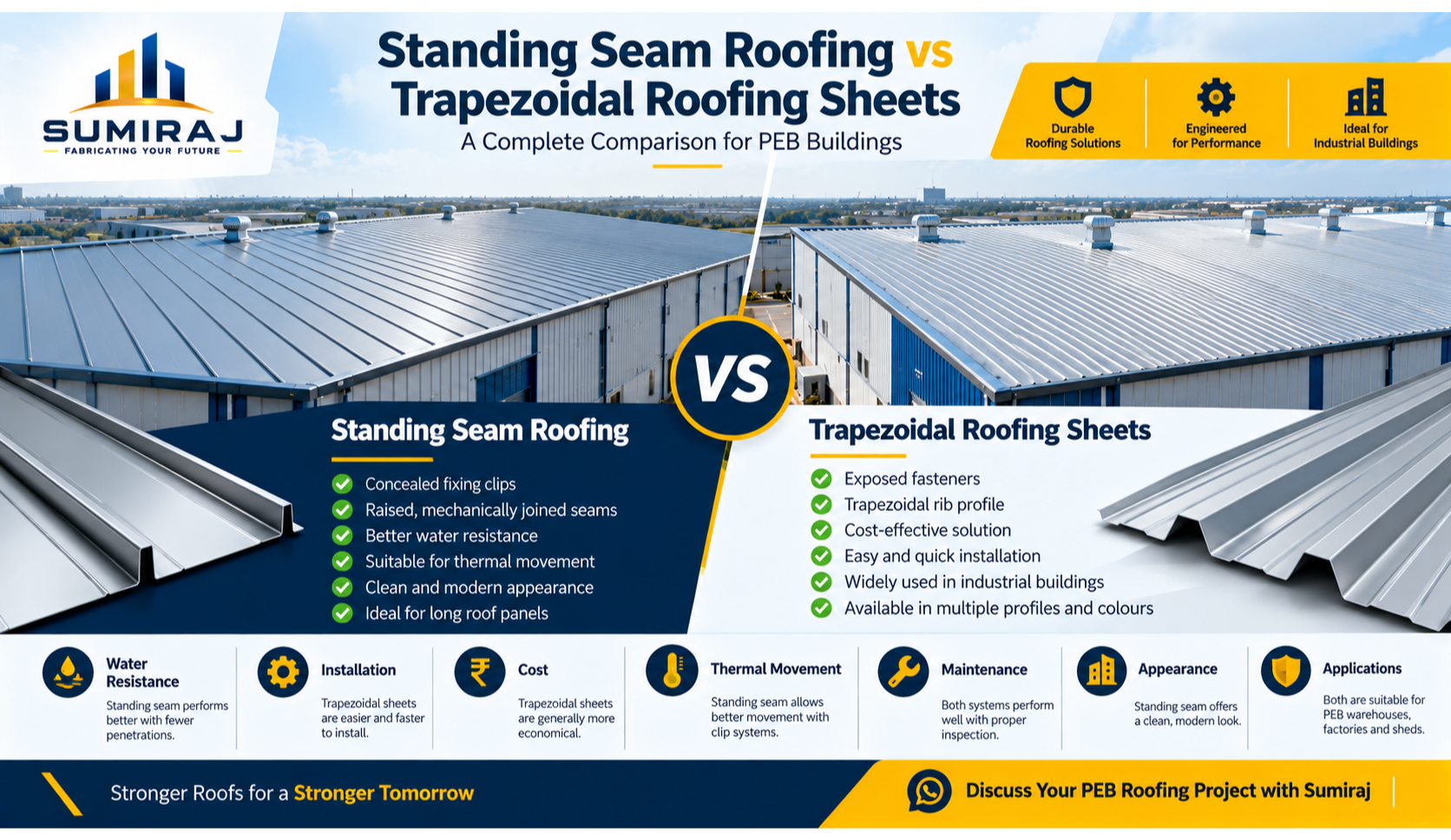
Standing seam roofing is a metal roofing system in which adjacent panels are joined using raised vertical seams. The panels are generally secured to the supporting structure through concealed clips rather than conventional exposed fasteners passing through the roof sheet.
Depending on the system, the seams may be mechanically folded or mechanically locked using specialised equipment.
Key Features of Standing Seam Roofing
Concealed fixing clips.
Raised and mechanically joined seams.
Fewer exposed fasteners across the roof surface.
Provision for thermal expansion and contraction in suitable clip systems.
Long-length panel options, depending on manufacturing and transportation requirements.
A clean, continuous roof appearance.
One important advantage is that concealed fixing avoids conventional fastener penetrations through the main weathering surface. Certain systems also use sliding clips to accommodate longitudinal thermal movement. The exact arrangement depends on the selected roofing profile and manufacturer's specifications.
What Are Trapezoidal Roofing Sheets?
Trapezoidal roofing sheets are profiled metal sheets with raised ribs and flat sections that create a trapezoidal pattern. They are commonly used in industrial buildings because of their practical installation, availability, and suitability for many conventional roof designs.
These sheets are generally fixed to roof purlins using self-drilling screws and suitable sealing washers. The fasteners typically pass through designated portions of the sheet according to the roofing manufacturer's installation instructions.
Key Features of Trapezoidal Roofing Sheets
Trapezoidal rib profile for structural stiffness.
Through-fastened installation.
Availability in different thicknesses, coatings, and colours.
Compatibility with common PEB purlin arrangements.
Practical installation and replacement.
Suitable for a wide range of industrial and storage buildings.
Trapezoidal sheets are commonly selected for general-purpose factories, warehouses, and industrial sheds where the specified roof slope and support arrangement are suitable.
Standing Seam Roofing vs Trapezoidal Roofing Sheets: Key Differences
Although both systems use metal panels, their fixing arrangements and performance characteristics differ.
| Comparison Factor | Standing Seam Roofing | Trapezoidal Roofing Sheets |
|---|---|---|
| Fixing method | Concealed clips | Exposed screws and fasteners |
| Joint design | Raised, mechanically joined seams or specified snap-lock joints | Overlapping side and end laps where required |
| Fastener visibility | Generally concealed across the main roof surface | Generally visible |
| Water penetration risk | Fewer direct penetrations through the roof sheet | Depends on fasteners, washers, laps, and sealing |
| Thermal movement | Suitable clip systems can accommodate panel movement | Conventional through-fixing restrains movement at fastener locations |
| Installation | Requires system-specific clips and often specialised seaming equipment | Generally simpler conventional fixing |
| Maintenance | Requires inspection of seams, clips, flashings, and accessories | Requires inspection of fasteners, washers, laps, and coatings |
| Initial investment | Generally higher for comparable specifications | Generally more economical |
| Roof appearance | Continuous and modern appearance | Distinctive ribbed industrial appearance |
| Typical application | Projects requiring concealed fixing and enhanced weather detailing | General industrial sheds, factories, and warehouses |
The final performance of either system depends on product quality, engineering, installation, and detailing.
1. Water Resistance and Leakage Protection
Water leakage is an important concern for industrial warehouses and manufacturing facilities. Roof leaks can damage stored materials, machinery, electrical installations, and finished products.
Standing Seam Roofing
Standing seam systems use concealed clips and raised joints. Because conventional fasteners do not penetrate the main weathering surface, the system can reduce potential leakage points.
Its raised seams help direct rainwater towards the drainage system. Mechanically seamed systems can provide particularly reliable joints when installed according to the manufacturer's specifications.
Trapezoidal Roofing Sheets
Trapezoidal sheets rely on correctly installed fasteners, sealing washers, side laps, and end laps to maintain weather resistance.
Over time, damaged washers, loose fasteners, poorly sealed overlaps, or incorrect installation may create leakage risks.
Practical consideration: Standing seam roofing may be advantageous where enhanced weather protection is a priority, but neither system is automatically leak-proof. Flashings, ridge details, valleys, gutters, roof penetrations, and installation quality remain critical.
2. Thermal Expansion and Contraction
Metal roofing expands when heated and contracts when cooled. This movement is especially relevant in buildings with long roof panels exposed to significant temperature changes.
Standing seam roofing: Suitable concealed clip systems allow panels to move longitudinally while maintaining their connection to the supporting structure. The clip arrangement and fixed-point locations must be designed for the expected movement.
Trapezoidal roofing: Conventional through-fastened sheets are restrained at their fixing points. Their design and installation must account for thermal movement through suitable detailing and fastening arrangements.
For large PEB warehouses, thermal movement should be considered during roofing design rather than addressed only after installation.
3. Installation and Construction Requirements
Installation requirements influence construction planning, labour, equipment, and project scheduling.
Standing seam roofing generally requires trained installers, compatible clips, accurate panel alignment, and specialised seaming equipment for mechanically locked systems.
Trapezoidal sheets are generally simpler to install because they use conventional fasteners and standardised fixing arrangements. This can make them practical for many industrial roofing projects.
However, installation speed depends on roof area, access, panel length, weather conditions, and the experience of the installation team.
4. Cost Comparison
Cost is often a deciding factor for industrial construction projects.
Standing seam roofing generally involves higher initial costs because of its specialised clips, panel profiles, accessories, and installation requirements.
Trapezoidal roofing sheets are generally more economical for conventional industrial applications because of their simpler fixing arrangements and widespread availability.
However, project owners should compare more than the initial material price. The evaluation should include installation, accessories, maintenance, potential repairs, and the expected service conditions.
For a large warehouse where roof leakage could damage valuable inventory, investing in a more suitable roofing system may provide better long-term value.
5. Durability and Maintenance
Both roofing systems can provide long service when manufactured, specified, installed, and maintained correctly.
Standing seam roofing requires inspection of seams, clips, flashings, gutters, and roof penetrations.
Trapezoidal sheets require periodic checks of fasteners, sealing washers, overlaps, protective coatings, and damaged sheet areas.
For both systems, the steel grade, metallic coating, paint specification, environmental exposure, and maintenance practices influence durability.
Benefits of Choosing the Right Roofing System
Selecting the appropriate roof provides several practical benefits for industrial building owners.
Better weather protection: Suitable profiles, joints, and accessories help reduce water ingress.
Structural compatibility: Correct roofing selection ensures coordination with purlins, wind-load requirements, and the primary steel frame.
Efficient construction: Matching the roofing system to project requirements supports organised fabrication and installation.
Long-term value: Considering installation and maintenance costs helps project owners evaluate the complete lifecycle cost.
Improved building performance: Appropriate roofing materials and insulation arrangements can support thermal performance and the intended internal environment.
Applications of Standing Seam and Trapezoidal Roofing
Standing Seam Roofing Applications
Large warehouses requiring suitable long-panel roofing systems.
Manufacturing plants where roof leakage protection is a priority.
Industrial buildings with appropriate low-slope roof designs.
Facilities where thermal movement needs to be accommodated through concealed clips.
Projects requiring a clean, continuous roof appearance.
Trapezoidal Roofing Applications
General industrial sheds.
Conventional factory buildings.
Warehouses and storage facilities.
Workshops and fabrication units.
Industrial buildings where conventional exposed fixing meets the project requirements.
The best system depends on the building's geometry, environmental exposure, and operational requirements.
Which Roofing System Is Better for PEB Projects in Noida?
Industrial projects in Noida may experience different rainfall patterns, temperature variations, wind conditions, and environmental exposure.
Standing seam roofing may be worth considering for buildings where concealed fixing, long roof panels, or enhanced weather detailing are important.
Trapezoidal roofing may be suitable for conventional industrial sheds and warehouses where the roof slope, sheet specification, and fastening arrangement meet the design requirements.
Before selecting either system, project owners should evaluate:
Roof slope and drainage arrangement.
Building dimensions and purlin spacing.
Wind pressure and uplift requirements.
Steel thickness and metallic coating.
Fastener or concealed clip specifications.
Insulation and thermal requirements.
Installation quality and maintenance access.
The minimum roof slope must always follow the selected product manufacturer's technical specifications. It should not be assumed that every standing seam or trapezoidal profile can be installed at the same roof pitch.
Why Choose Sumiraj for PEB Roofing Solutions?
Sumiraj understands that roofing selection must be coordinated with the overall building design rather than treated as an independent material decision.
Important considerations include:
Engineering expertise: Coordinating roofing requirements with purlins, structural framing, and design loads.
Quality steel: Considering suitable steel grades, thicknesses, and protective coatings.
Customized designs: Selecting roofing arrangements according to building dimensions and operational requirements.
Cost efficiency: Evaluating initial investment alongside installation and maintenance requirements.
Timely delivery: Coordinating roofing specifications with fabrication and project schedules.
Indian standards: Considering applicable Indian standards and project-specific requirements.
Technical support: Helping clients understand roofing options and their suitability for industrial applications.
Sumiraj focuses on understanding the project before recommending a roofing arrangement.
Frequently Asked Questions
1. What is the main difference between standing seam and trapezoidal roofing sheets?
Standing seam roofing generally uses concealed clips and raised mechanically joined seams. Trapezoidal roofing sheets are generally fixed directly to purlins using exposed fasteners and sealing washers.
2. Which roofing system is better for industrial warehouses?
The choice depends on roof slope, weather exposure, building dimensions, budget, and maintenance requirements. Standing seam may suit projects requiring concealed fixing, while trapezoidal sheets are practical for many conventional warehouses.
3. Is standing seam roofing more expensive than trapezoidal roofing?
Generally, yes. Standing seam systems often involve specialised clips, accessories, and installation equipment, increasing the initial investment.
4. Can standing seam roofing be used on low-slope roofs?
Certain standing seam systems are designed for low-slope applications. However, the permitted minimum slope depends on the specific profile, seam configuration, panel length, and manufacturer's installation requirements.
5. Do trapezoidal roofing sheets leak?
They can provide effective weather protection when correctly specified and installed. Leakage may occur if fasteners, sealing washers, overlaps, flashings, or drainage details are defective.
6. Which roofing system handles thermal expansion better?
Suitable standing seam systems with sliding clips can accommodate longitudinal thermal movement. Conventional through-fastened trapezoidal sheets require appropriate design and installation detailing to address movement.
7. Can both roofing systems be used in PEB construction?
Yes. Both systems can be used in PEB buildings when the roof structure, purlins, slope, loading conditions, and connection details are designed for the selected roofing system.
Conclusion
Standing seam roofing vs trapezoidal roofing sheets is an important comparison when planning a PEB warehouse, factory, or industrial shed. Standing seam roofing offers concealed fixing, raised joints, and thermal movement accommodation through suitable clip systems. Trapezoidal roofing provides a practical and generally economical option for many conventional industrial buildings.
For industrial projects in Noida, the right choice depends on roof slope, rainfall exposure, structural requirements, installation quality, maintenance expectations, and budget.
At Sumiraj, roofing selection is considered alongside the complete PEB structure to help industrial buyers choose a suitable system for their project requirements.
Discuss Your Project With Sumiraj
Planning a new factory, warehouse, or industrial shed? Contact Sumiraj through WhatsApp or phone to discuss your roof dimensions, roofing sheet requirements, and suitable PEB roofing options.
Subscribe to our updates and stay informed about the latest trends, innovations, and cost-saving solutions in PEB construction, industrial buildings, and warehouse development.