Introduction
The roof of an industrial building must provide reliable protection against rain, heat, wind, and environmental exposure. Choosing the right roofing material is therefore an important part of planning a factory, warehouse, or industrial shed. Galvalume roofing sheets are widely used in industrial construction because their aluminium-zinc alloy coating provides corrosion resistance, heat reflectivity, and a durable surface for roofing applications.
For industrial businesses in Noida, Galvalume roofing can be a practical option when the sheet grade, coating class, thickness, and profile are selected according to project requirements. At Sumiraj, roofing material selection is considered alongside the PEB structure, purlin arrangement, drainage design, and environmental conditions to support the overall performance of the building.
What Are Galvalume Roofing Sheets?
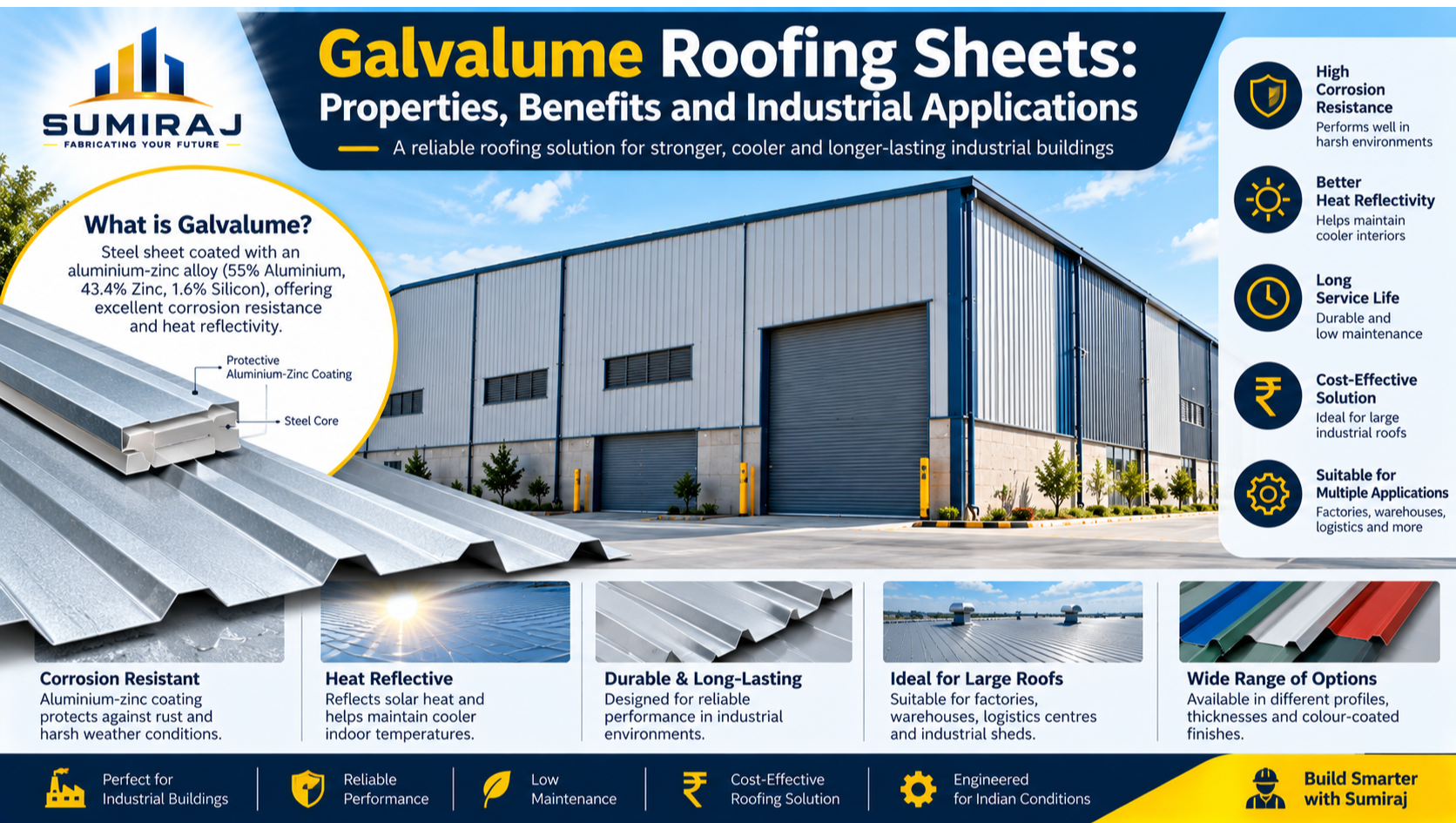
Galvalume is a steel sheet coated with an aluminium-zinc alloy through a continuous hot-dip coating process. The commonly specified coating composition is approximately 55% aluminium, 43.4% zinc, and 1.6% silicon by weight.
Each element contributes to the coating's performance. Aluminium provides a protective barrier against the surrounding environment, while zinc offers sacrificial protection in certain damaged areas. Silicon helps control the formation of the alloy layer during manufacturing and supports coating adhesion during subsequent processing.
Galvalume sheets are supplied in different steel grades, thicknesses, coating classes, and surface finishes. They can be used in bare metallic form or supplied with an additional colour-coated paint system, depending on the application.
Key Properties of Galvalume Roofing Sheets
1. Corrosion Resistance
One of the important properties of Galvalume is its resistance to atmospheric corrosion. The aluminium-rich coating provides barrier protection, while zinc contributes sacrificial protection at certain scratches and cut edges.
This combination makes Galvalume suitable for many industrial roofing and cladding applications. However, actual performance depends on coating mass, installation quality, environmental exposure, and maintenance. It should not be assumed that every coating class will perform equally in all environments.
2. Heat Reflectivity
The metallic coating has reflective properties that can help reduce the amount of solar energy absorbed by the roof surface compared with some darker, less reflective finishes.
Actual indoor temperature depends on several factors, including roof colour, insulation, ventilation, building orientation, and local climate. Galvalume alone does not provide thermal insulation; insulated panels or a separate insulation system may be required where temperature control is important.
3. Formability and Fabrication
Galvalume-coated steel can be roll-formed into different roofing profiles, including trapezoidal and other profiled sheets. This makes it suitable for a range of roof designs.
The forming process must be controlled to avoid unnecessary damage to the metallic coating. The selected steel grade should also suit the profile geometry and manufacturing process.
4. Surface Appearance
Bare Galvalume generally has a bright metallic appearance. Pre-painted Galvalume is available in different colours and finishes, allowing building owners to coordinate the roof with the external appearance of their facility.
5. Temperature Performance
The aluminium content contributes to the coating's resistance to oxidation at elevated temperatures. However, the permissible operating conditions should be checked against the manufacturer's product data rather than assuming that every roofing sheet is suitable for high-temperature industrial processes.
Benefits of Using Galvalume Roofing Sheets in Industrial Buildings
1. Long-Term Corrosion Protection
Galvalume can provide durable protection in many atmospheric environments when the coating specification is appropriate for the site conditions. This can help reduce premature deterioration and associated maintenance work.
2. Lightweight Roofing System
Profiled Galvalume sheets are relatively lightweight compared with many conventional roofing materials. Their use can help reduce roof dead load, provided the selected sheet thickness, profile, support spacing, and fixing arrangement meet the structural design requirements.
3. Compatibility With PEB Structures
Galvalume roofing sheets can be coordinated with steel purlins and other PEB components. Their profile, length, and fixing details can be selected to suit the roof design and installation sequence.
4. Reduced Maintenance Requirements
A suitable coating can help limit corrosion-related maintenance. Nevertheless, periodic inspection remains important, particularly around fasteners, overlaps, cut edges, gutters, and roof penetrations.
5. Design Flexibility
Different profiles, thicknesses, coating classes, and colour finishes allow Galvalume sheets to be considered for a variety of industrial buildings.
6. Cost-Conscious Building Solution
The lightweight nature and corrosion-protection properties of Galvalume can make it a practical roofing option. Project owners should compare total lifecycle cost, including material, installation, insulation, accessories, and maintenance, rather than relying only on the initial sheet price.
Specifications to Check Before Buying Galvalume Roofing Sheets
Selecting Galvalume roofing requires more than confirming that the sheet has an aluminium-zinc coating.
Base metal thickness (BMT): This refers to the thickness of the steel substrate before metallic coating and paint are included. It is important for evaluating the sheet's structural properties.
Total coated thickness (TCT): This includes the base steel and the applied coatings. Buyers should confirm whether a quoted thickness refers to BMT or TCT to avoid specification misunderstandings.
Coating class: Coating designations such as AZ150 indicate a specified aluminium-zinc coating mass. The applicable test method and whether the stated mass represents both surfaces should be confirmed in the product documentation.
Steel grade: The grade should provide the mechanical properties required for the selected roofing profile and design loads.
Roof profile: The rib height and profile geometry influence sheet stiffness, water drainage, and support requirements.
Paint system: Where colour-coated sheets are selected, check the paint type, coating thickness, finish, and warranty conditions separately from the metallic coating specification.
For Indian procurement, the relevant product standard should be identified in the purchase specification. BIS lists IS 15961:2025, the first revision covering hot-dip aluminium-zinc alloy metallic-coated steel strip and sheet. International specifications such as ASTM A792/A792M may also be referenced where appropriate to the product and contract.
Industrial Applications of Galvalume Roofing Sheets
Galvalume roofing is used across different industrial and commercial building applications.
Manufacturing plants: Provides an external roof covering for production and assembly facilities.
Warehouses: Protects stored goods, packaging materials, and equipment from weather exposure.
Logistics centres: Can be used for large roof areas covering storage, sorting, and dispatch operations.
Industrial sheds: Suitable for many workshops, fabrication units, and storage structures.
Agricultural buildings: May be used for selected storage and processing facilities where the exposure conditions are suitable.
Commercial industrial buildings: Offers a metallic or colour-coated finish for suitable commercial and institutional structures.
The selected sheet must be compatible with the building's roof slope, purlin spacing, wind loads, drainage arrangement, and intended use.
Important Installation and Maintenance Considerations
Even a suitable roofing sheet can underperform when installed incorrectly. Sheets should be handled carefully to prevent scratches, dents, and coating damage.
Use fasteners compatible with the coating and specified for the project's exposure conditions. Correct washers, fixing positions, side laps, end laps, flashings, and sealants are essential for weather protection. Metal cutting debris should be removed promptly because retained swarf can cause staining and localised corrosion.
Avoid prolonged water accumulation and direct contact with incompatible materials such as copper, lead, wet treated timber, and uncured concrete. Storage should also keep sheets dry and protected from trapped moisture. Follow the roofing manufacturer's handling and installation instructions.
Galvalume Roofing for Projects in Noida
Industrial projects in Noida may experience seasonal rainfall, temperature variations, dust, and different levels of environmental exposure. These conditions should be considered when selecting the roofing sheet and its protective coating.
Before finalising procurement, developers should confirm roof slope, sheet profile, BMT, coating class, steel grade, purlin spacing, fastener specifications, and drainage details. Facilities exposed to chemicals, persistent moisture, or aggressive industrial emissions may require a more specialised corrosion-protection assessment.
Early coordination between the PEB manufacturer, roofing supplier, structural designer, and installation contractor helps ensure that the roof system is compatible with the complete building.
Why Choose Sumiraj for PEB Roofing Solutions?
Sumiraj understands that roofing performance depends on the coordination of material specifications, structural design, fabrication, and installation requirements.
Key considerations include:
Engineering expertise: Coordinating roofing selection with purlins, roof geometry, and structural loads.
Quality steel: Considering steel grade, thickness, and coating specifications for the intended application.
Customized designs: Matching roofing profiles and layouts to building dimensions and operational needs.
Cost efficiency: Evaluating material selection alongside installation and maintenance requirements.
Timely delivery: Coordinating roofing specifications with project and fabrication schedules.
Indian standards: Considering applicable Indian standards and project-specific requirements.
Technical support: Helping clients understand roofing options and their compatibility with PEB systems.
A project-specific approach helps industrial buyers select roofing materials that meet their actual building requirements.
Frequently Asked Questions
1. What is the main advantage of Galvalume roofing sheets?
Their aluminium-zinc coating provides corrosion resistance and heat-reflective properties, making them suitable for many industrial roofing applications.
2. What is the composition of Galvalume coating?
The commonly specified composition is approximately 55% aluminium, 43.4% zinc, and 1.6% silicon by weight.
3. What does AZ150 mean in Galvalume sheets?
AZ150 is a coating designation indicating a specified aluminium-zinc coating mass. Buyers should confirm the applicable standard, test method, and whether the stated mass refers to both surfaces.
4. Are Galvalume roofing sheets suitable for warehouses?
Yes. They are used in many warehouses and industrial storage buildings. The sheet thickness, coating class, profile, and fixing arrangement must be selected according to the building design and environmental conditions.
5. Can Galvalume sheets be colour-coated?
Yes. Galvalume substrates can be supplied with an additional paint system in different colours. The metallic coating and paint system should both be specified and verified.
6. Do Galvalume roofing sheets require maintenance?
They generally need limited routine coating maintenance when correctly specified and installed, but periodic inspections are still necessary. Fasteners, overlaps, cut edges, gutters, and damaged areas should be checked.
7. Are Galvalume sheets suitable for every industrial environment?
No. Highly corrosive environments, chemical exposure, persistent moisture, and incompatible materials can affect coating performance. The exposure conditions should be assessed before selecting the product.
Conclusion
Galvalume roofing sheets offer a combination of aluminium-based barrier protection, zinc-based sacrificial protection, heat reflectivity, and fabrication flexibility. These properties make them a practical option for many factories, warehouses, logistics centres, and industrial sheds.
For projects in Noida, the right selection depends on base metal thickness, coating class, steel grade, roof profile, structural support, installation quality, and environmental exposure. Checking these specifications before procurement helps support reliable roof performance and better lifecycle planning.
Sumiraj can help industrial buyers coordinate roofing requirements with the complete PEB design and project specifications.
Discuss Your Project With Sumiraj
Planning a factory, warehouse, or industrial shed? Contact Sumiraj through WhatsApp or phone to discuss your roofing requirements, Galvalume sheet specifications, and PEB project needs.
Subscribe to our updates and stay informed about the latest trends, innovations, and cost-saving solutions in PEB construction, industrial buildings, and warehouse development.