Introduction
Choosing the right roofing and wall cladding system directly affects an industrial building's comfort, energy performance, maintenance requirements, and overall project cost. Insulated sandwich panels vs single-skin metal sheets is an important comparison for factory owners and warehouse developers planning a Pre-Engineered Building (PEB).
Both options use metal sheets as part of the external building envelope, but their construction and performance are different. Single-skin sheets provide a lightweight external covering, while insulated sandwich panels combine metal facings with an insulating core. For industrial businesses in Noida, the right choice depends on the building's purpose, internal temperature requirements, budget, and operating environment.
At Sumiraj, roofing and wall cladding selection should be coordinated with the building's structural design and intended use. Understanding the differences between these systems helps project owners make a practical investment decision.
What Are Single-Skin Metal Sheets?
Single-skin metal sheets are profiled sheets manufactured from coated steel or other specified metals. They are commonly used for roofing and wall cladding in factories, warehouses, workshops, and industrial sheds.
These sheets are generally fixed to secondary structural members, such as roof purlins or wall girts, using appropriate fasteners and accessories.
Key Characteristics
Lightweight construction.
Available in different profiles, thicknesses, and colours.
Suitable for a wide range of industrial buildings.
Relatively straightforward installation.
Can be combined with separate insulation systems where required.
Single-skin sheets provide weather protection when correctly designed and installed, but they offer limited thermal insulation on their own. Where temperature control is important, insulation may need to be added as a separate layer.
What Are Insulated Sandwich Panels?
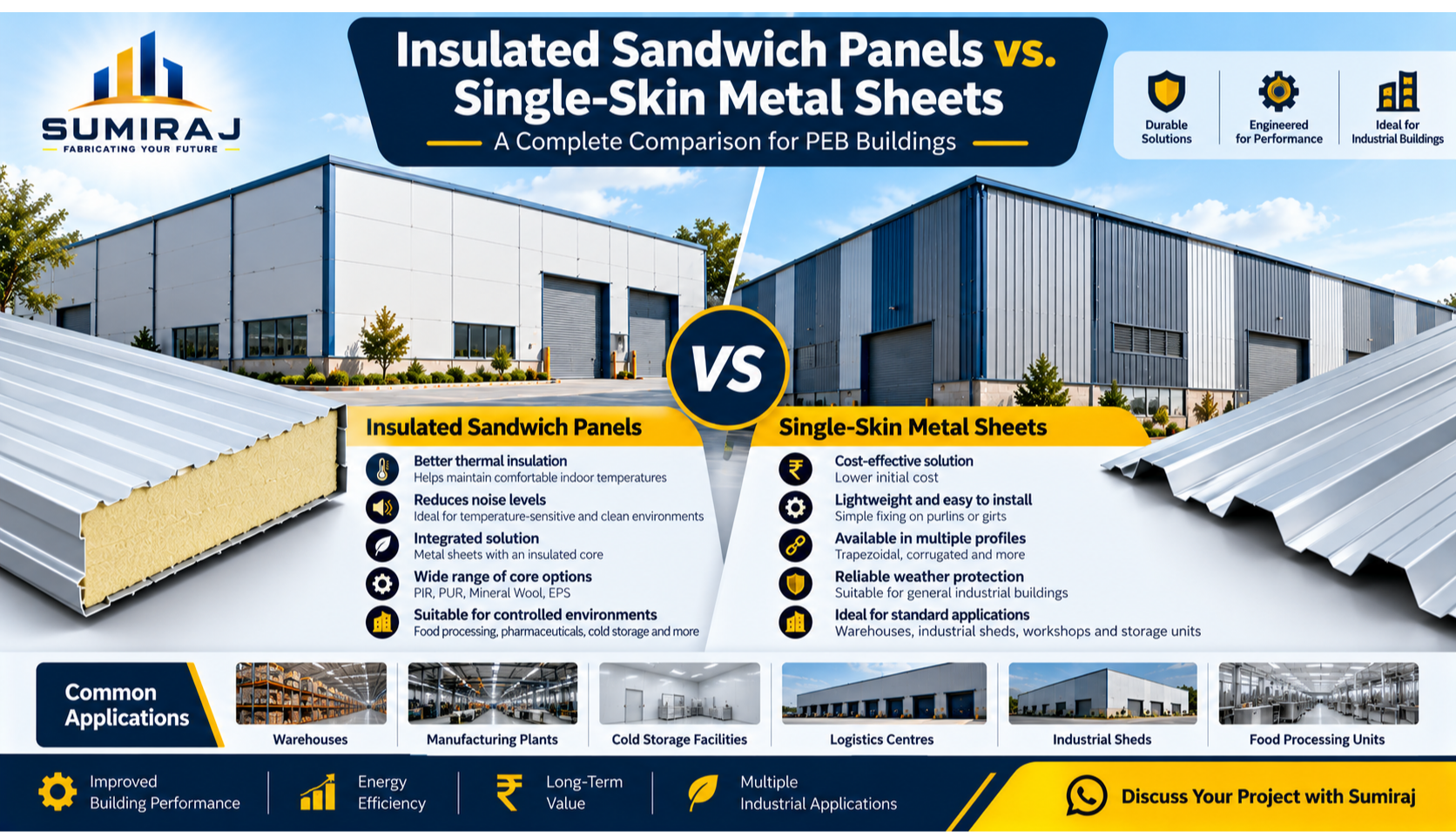
Insulated sandwich panels are factory-manufactured building panels consisting of two metal facings with an insulating core between them. The core is commonly made from materials such as PIR, PUR, mineral wool, or EPS.
The metal facings provide the external and internal surfaces, while the core reduces heat transfer through the panel. Panel thickness, core material, joint design, and facing specifications determine the overall performance.
Key Characteristics
Integrated metal facings and insulation.
Better thermal performance than a single metal sheet alone.
Available in different thicknesses and core materials.
Designed with panel joints and fixing systems.
Can reduce the need for separately installed insulation layers.
The performance of a sandwich panel depends on its complete construction. Fire performance, moisture resistance, thermal conductivity, and structural capacity vary by core material and product specification. These details should be verified through manufacturer documentation.
1. Thermal Insulation and Indoor Temperature
Thermal performance is one of the most important differences between the two systems.
Insulated Sandwich Panels
The insulating core reduces heat transfer through the building envelope. This can help maintain more stable indoor temperatures and reduce the heating or cooling demand where mechanical temperature control is used.
For example, a food-processing facility or temperature-sensitive storage area may benefit from insulated panels because internal conditions can be important to product quality and operations.
However, insulation performance depends on panel thickness, core material, joints, openings, and the overall building design.
Single-Skin Metal Sheets
Single-skin sheets do not provide significant thermal insulation by themselves. They protect against external weather, but heat can transfer through the metal relatively easily.
Where improved thermal performance is required, separate insulation can be installed beneath the sheet using a suitable system. The complete assembly must account for vapour control, condensation risk, support arrangements, and internal finishes.
2. Cost Comparison
Initial project cost is often a major consideration for industrial construction.
Single-skin metal sheets generally have a lower initial material cost because they consist of one profiled sheet and a conventional fixing arrangement.
Insulated sandwich panels usually require a higher initial investment because they include two metal facings and an insulating core. Their installation may also involve specialised joints, flashings, and accessories.
However, the decision should not be based only on purchase price. Where a facility requires regular cooling or heating, the improved thermal performance of insulated panels may help reduce energy consumption. Actual savings depend on operating hours, insulation specification, climate, equipment efficiency, and building design.
A lifecycle cost comparison provides a more useful basis for selecting the system.
3. Condensation and Moisture Management
Condensation occurs when a surface temperature falls below the dew point of the surrounding air. It can cause moisture accumulation on the inner surface of roofing and wall systems.
With single-skin metal sheets, the internal metal surface can become cold under certain conditions. In buildings with high internal humidity, this may lead to condensation unless suitable insulation and vapour-control measures are provided.
Insulated sandwich panels generally maintain a warmer internal surface under comparable conditions, which can reduce condensation risk. However, poorly sealed joints, thermal bridges, and incorrect installation can still create moisture problems.
Proper ventilation, vapour-control detailing, and moisture management remain important for both systems.
4. Installation and Construction Time
Single-skin sheets are generally easier to handle and install because they use conventional fixing arrangements. They can be practical for large industrial buildings where basic weather protection is the main requirement.
Sandwich panels are often supplied as larger integrated units. Their installation can be efficient, but panel handling, alignment, joint sealing, and lifting arrangements require careful planning.
For both systems, installation quality is critical. Incorrect fastener placement, damaged coatings, poorly sealed joints, or inadequate flashing details can lead to water ingress and maintenance problems.
5. Durability and Maintenance
Both options can provide long service when manufactured to suitable specifications and installed correctly.
Single-skin metal sheets require inspection of fasteners, sealing washers, overlaps, protective coatings, and cut edges.
Insulated sandwich panels require inspection of the metal facings, panel joints, fixing points, sealants, and areas exposed to mechanical damage. Water entering damaged joints can affect the panel assembly and its insulation core.
Material grade, coating specification, environmental exposure, and maintenance practices influence the service life of both systems.
Benefits of Choosing the Right Cladding System
Selecting the appropriate system offers several advantages:
Better building performance: The selected system can match the thermal and weather-protection requirements of the facility.
Cost control: Evaluating initial and operating costs helps improve long-term project value.
Improved internal conditions: Insulated panels can support temperature management where required.
Efficient construction: Correctly specified components and installation details help reduce avoidable site adjustments.
Maintenance planning: Suitable materials and proper detailing make inspection and repair more manageable.
Operational suitability: The building envelope can be designed around manufacturing, storage, and logistics requirements.
Applications: Where Should Each System Be Used?
Insulated Sandwich Panels
These may be suitable for:
Food-processing and packaging facilities.
Pharmaceutical and healthcare-related manufacturing areas.
Temperature-sensitive warehouses.
Industrial buildings requiring improved thermal performance.
Facilities with controlled internal environments.
Cold-storage facilities need additional attention to vapour barriers, airtight joints, thermal bridges, refrigeration requirements, and floor insulation. Sandwich panels alone do not create a complete cold-storage system.
Single-Skin Metal Sheets
These may be suitable for:
General-purpose industrial sheds.
Conventional warehouses.
Fabrication workshops.
Equipment storage buildings.
Factories where strict temperature control is not required.
A separate insulation system can also be considered where the building needs better thermal performance without using integrated sandwich panels.
Choosing the Right System for Projects in Noida
Industrial buildings in Noida may face seasonal temperature changes, rainfall, dust, and different operational demands. These conditions should be considered before selecting the roofing or wall cladding system.
Project owners should evaluate the following:
Whether the facility needs temperature control.
The type of products or materials stored.
The building's operating hours and internal heat generation.
Required fire and safety performance.
Roof and wall dimensions, support spacing, and structural loads.
Initial investment and expected operating costs.
Maintenance access and future repair requirements.
The selected system should be coordinated with the PEB frame, purlins, girts, fasteners, flashings, drainage, and ventilation arrangements. Applicable Indian standards and product-specific technical specifications should guide the final decision.
Why Choose Sumiraj for PEB Solutions?
Sumiraj understands that roofing and wall cladding must work as part of the complete industrial building system.
Key considerations include:
Engineering expertise: Coordinating cladding selection with the structural frame and secondary members.
Quality steel: Considering suitable material grades, thicknesses, and protective coatings.
Customized designs: Matching the building envelope to the intended industrial application.
Cost efficiency: Evaluating initial investment alongside installation and operating requirements.
Timely delivery: Coordinating specifications and project requirements with construction schedules.
Indian standards: Considering applicable Indian standards and project-specific requirements.
Technical support: Helping clients understand available cladding options and their suitability.
A project-specific approach helps factory owners and warehouse developers select a building envelope that meets their actual operational needs.
Frequently Asked Questions
1. Which is better: insulated sandwich panels or single-skin metal sheets?
Insulated sandwich panels are generally better where thermal performance is important. Single-skin sheets are suitable for many general-purpose industrial buildings where basic weather protection is sufficient.
2. Are insulated sandwich panels more expensive?
Generally, yes. They include two metal facings and an insulating core, so their initial cost is usually higher than that of single-skin sheets.
3. Can single-skin metal sheets be insulated?
Yes. Separate insulation can be installed beneath single-skin sheets using a suitable system. Vapour control, condensation management, and internal lining details must be considered.
4. Which system is suitable for a general warehouse?
Single-skin sheets may be suitable for ordinary storage warehouses. Insulated panels may be preferable where stored goods require more stable internal temperatures.
5. Are sandwich panels suitable for cold-storage buildings?
They can form an important part of cold-storage wall and roof systems. The design must also address panel core selection, airtight joints, vapour barriers, thermal bridges, floors, and refrigeration requirements.
6. Do insulated panels require maintenance?
Yes. Panel joints, sealants, fasteners, facings, and damaged areas should be inspected periodically to maintain weather protection and performance.
7. Can both systems be used in the same PEB building?
Yes. A project may use insulated panels in selected areas and single-skin sheets in other locations, provided the interfaces, structural support, weatherproofing, and performance requirements are properly coordinated.
Conclusion
Insulated sandwich panels vs single-skin metal sheets is an important decision when planning the roofing and wall cladding of a PEB. Sandwich panels offer integrated insulation and are suitable for applications requiring improved thermal performance. Single-skin metal sheets provide a simpler and generally more economical external covering for many conventional industrial buildings.
For factories, warehouses, and manufacturing facilities in Noida, the right choice depends on operating conditions, temperature requirements, fire performance, structural compatibility, installation, and lifecycle cost.
Sumiraj can help industrial buyers evaluate their project requirements and coordinate a suitable roofing and wall cladding solution as part of the complete PEB system.
Discuss Your Project With Sumiraj
Planning a factory, warehouse, or industrial shed? Contact Sumiraj through WhatsApp or phone to discuss your building requirements, insulation needs, and suitable roofing and wall cladding options.
Subscribe to our updates and stay informed about the latest trends, innovations, and cost-saving solutions in PEB construction, industrial buildings, and warehouse development.