
Introduction
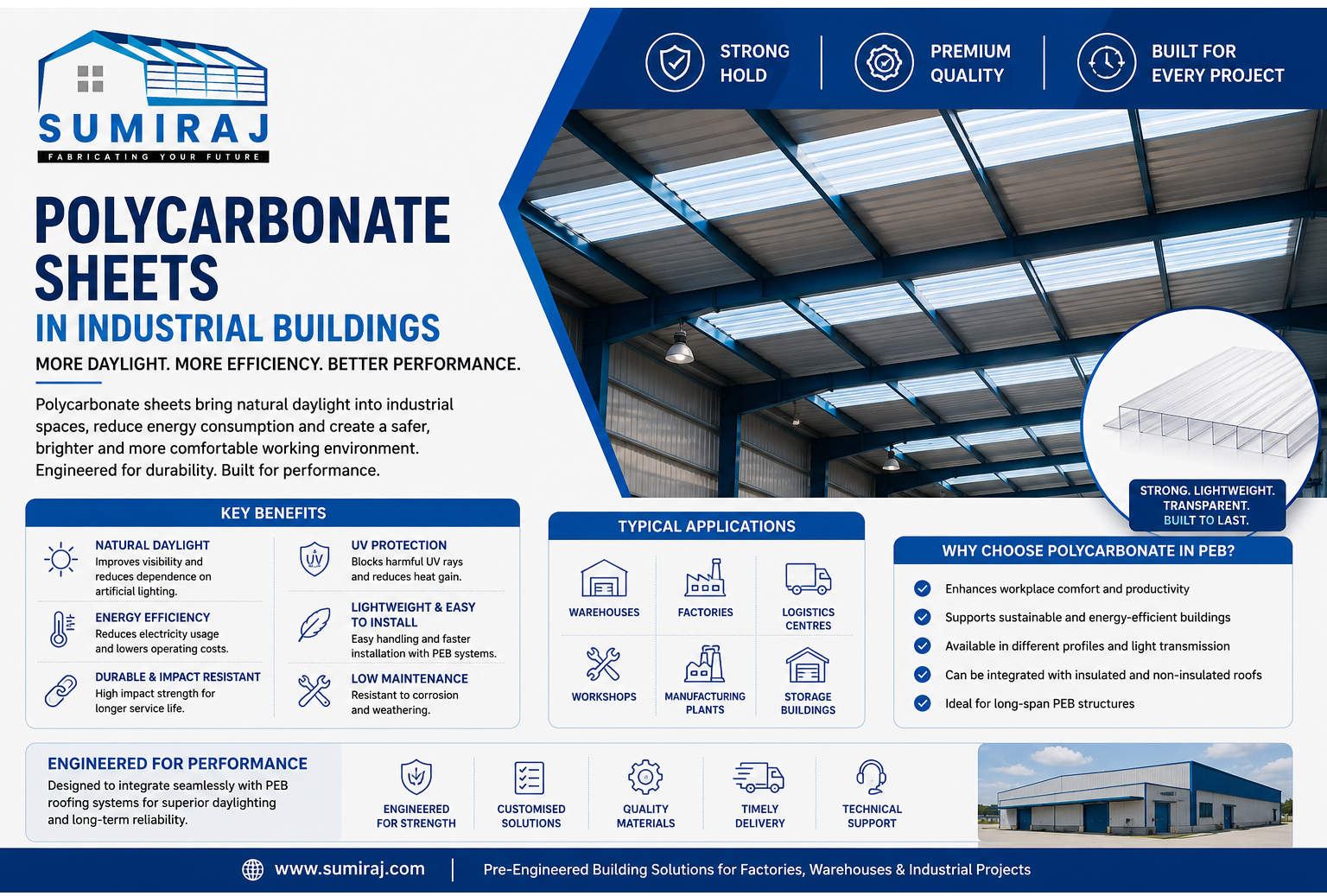
Natural daylight can make a major difference in an industrial building. It can reduce dependence on artificial lighting, improve visibility for workers, and create a more comfortable working environment. This is where polycarbonate sheets in industrial buildings offer a practical solution.
Polycarbonate sheets are lightweight, durable roofing and wall-lighting materials that can be integrated with PEB systems to introduce controlled natural light into factories, warehouses, workshops, and logistics facilities. For businesses planning industrial buildings in Noida, the right combination of structural design, roofing, insulation, and daylighting can improve both building performance and operating efficiency. Sumiraj integrates practical PEB engineering considerations with project-specific requirements to help businesses achieve functional and efficient industrial spaces.
What Are Polycarbonate Sheets?
Polycarbonate is a thermoplastic material known for its high impact resistance, relatively low weight, and ability to transmit natural light. In industrial construction, sheets are commonly available in profiles designed to match or work alongside metal roofing systems.
Depending on the project, polycarbonate sheets may be transparent, translucent, or available in different light-transmitting finishes. They can be installed as selected roof panels, skylight strips, wall panels, or daylighting sections.
The objective is not necessarily to replace the complete metal roof. Instead, polycarbonate is often used strategically to introduce daylight while retaining the strength and weather protection of the primary roofing system.
How Polycarbonate Works with a PEB Roof
A typical PEB roof consists of primary steel frames, secondary members such as purlins, and roof cladding. Polycarbonate daylighting panels can be incorporated into the roof layout at selected locations.
The supporting structure and sheet profile must be properly coordinated. Panel dimensions, fixing arrangements, thermal movement, weather sealing, drainage, and compatibility with adjacent roofing materials should all be considered during detailing.
Why Polycarbonate Sheets Are Used in Industrial Buildings
Natural Daylight
One of the main reasons for using translucent polycarbonate panels is to bring daylight into large enclosed spaces.
Factories and warehouses often have substantial floor areas with limited side openings. Strategically positioned roof daylighting can distribute natural light across working zones during daylight hours.
Reduced Dependence on Artificial Lighting
Better daylight availability can reduce the need for electrical lighting during suitable daytime conditions. The actual saving depends on building orientation, panel arrangement, operating hours, geographical conditions, and lighting controls.
For a large warehouse operating throughout the day, even a partial reduction in artificial lighting demand can contribute to lower operating costs.
Lightweight Construction
Polycarbonate sheets are relatively lightweight compared with many conventional building materials. This characteristic can be advantageous in PEB applications because the roofing system can be designed with appropriate consideration of the additional dead load.
However, lightweight does not mean that structural design can be overlooked. Wind loads, fixing forces, panel configuration, and support spacing still need to be evaluated.
Key Benefits of Polycarbonate Sheets in Industrial Buildings
1. Improved Workplace Visibility
Natural daylight can improve visibility in production areas, storage zones, loading areas, and workshops. A well-planned daylighting system can reduce dark spots and support safer movement within the facility.
2. Better Energy Efficiency
By making better use of available daylight, polycarbonate roof panels can reduce artificial lighting requirements during daytime operation.
This is particularly relevant for warehouses and manufacturing facilities with long operating hours.
3. High Impact Resistance
Polycarbonate is valued for its impact resistance compared with many conventional transparent materials. This makes it suitable for demanding industrial environments where durability is important.
The actual performance depends on the product specification, thickness, profile, installation quality, and environmental exposure.
4. Efficient Installation
Profiled sheets can be designed to integrate with industrial roofing systems, allowing installation alongside compatible metal panels.
Proper detailing is essential to maintain alignment, weather resistance, and reliable fastening.
5. Better Use of Large Industrial Spaces
A large factory or warehouse can feel visually enclosed when it relies entirely on artificial lighting. Roof daylighting helps create a more open and naturally illuminated environment without requiring extensive glazing.
6. Design Flexibility
Polycarbonate sheets can be incorporated into different industrial building layouts. Their placement can be planned according to production zones, storage requirements, roof geometry, and daylight objectives.
Important Design Considerations
Polycarbonate should not be selected simply because it allows light transmission. Its performance depends heavily on correct engineering and installation.
Sheet Profile and Compatibility
The profile should be compatible with the surrounding roofing system. Poorly matched profiles can create problems at overlaps, fasteners, and interfaces.
Thermal Expansion
Polycarbonate expands and contracts with temperature changes. Industrial buildings experience significant temperature variation, particularly under direct solar exposure.
Fixing systems should therefore accommodate the material's movement while maintaining weather-tightness.
Weather Protection
Joints, overlaps, flashings, and sealants require careful detailing. A daylighting panel is only effective when it remains properly integrated with the roof system.
Solar Heat Gain
More daylight is not automatically better. Excessive solar radiation can increase heat gain inside the building.
The selection of sheet type, light transmission, coating, location, and quantity should therefore consider the building's thermal requirements.
Fire Performance
Industrial projects may have specific fire-performance requirements based on the building's use, occupancy, materials stored, and applicable regulations.
Polycarbonate products should be selected according to the project's technical and fire-safety requirements rather than treated as a one-size-fits-all material.
Applications of Polycarbonate Sheets
Polycarbonate daylighting solutions are commonly considered for:
Manufacturing plants
Warehouses
Industrial sheds
Logistics and distribution centres
Workshops
Storage facilities
Assembly units
Agricultural and industrial buildings
Loading and service areas
Commercial-industrial facilities
For example, a warehouse can use strategically placed rooflight strips above aisles or general storage areas to introduce daylight without installing extensive glazed openings in the external walls.
In a manufacturing plant, daylighting can be positioned over production zones where consistent visibility is important.
Polycarbonate Sheets for PEB Projects in Noida
Industrial development in Noida can involve a wide range of building sizes, operating conditions, and architectural requirements. A warehouse used for general storage may have different daylighting needs from a production facility running multiple shifts.
The local climate and site conditions should also be considered during design. Solar exposure, rainfall, wind conditions, temperature variation, roof orientation, and ventilation strategy can all influence material selection and detailing.
For warehouse developers and factory owners, it is therefore better to evaluate polycarbonate roofing as part of the complete PEB system rather than as an isolated roofing component.
A coordinated approach allows the structural frame, purlins, roof cladding, insulation, daylighting panels, drainage, and ventilation requirements to work together.
Why Choose Sumiraj?
Sumiraj provides PEB solutions focused on the practical requirements of industrial businesses, from structural engineering to fabrication and project support.
Engineering expertise: Our approach considers the interaction between the steel frame, secondary members, roofing, cladding, daylighting, and project-specific loads.
Quality steel: Appropriate steel materials and controlled fabrication contribute to structural reliability and consistent construction quality.
Customized designs: Every industrial facility has different dimensions, operational requirements, equipment, ventilation needs, and daylighting objectives. Designs can be developed around those project conditions.
Cost efficiency: The objective is to balance structural performance, material selection, daylighting requirements, and overall project cost rather than adding unnecessary components.
Timely delivery: Proper coordination between engineering, fabrication, and erection activities helps maintain an organized project schedule.
Indian standards: Applicable Indian Standards, project specifications, and relevant technical requirements are considered during the design and detailing process.
Technical support: Sumiraj can support clients and project teams with practical guidance on PEB components, roofing systems, structural coordination, and installation requirements.
Frequently Asked Questions
1. What are polycarbonate sheets used for in industrial buildings?
They are primarily used to introduce natural daylight through roofs or walls while maintaining an enclosed industrial environment. They are commonly integrated with metal roofing systems in factories and warehouses.
2. Are polycarbonate sheets suitable for PEB roofs?
Yes. Suitable profiled polycarbonate sheets can be incorporated into PEB roofing systems when the sheet profile, support spacing, fixing arrangement, thermal movement, weather sealing, and structural requirements are properly coordinated.
3. Do polycarbonate sheets reduce electricity consumption?
They can reduce the need for artificial lighting during daylight hours by bringing natural light into the building. The actual energy savings depend on the building design, operating schedule, daylight availability, and lighting controls.
4. Are polycarbonate sheets stronger than glass?
Polycarbonate is generally known for high impact resistance and lower weight compared with conventional glass. However, product performance varies, so selection should be based on the required thickness, profile, environmental exposure, and project specifications.
5. Can polycarbonate sheets make an industrial building hotter?
They can contribute to solar heat gain depending on their light transmission and solar characteristics. The quantity, type, location, and specification of daylighting panels should therefore be selected along with the building's overall thermal strategy.
6. How much polycarbonate roofing should a warehouse have?
There is no universal percentage suitable for every warehouse. The appropriate quantity depends on the desired daylight level, roof configuration, orientation, climate, internal activities, and energy objectives. A project-specific assessment is recommended.
Conclusion
Polycarbonate sheets in industrial buildings can be a valuable component of a well-designed PEB when natural daylight, energy efficiency, and workplace visibility are important project objectives. Their success depends not only on the sheet itself but also on correct structural coordination, thermal considerations, weatherproofing, fixing details, and material selection.
For factories, warehouses, logistics facilities, and manufacturing units in Noida, integrating daylighting into the PEB design from the beginning can deliver a more practical and efficient building. With engineering expertise, quality steel, customized designs, and technical support, Sumiraj helps industrial businesses develop PEB solutions suited to their functional requirements.
Discuss Your Project
Planning a factory, warehouse, industrial shed, or logistics facility? Contact Sumiraj via WhatsApp or phone to discuss your project and explore a PEB solution with the right roofing and daylighting approach.
Subscribe to our updates and stay informed about the latest trends, innovations, and cost-saving solutions in PEB construction, industrial buildings, and warehouse development.