

PEB Building Insulation: PUF vs PIR vs Rockwool – Which Is Best for Industrial Buildings?
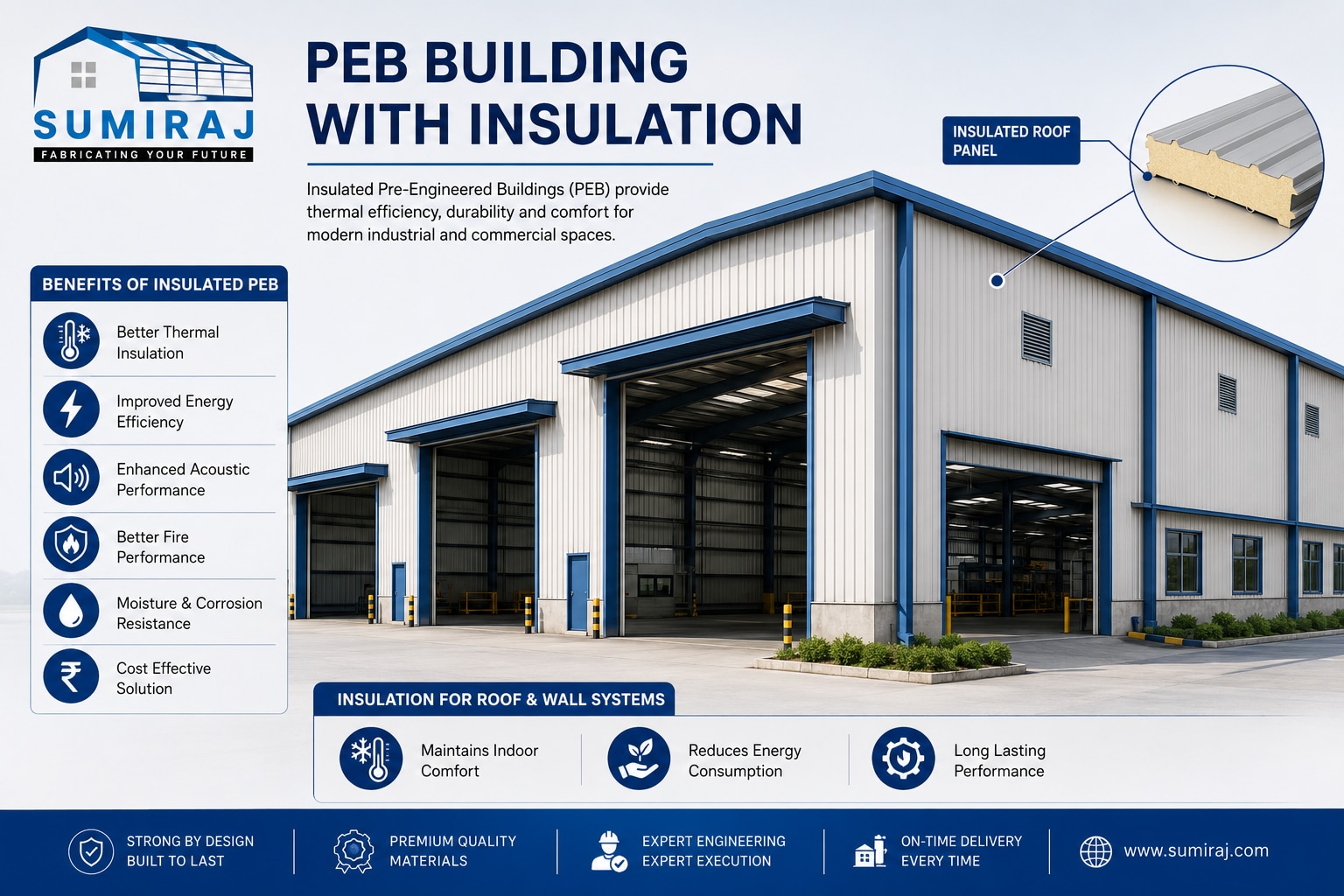
Insulation plays an important role in the performance of a Pre-Engineered Building (PEB). The right insulation system can help control indoor temperature, improve energy efficiency, reduce heat transfer and provide better working conditions inside industrial buildings.
For factories, warehouses, workshops, logistics centres and commercial buildings, three commonly considered insulation options are PUF, PIR and Rockwool.
But which one is suitable for your PEB project?
This guide explains the key differences between PUF, PIR and Rockwool insulation and the factors you should consider before making a choice.
What Is Insulation in a PEB Building?
PEB insulation is installed within the roof and/or wall system to reduce heat transfer between the interior and exterior of the building.
A properly designed insulation system can help:
Reduce heat entering the building through the roof and walls
Maintain a more comfortable indoor environment
Reduce the load on cooling systems
Control condensation when properly designed
Improve energy efficiency
Provide better acoustic performance, depending on the insulation material
The right insulation depends on the building's location, application, temperature requirements, fire-safety requirements and budget.
PUF Insulation for PEB Buildings
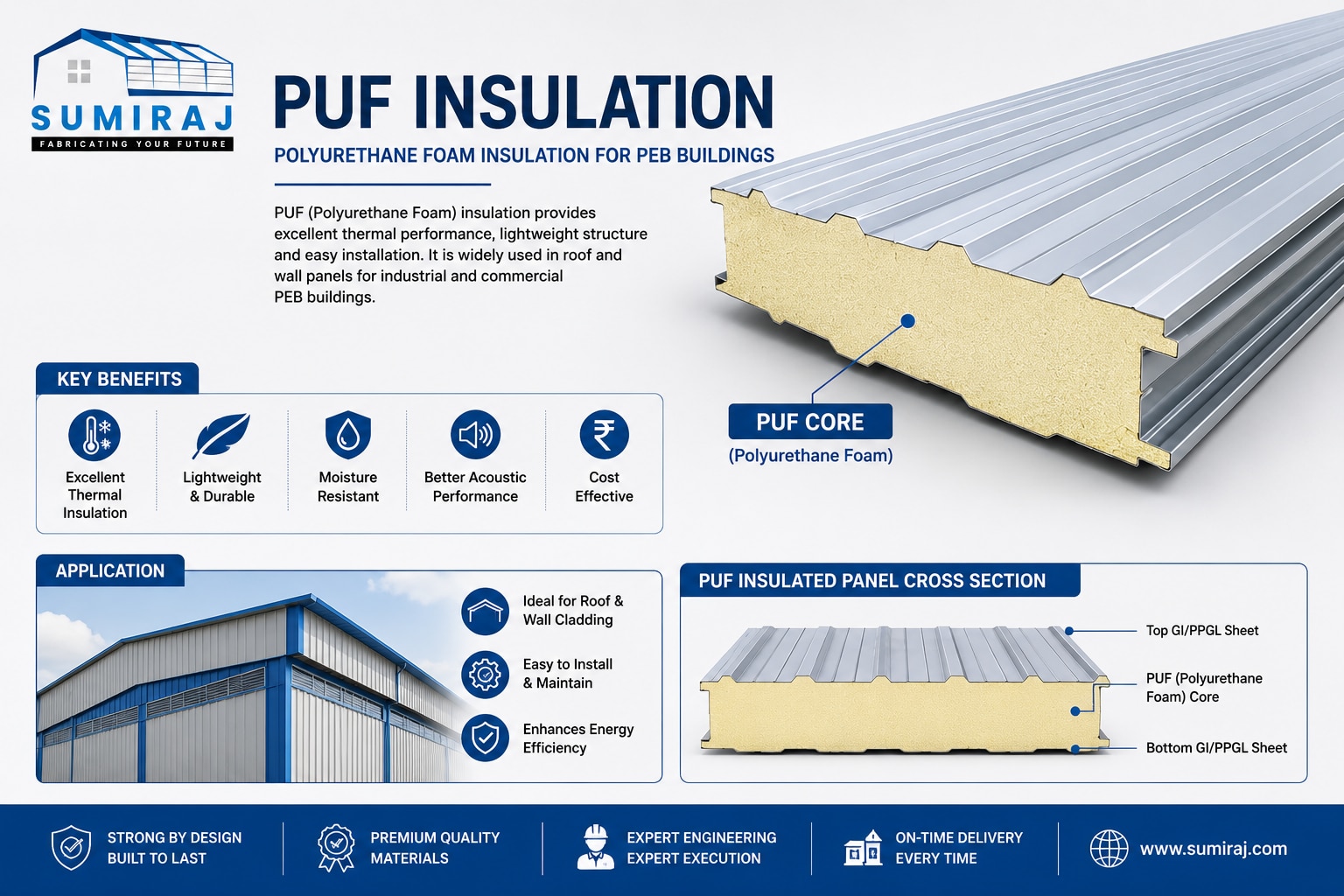
PUF stands for Polyurethane Foam. It is a lightweight insulation material commonly used in insulated roofing and wall panels.
Advantages of PUF
Good thermal insulation
Lightweight construction
Suitable for roof and wall applications
Easy integration with sandwich panels
Good moisture resistance when properly installed
Suitable for many factories and warehouses
Cost-effective for projects where standard thermal insulation is required
PUF can be a practical option for industrial buildings where thermal insulation, lightweight construction and cost efficiency are important.
PIR Insulation for PEB Buildings
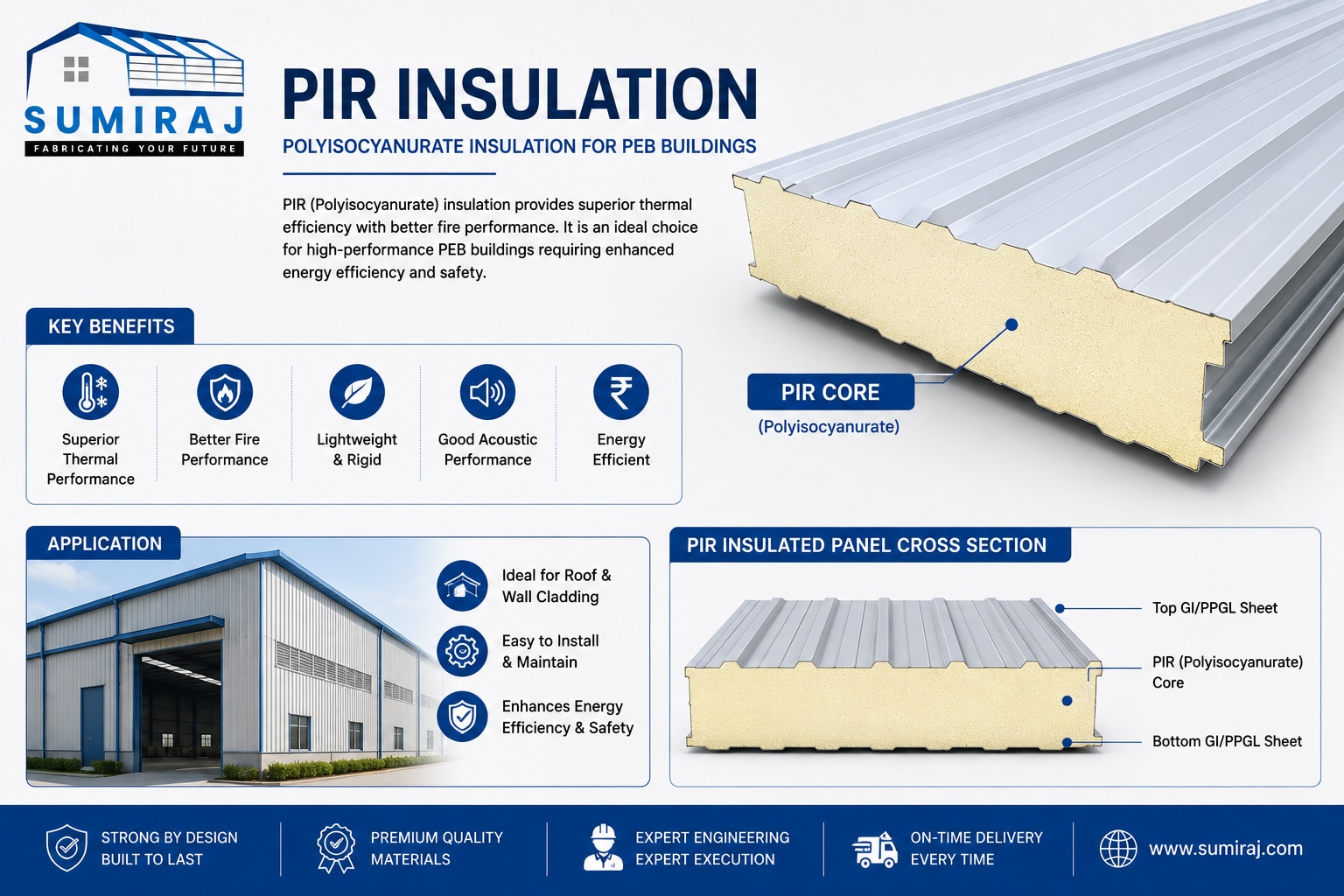
PIR stands for Polyisocyanurate. It is a rigid foam insulation material that is closely related to polyurethane but is formulated for higher thermal performance and improved fire behaviour.
Advantages of PIR
High thermal insulation performance
Good insulation with relatively low thickness
Lightweight
Suitable for insulated roof and wall panels
Improved fire performance compared with conventional PUF systems, depending on the specific product
Useful where higher insulation performance is required
PIR can be considered for PEB projects where thermal efficiency and fire-performance requirements are higher priorities.
Rockwool Insulation for PEB Buildings
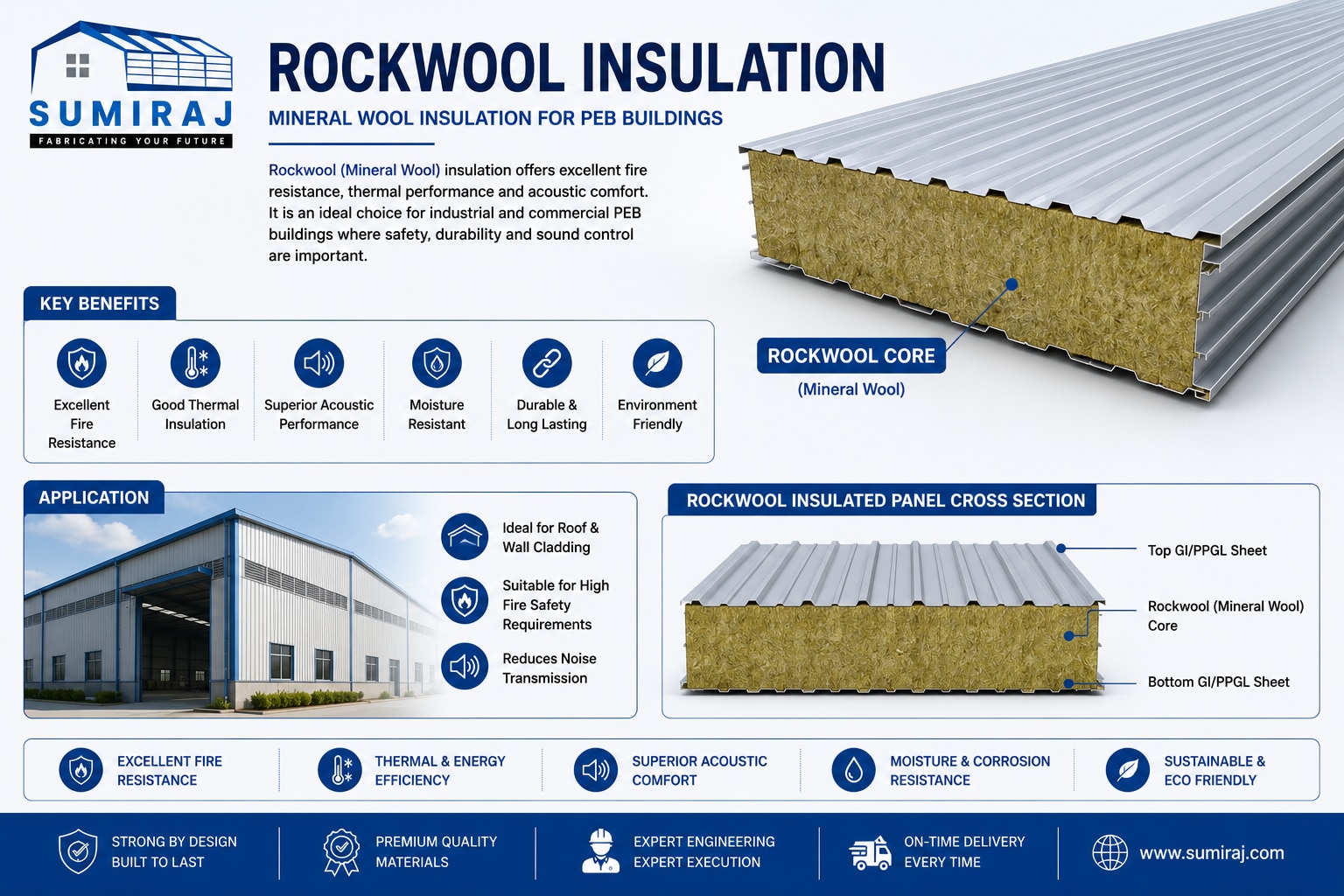
Rockwool, or mineral wool, is a fiber-based insulation material manufactured from mineral or rock materials.
Unlike foam-based insulation, Rockwool is particularly valued for its fire resistance and acoustic properties.
Advantages of Rockwool
Excellent fire resistance
Good thermal insulation
Strong acoustic performance
Suitable for industrial and commercial buildings
Useful where fire-safety requirements are particularly important
Can help reduce transmission of external and internal noise
Rockwool is often considered where the project requires a combination of thermal insulation, fire protection and sound control.
PUF vs PIR vs Rockwool: Which Is Better?
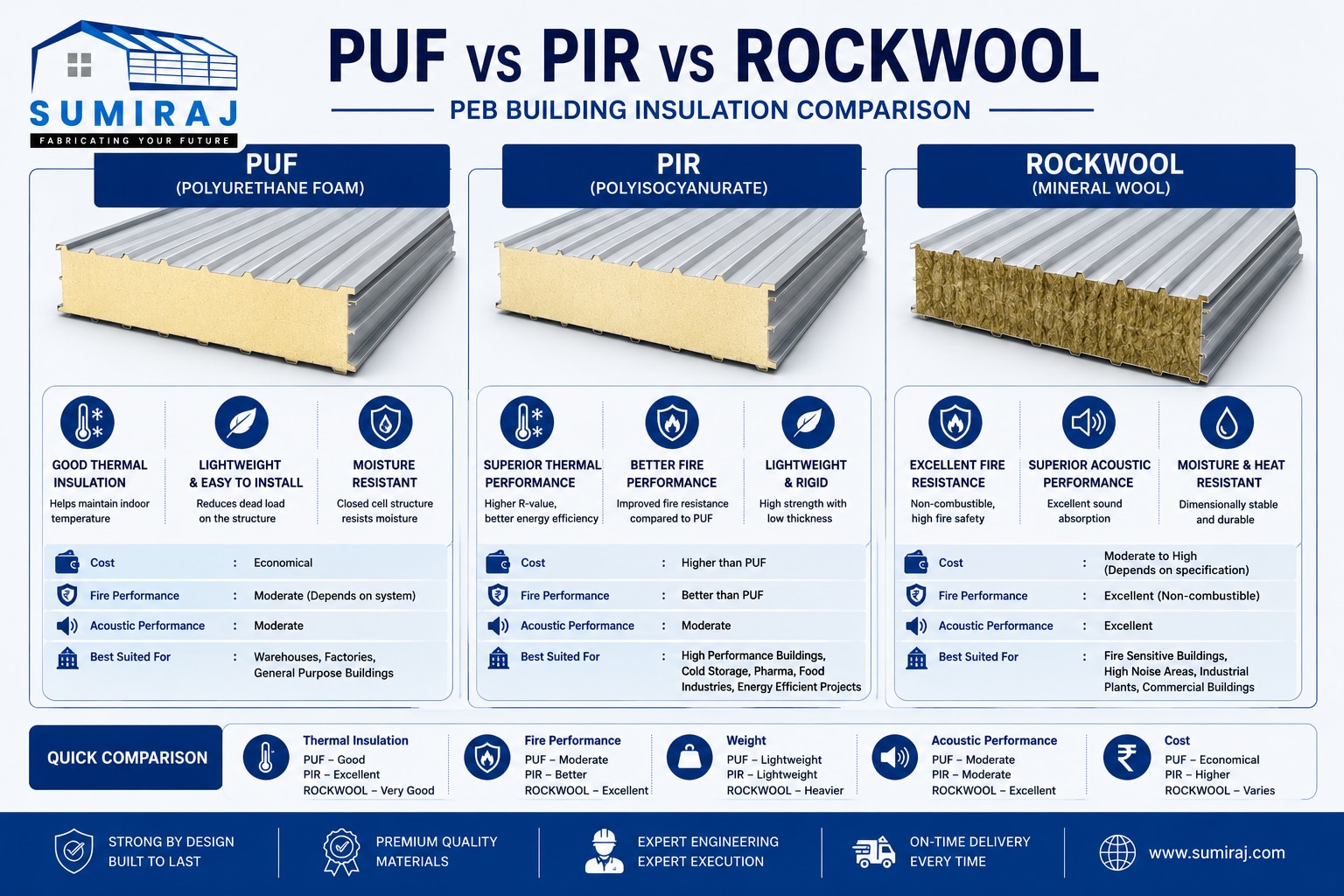
The three materials have different strengths.
| Feature | PUF | PIR | Rockwool |
|---|---|---|---|
| Thermal insulation | Very Good | Excellent | Very Good |
| Fire performance | Depends on product/system | Generally better than conventional PUF | Excellent |
| Weight | Lightweight | Lightweight | Heavier |
| Acoustic performance | Moderate | Moderate | Excellent |
| Typical use | Factories & warehouses | High-performance PEBs | Fire & acoustic applications |
| Cost | Generally economical | Generally higher | Depends on specification |
The comparison should not be based on price alone. The insulation material should be selected according to the actual requirements of the building.
Which PEB Insulation Should You Choose?
Choose PUF When:
PUF can be considered when the project requires good thermal insulation while maintaining a lightweight and economical construction system.
It is suitable for many standard factories, warehouses and industrial buildings.
Choose PIR When:
PIR may be preferred when the project requires higher thermal performance and enhanced fire-performance characteristics from the insulation system.
It can be useful for buildings where insulation thickness and energy efficiency are important considerations.
Choose Rockwool When:
Rockwool is a strong option when fire resistance and acoustic performance are major priorities.
It can be particularly suitable for industrial facilities where fire-safety specifications or noise control requirements are important.
Factors to Consider Before Selecting PEB Insulation
Choosing insulation should be part of the overall PEB design process.
Consider:
1. Building Location
The local climate has a direct impact on insulation requirements. Buildings in hot regions may require greater attention to heat gain through the roof and walls.
2. Building Usage
A warehouse storing general goods may have different requirements from a manufacturing facility, pharmaceutical facility or temperature-sensitive storage building.
3. Fire-Safety Requirements
The required fire performance should be established before selecting an insulation system. Project specifications and applicable building regulations should always be considered.
4. Roof and Wall Design
The insulation should be compatible with the selected roofing and wall-cladding system.
5. Energy Efficiency
If the building will use air conditioning or other mechanical cooling systems, better insulation can help reduce heat transfer and potentially lower cooling requirements.
6. Acoustic Requirements
Factories with heavy machinery may require better acoustic insulation. In such cases, Rockwool may provide advantages because of its sound-absorption characteristics.
7. Installation Quality
Even a high-performance insulation material can underperform if joints, fasteners, overlaps and panel connections are poorly installed.
Frequently Asked Questions (FAQs)
1. What is the best insulation for a PEB building?
There is no single insulation material that is best for every PEB building. PUF is a practical and economical option for general thermal insulation, PIR offers high thermal performance with improved fire characteristics, while Rockwool is preferred where fire resistance and acoustic performance are important. The right choice depends on the building's application, climate, fire-safety requirements and budget.
2. What is the difference between PUF, PIR and Rockwool insulation?
PUF and PIR are rigid foam insulation materials, while Rockwool is a mineral-wool insulation. PUF provides good thermal insulation at an economical cost, PIR offers higher thermal performance and improved fire behaviour, and Rockwool provides excellent fire resistance along with strong acoustic performance.
3. Is PUF insulation suitable for PEB warehouses?
Yes. PUF insulation can be suitable for many PEB warehouses, factories and industrial buildings where good thermal insulation, lightweight construction and cost efficiency are required. The appropriate thickness and panel specification should be selected according to the building's location and usage.
4. Why choose PIR insulation for a PEB building?
PIR insulation can be considered when a project requires high thermal insulation performance and improved fire characteristics. It can provide strong insulation performance without requiring excessive thickness, making it suitable for high-performance industrial and commercial PEB applications.
5. Is Rockwool better than PUF and PIR for fire safety?
Rockwool generally has an advantage when fire resistance is a primary requirement, because mineral wool is non-combustible. However, the actual fire performance of a complete PEB wall or roof system depends on the specific products, thicknesses, assemblies and applicable fire-safety standards.
6. How does Sumiraj help with PEB insulation selection?
Sumiraj can help customers evaluate insulation requirements as part of the overall PEB roofing and wall-cladding system. Factors such as building usage, local climate, thermal requirements, fire safety, acoustic requirements and project specifications should be considered before selecting PUF, PIR or Rockwool insulation.
Conclusion
Selecting the right insulation is an important decision when planning a Pre-Engineered Building. PUF, PIR and Rockwool each offer different benefits, and the best option depends on the specific requirements of the project.
For a standard industrial warehouse or factory, PUF may provide an effective balance of thermal performance and cost. PIR can be considered for projects requiring higher insulation performance, while Rockwool is particularly valuable where fire resistance and acoustic performance are priorities.
At Sumiraj Industries, the insulation system should be selected as part of the complete PEB roofing and wall-cladding design to ensure that the building delivers the required performance, durability and efficiency.
Get in touch
Planning a new PEB factory or warehouse? Contact Sumiraj Industries to discuss the right roofing, cladding and insulation solution for your project.
