
Introduction
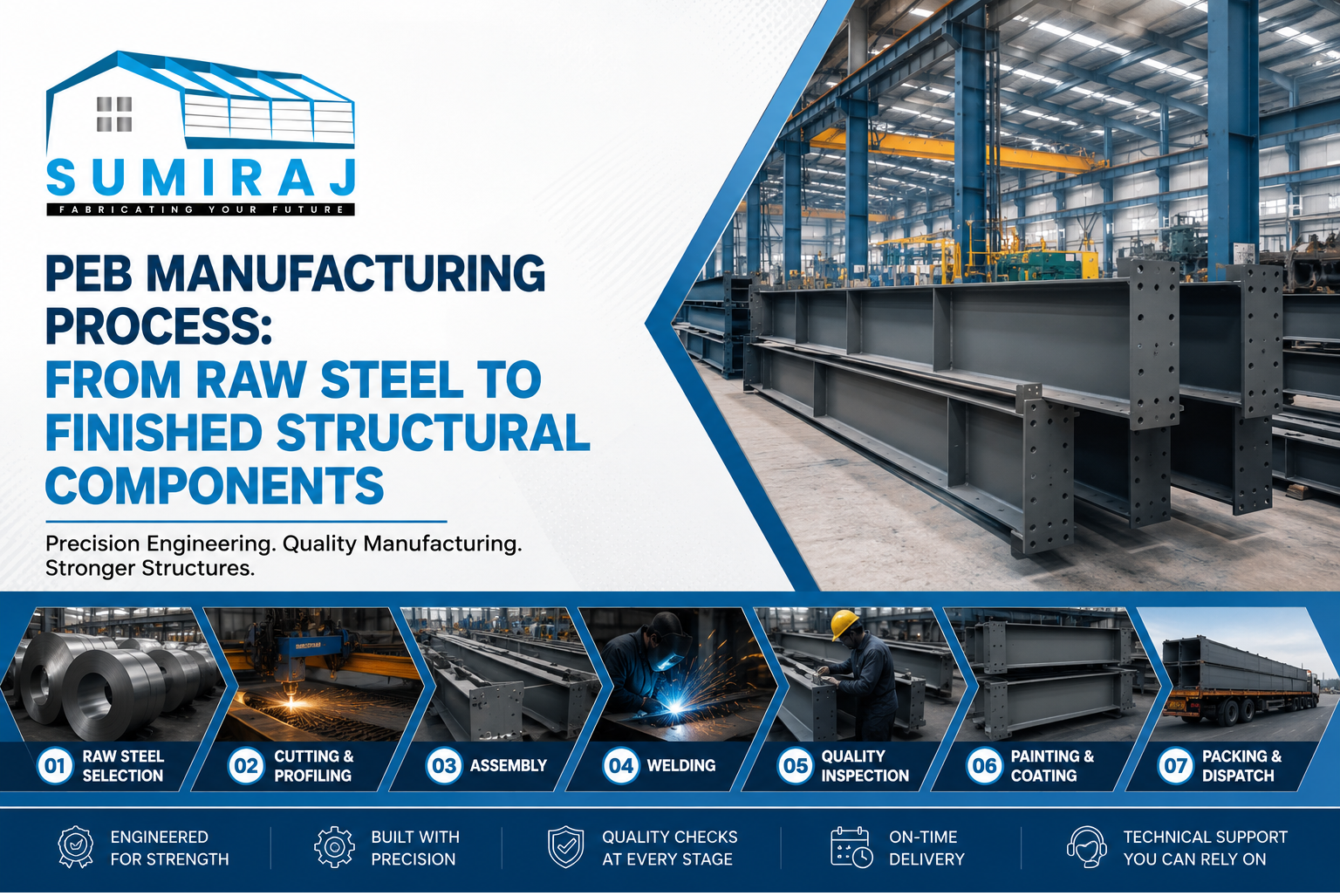
A reliable pre-engineered building starts long before the steel structure reaches the construction site. The PEB manufacturing process determines how accurately structural members are fabricated, how efficiently the building is assembled, and ultimately how well the completed structure performs.
For factory owners, warehouse developers, logistics companies, and industrial investors, understanding this process helps in evaluating a PEB supplier beyond just the quoted price. From engineering and raw material selection to automated cutting, welding, quality inspection, and dispatch, every stage affects the final building.
Industrial businesses in Noida increasingly need structures that can be manufactured efficiently and erected with minimal site disruption. Sumiraj approaches PEB manufacturing with a focus on engineering accuracy, material quality, fabrication control, and practical project requirements.
What Is the PEB Manufacturing Process?
PEB manufacturing is a controlled industrial process in which structural steel members are engineered, fabricated, finished, inspected, and prepared for site erection according to the approved building design.
Unlike conventional construction, much of the structural work is completed in a manufacturing facility before the components reach the project site. This allows fabrication to take place under controlled conditions while reducing the amount of structural work required during erection.
The typical process includes:
Structural design and detailing
Procurement and inspection of steel
Cutting and profiling
Plate assembly
Welding
Straightening and dimensional inspection
Surface preparation and painting
Quality control
Packing and dispatch
1. Structural Design and Detailing
The process begins with engineering.
Based on the building dimensions, span, height, loading conditions, location, usage, and architectural requirements, structural engineers develop the PEB design. The design considers dead loads, live loads, wind loads, seismic conditions, service requirements, and applicable Indian standards.
Once the structural design is approved, detailed fabrication drawings are prepared. These drawings specify member dimensions, connection details, plate thicknesses, bolt locations, weld requirements, and component identification.
Accurate detailing is critical because even a small dimensional error can create difficulties during erection.
2. Raw Steel Procurement and Inspection
The next stage involves sourcing structural steel and other required materials.
Depending on the design, the project may require steel plates, coils, sections, angles, rods, bolts, and other connection components. Material specifications are checked against the approved engineering requirements.
Quality documentation, dimensions, thickness, and visual condition are verified before production. Using appropriate grades and properly inspected material establishes the foundation for structural reliability.
3. Cutting and Profiling
Steel plates are cut into the required dimensions using suitable cutting equipment.
Computer-controlled cutting can provide consistent dimensions and repeatability, particularly for components such as web plates, flange plates, stiffeners, and connection plates.
The accuracy achieved at this stage directly affects subsequent assembly and welding operations.
4. Plate Assembly and Built-Up Member Fabrication
Many PEB primary members are fabricated as built-up sections rather than using standard rolled sections.
Flange and web plates are positioned according to the approved fabrication drawings. Automated or controlled assembly equipment helps maintain alignment before welding.
For tapered rafters and columns, the geometry of the member can vary along its length. Precise fabrication is therefore important to achieve the required structural profile.
5. Welding of Structural Components
Welding joins the individual steel plates to form complete structural members.
Depending on the member and production setup, suitable welding processes are selected to achieve the required weld quality and productivity. Weld parameters, joint preparation, alignment, and inspection are controlled throughout fabrication.
Welded connections must meet the requirements specified by the engineering design and applicable standards. Inspection may include visual examination and, where required by the project, appropriate non-destructive testing.
6. Straightening and Dimensional Inspection
After welding, heat input can cause minor distortion in fabricated members. Controlled straightening is therefore carried out where necessary.
The fabricated member is then checked for critical dimensions, alignment, camber, flange position, connection locations, and other specified tolerances.
This stage is particularly important because accurate fabrication makes site erection faster and reduces the possibility of fit-up problems.
Surface Preparation and Painting
Once structural members pass fabrication checks, their surfaces are prepared for the specified protective coating system.
Surface preparation removes contaminants, rust, mill scale, and other unwanted material. The required primer or paint system is then applied according to the project specification.
The coating system depends on the environmental exposure and intended application of the building. Proper surface preparation is essential because coating performance depends heavily on the condition of the steel surface.
Quality Control in PEB Manufacturing
Quality control is not limited to the final inspection. It should operate throughout the manufacturing process.
Typical checks can include:
Incoming material inspection
Plate thickness and dimensional verification
Weld inspection
Member alignment checks
Fabrication tolerance verification
Surface preparation inspection
Coating thickness checks
Final dimensional inspection
Identification and traceability of components
A structured inspection process helps identify deviations before components are dispatched to the project site.
Benefits of a Controlled PEB Manufacturing Process
Better Fabrication Accuracy
Factory-controlled fabrication provides better consistency than performing extensive structural fabrication at the construction site.
Faster Site Erection
When components arrive ready for assembly, the erection team can focus primarily on installation and connections rather than extensive fabrication.
Efficient Material Utilization
Engineering-led fabrication allows steel quantities and member dimensions to be developed according to structural requirements, helping control material consumption.
Improved Quality Control
Manufacturing facilities provide controlled environments for welding, dimensional inspection, surface preparation, and finishing.
Reduced Site Disruption
A significant portion of structural work is completed before delivery, which can reduce site labour requirements and simplify project coordination.
Applications of PEB Structures
PEB systems are widely used for applications where large column-free spaces, quick construction, and adaptable layouts are important.
Common applications include:
Manufacturing plants
Industrial sheds
Warehouses
Logistics and distribution centers
Automobile facilities
Workshops
Cold-storage buildings
Commercial storage facilities
Agricultural and processing facilities
Aircraft and equipment hangars
For warehouse developers and manufacturing businesses, PEBs can also support future expansion through appropriately planned structural layouts.
PEB Manufacturing for Industrial Projects in Noida
Industrial development in Noida requires practical consideration of site conditions, building usage, logistics, wind exposure, seismic requirements, and local project constraints.
A PEB manufacturer must therefore understand more than fabrication. Engineering coordination, documentation, transportation planning, erection requirements, and communication with contractors all influence project execution.
For businesses developing factories or warehouses in Noida, selecting a manufacturer with a structured engineering-to-fabrication workflow can help reduce avoidable coordination issues during construction.
Why Choose Sumiraj for PEB Manufacturing?
Choosing a PEB manufacturer is ultimately a decision about engineering capability, manufacturing control, and project coordination.
Engineering expertise: Sumiraj focuses on structural engineering and detailing aligned with the project's functional and structural requirements.
Quality steel: Appropriate steel grades and material specifications are selected according to approved project requirements, with inspection forming part of the manufacturing workflow.
Customized designs: Industrial buildings differ in span, height, loading, crane requirements, mezzanines, openings, and operational needs. PEB solutions can therefore be developed around individual project conditions.
Cost efficiency: Efficient structural design and controlled fabrication can help manage steel consumption, fabrication effort, transportation, and site erection requirements.
Timely delivery: A coordinated manufacturing process helps organize fabrication and dispatch around the project's erection schedule.
Indian standards: Structural design and fabrication are undertaken with applicable Indian standards and project specifications in consideration.
Technical support: Proper coordination between engineering, fabrication, erection, and the client is important for resolving technical requirements throughout the project lifecycle.
FAQs About the PEB Manufacturing Process
1. How long does PEB manufacturing take?
The duration depends on building size, design complexity, material availability, fabrication capacity, approval cycles, and project specifications. Larger or technically complex structures naturally require more production and coordination time.
2. What steel is used in PEB structures?
PEB projects use structural steel selected according to the engineering design and applicable specifications. The required grade, thickness, and material properties depend on the structural member and project requirements.
3. Is PEB manufacturing done completely in a factory?
Most primary structural fabrication is completed in a controlled manufacturing facility. Certain activities, including final assembly, bolted connections, roofing, cladding, and other installation work, are completed at the project site.
4. How is weld quality checked in PEB manufacturing?
Weld quality can be evaluated through visual inspection and, where specified, appropriate non-destructive testing methods. The inspection requirements depend on the design, project specifications, and applicable standards.
5. Can PEB components be customized?
Yes. PEB systems can be designed and fabricated for specific spans, heights, loading requirements, crane systems, mezzanine floors, openings, insulation requirements, and operational needs.
6. Why is fabrication accuracy important for PEB erection?
PEB components are designed to fit together through predefined connections. Accurate fabrication helps ensure proper alignment and reduces fit-up problems during erection.
7. Is PEB suitable for factories and warehouses in India?
Yes. PEB systems are widely applicable to industrial buildings, warehouses, logistics facilities, workshops, and manufacturing units where efficient structural systems and relatively fast site assembly are required.
Conclusion
The PEB manufacturing process transforms engineered designs and raw steel into accurately fabricated structural components ready for site erection. Every stage—from material inspection and cutting to welding, dimensional checks, surface preparation, and final quality control—contributes to the performance and constructability of the finished building.
For industrial projects in India, the right PEB manufacturer should combine engineering knowledge with disciplined manufacturing and project coordination. Sumiraj provides a structured approach to PEB manufacturing for businesses planning factories, warehouses, industrial sheds, and other steel buildings.
Discuss Your Project
Planning a factory, warehouse, industrial shed, or logistics facility? Discuss your project requirements with Sumiraj through WhatsApp or phone and get technical guidance for your PEB requirements.
Newsletter Subscription
Subscribe to our updates and stay informed about the latest trends, innovations, and cost-saving solutions in PEB construction, industrial buildings, and warehouse development.