
PEB Factory Building Design Guide
Modern manufacturing facilities require structures that are durable, cost-effective, and quick to construct. This is where Pre-Engineered Buildings (PEB) have transformed industrial construction. A well-designed PEB factory building can improve operational efficiency, reduce construction timelines, and optimize long-term maintenance costs.
In this comprehensive guide, we will explain the key aspects of PEB factory building design, important planning considerations, structural components, and why businesses across industries are choosing PEB solutions for their manufacturing facilities.
What is a PEB Factory Building?
A PEB factory building is a steel structure designed and fabricated using advanced engineering software and manufactured under controlled factory conditions. The components are then transported to the project site and assembled quickly.
Unlike conventional construction methods, PEB systems are customized according to the client's operational requirements, load conditions, and future expansion plans.
At Sumiraj, we design and manufacture high-quality PEB factory buildings that deliver strength, flexibility, and long-term value for industrial applications.
Why Choose a PEB Factory Building?
1. Faster Construction
PEB components are pre-fabricated in manufacturing facilities, significantly reducing on-site construction time.
2. Cost Efficiency
Optimized steel usage and reduced labor requirements lower the overall project cost.
3. Large Clear Spans
PEB structures can provide large column-free spaces, allowing smooth movement of machinery and materials.
4. Future Expansion Flexibility
Factory buildings can be expanded easily as production requirements increase.
5. Low Maintenance
Modern steel coatings and protective systems minimize maintenance costs.
6. Sustainability
Steel is recyclable, making PEB buildings an environmentally responsible construction solution.
Key Factors in PEB Factory Building Design
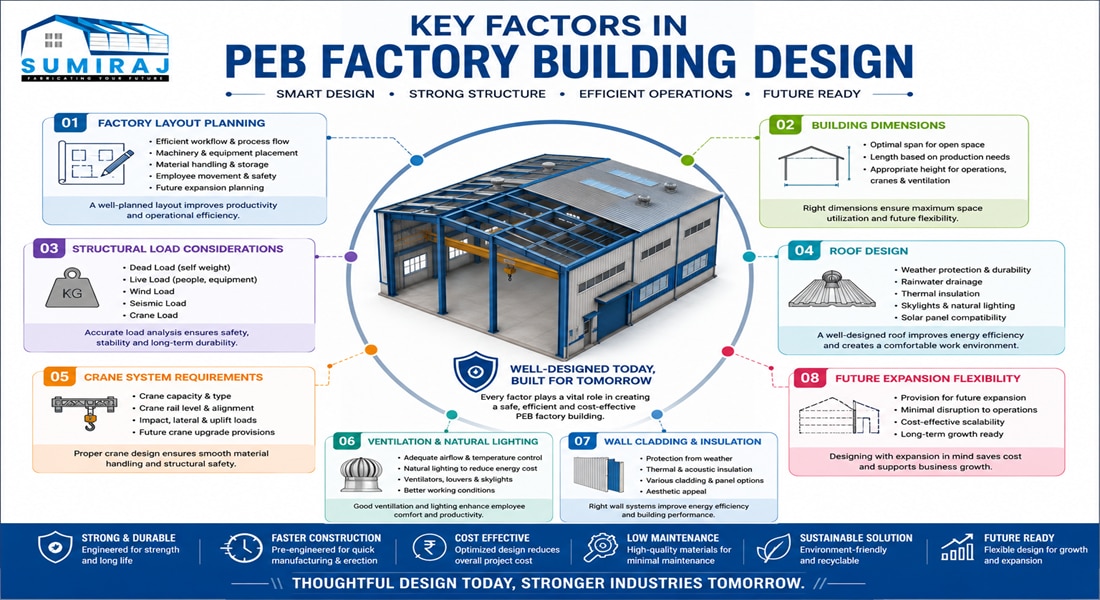
1. Factory Layout Planning
Before designing a factory building, it is essential to understand:
- Production process flow
- Machinery placement
- Material handling routes
- Storage requirements
- Employee movement
- Future expansion plans
An efficient layout minimizes operational bottlenecks and improves productivity.
2. Building Dimensions
The overall dimensions depend on:
Width (Span)
The distance between side columns.
Length
Determined by production capacity and available land.
Height
Depends on:
- Manufacturing process
- Crane requirements
- Storage needs
- Ventilation requirements
Proper dimensions ensure optimum utilization of space.
3. Crane System Requirements
Many factories use EOT cranes for material handling.
Design considerations include:
- Crane capacity
- Crane rail elevation
- Impact loads
- Lateral forces
- Future crane upgrades
Incorrect crane design can affect structural performance and safety.
4. Roof Design
The roof system plays a critical role in protecting the facility and maintaining operational efficiency.
Factors include:
- Rainwater drainage
- Wind loads
- Thermal insulation
- Skylight requirements
- Solar panel installation
Popular roofing options include:
- Galvalume roofing sheets
- Color-coated sheets
- Insulated sandwich panels
5. Ventilation and Natural Lighting
A well-designed factory building should provide:
- Adequate airflow
- Comfortable working conditions
- Reduced energy consumption
Common solutions include:
- Turbo ventilators
- Ridge ventilators
- Louvers
- Skylights
- Wall ventilators
6. Structural Load Considerations
Professional PEB design considers multiple load conditions:
Dead Load
Weight of the building itself.
Live Load
Personnel, equipment, and maintenance loads.
Wind Load
Calculated according to applicable standards.
Seismic Load
Critical for earthquake-prone regions.
Crane Load
Applicable in industrial manufacturing facilities.
Accurate load analysis ensures structural safety and durability.
Major Components of a PEB Factory Building
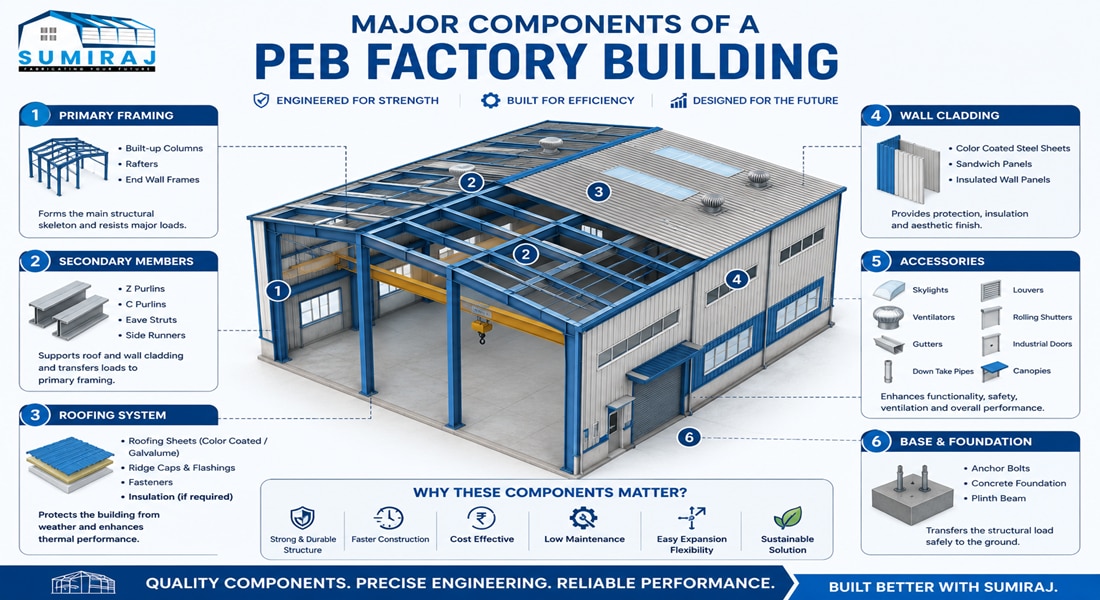
Primary Framing
Primary framing forms the main structural skeleton.
Components include:
- Built-up columns
- Rafters
- End-wall frames
These members carry the major structural loads.
Secondary Members
Secondary framing supports roofing and wall systems.
Components include:
- Z purlins
- C purlins
- Eave struts
- Side runners
Roofing System
The roofing system generally consists of:
- Color-coated steel sheets
- Fasteners
- Ridge caps
- Flashings
- Insulation materials
Wall Cladding
Wall systems provide protection and aesthetics.
Options include:
- Color-coated steel cladding
- Sandwich panels
- Insulated wall panels
Accessories
Additional components include:
- Skylights
- Ventilators
- Gutters
- Down-take pipes
- Louvers
- Rolling shutters
- Industrial doors
Industries Using PEB Factory Buildings
PEB factory buildings are widely used in:
- Manufacturing Plants
- Automobile Industries
- Food Processing Units
- Textile Industries
- Engineering Workshops
- Pharmaceutical Facilities
- Packaging Industries
- Electronics Manufacturing Units
Cost Factors in PEB Factory Building Design
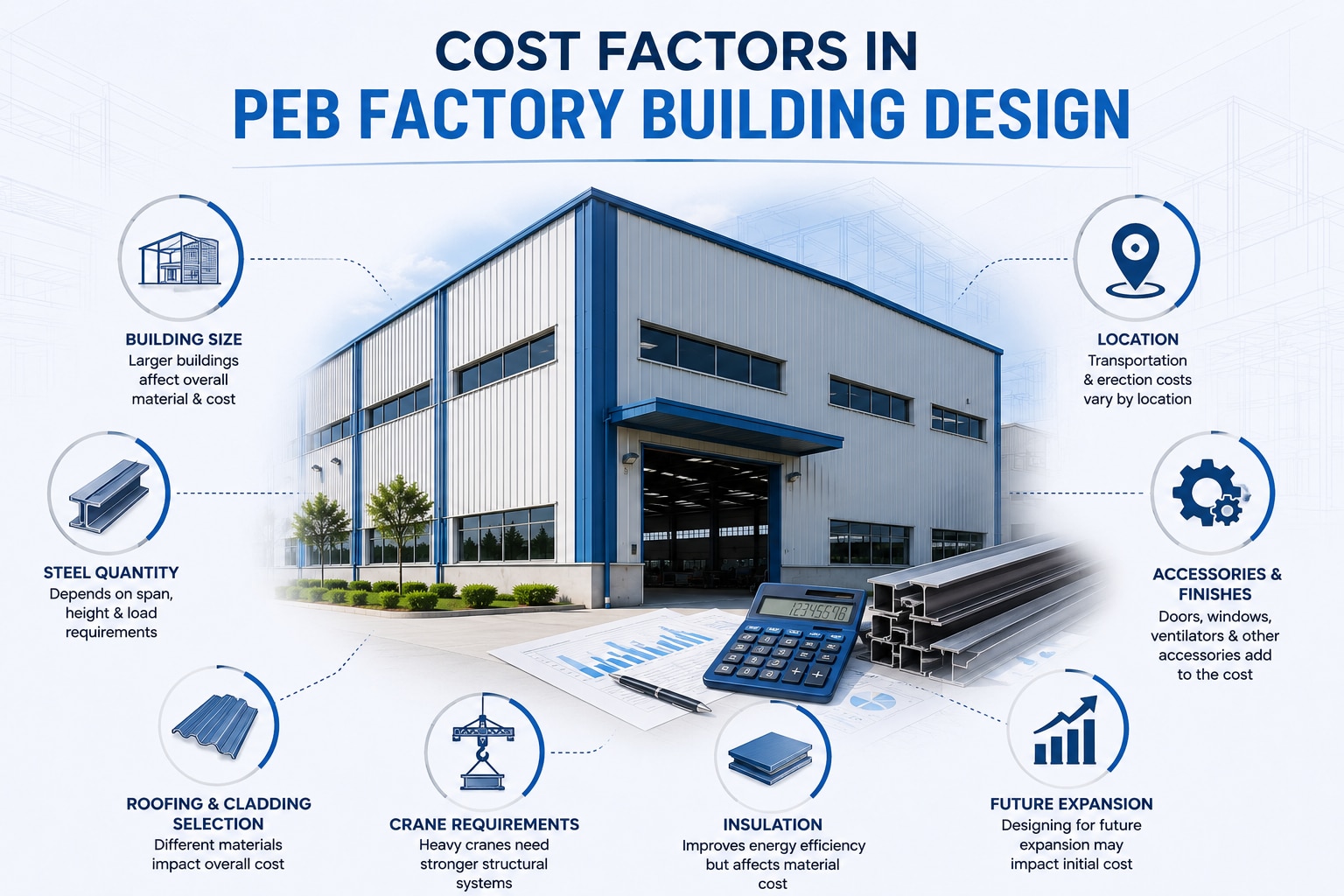
Several factors influence project cost:
Building Size
Larger buildings generally offer better cost efficiency per square meter.
Steel Quantity
Depends on span, height, and loading conditions.
Roofing and Cladding Selection
Premium materials increase initial investment but may reduce long-term maintenance.
Crane Requirements
Heavy cranes require stronger structural systems.
Insulation
Thermal insulation affects material cost but improves energy efficiency.
Location
Transportation and erection costs vary by project location.
Best Practices for PEB Factory Building Design
To achieve maximum performance:
✔ Plan for future expansion
✔ Optimize workflow and material movement
✔ Select appropriate roofing and cladding systems
✔ Ensure proper ventilation and daylighting
✔ Design according to applicable codes and standards
✔ Work with experienced PEB manufacturers
✔ Use corrosion-resistant coatings
✔ Conduct detailed structural analysis
Why Choose Sumiraj for PEB Factory Buildings?
At Sumiraj, we provide complete PEB solutions tailored to industrial requirements. Our team focuses on delivering:
- Custom-engineered factory buildings
- High-quality steel fabrication
- Cost-effective structural solutions
- Timely project execution
- Professional technical support
- Durable and reliable PEB systems
Whether you require a new manufacturing facility, production plant, or industrial shed, Sumiraj can deliver a solution designed specifically for your operational needs.
Frequently Asked Questions (FAQs)
What is the ideal span for a PEB factory building?
The ideal span depends on the manufacturing process and equipment layout. PEB structures can efficiently accommodate large clear spans without internal columns.
How long does it take to construct a PEB factory building?
Construction time varies by project size, but PEB buildings are typically completed significantly faster than conventional RCC structures due to off-site fabrication.
Are PEB factory buildings suitable for heavy industrial applications?
Yes. Properly engineered PEB structures can support heavy machinery, cranes, and industrial equipment while maintaining structural integrity.
Can a PEB factory building be expanded later?
Yes. One of the major advantages of PEB construction is the ease of future expansion with minimal disruption to operations.
Do PEB factory buildings require insulation?
Insulation is recommended for temperature control, energy efficiency, and improved indoor working conditions, especially in manufacturing environments.
Are PEB factory buildings earthquake resistant?
PEB structures can be designed to comply with seismic requirements and relevant building codes, making them suitable for earthquake-prone areas.
Conclusion
A well-designed PEB factory building offers the perfect combination of speed, strength, flexibility, and cost efficiency. From layout planning and structural design to roofing, ventilation, and future expansion, every aspect must be carefully engineered to ensure long-term performance.
As a leading PEB manufacturer and supplier, Sumiraj delivers customized factory building solutions that help businesses create efficient, durable, and scalable industrial facilities.
Contact Sumiraj
Looking for a reliable PEB factory building solution?
Visit our website and submit your project requirements through our contact form. Our experts will help you design a cost-effective and high-performance factory building tailored to your business needs.
