
Snow Load Considerations for Steel Structures
Introduction
Heavy snowfall can turn a lightweight industrial roof into a significant structural challenge. Even when snow is not a routine concern across most of India, projects located in snow-prone regions require careful evaluation of roof loading, structural stability, drainage, and member capacity. Snow load considerations for steel structures therefore need to be addressed during the engineering stage, not after fabrication begins.
For factories, warehouses, cold-storage facilities, logistics buildings, and industrial projects in Noida, the structural design must reflect the actual site conditions and applicable design requirements. At Sumiraj, snow loading is considered alongside wind, dead load, live load, roof geometry, drainage, and other project-specific factors when developing PEB solutions.
What Is Snow Load?
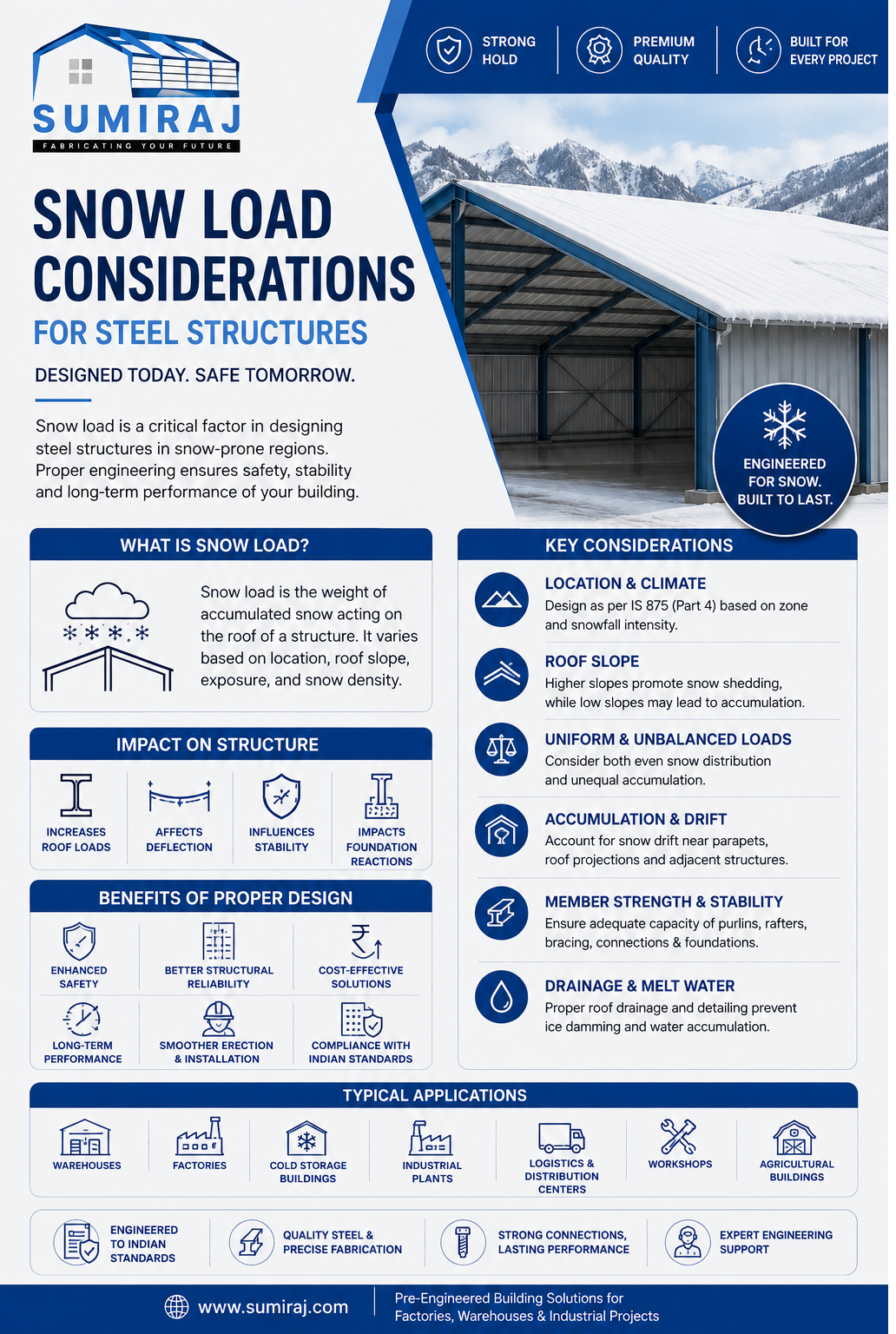
Snow load is the gravitational load imposed on a roof by accumulated snow. Unlike permanent dead loads, snow loads can vary depending on weather conditions, roof geometry, exposure, and the characteristics of the snow itself.
A roof that appears lightly loaded under normal conditions can experience substantially higher forces when snow accumulates. The resulting load is transferred through roof sheeting and secondary framing to the primary steel frames and ultimately into the foundations.
For this reason, snow load should be treated as a structural design action wherever the project location and applicable standards require it.
Why Snow Load Matters in PEB Design
PEBs are engineered for efficient use of steel. Primary frames, purlins, bracing systems, and connections are sized according to calculated loads rather than arbitrary material quantities.
When snow is a governing load, it can influence:
Rafter and column design
Purlin capacity
Roof deflection
Connection forces
Bracing requirements
Foundation reactions
Roof drainage
Overall structural stability
Key Snow Load Considerations for Steel Structures
Site Location and Snowfall Conditions
The first consideration is the building's geographical location. Snow intensity varies considerably between regions, so design loads should be established using the applicable Indian Standard and relevant site information.
Projects in snow-prone areas require greater attention to roof loading than industrial buildings in regions where snowfall is negligible. The design should not rely solely on general assumptions about the climate.
Roof Geometry
Roof slope has a direct influence on how snow accumulates and sheds from a building.
A sloping roof may naturally shed snow under suitable conditions, while a low-slope roof can retain accumulation for longer periods. However, snow shedding should never be assumed to eliminate structural loading.
Roof geometry should therefore be evaluated together with the design snow load, roof covering, thermal conditions, surrounding structures, and drainage arrangement.
Uniform Snow Loading
A uniform snow load represents an accumulation distributed across the roof area. This loading condition can generate significant reactions in rafters, purlins, columns, and foundations.
Structural engineers consider the applicable design load and determine how the building's framing system responds to it.
Unbalanced Snow Loading
Snow does not always accumulate evenly across both sides of a roof. Wind, roof geometry, nearby obstructions, and differences in exposure can produce uneven accumulation.
An unbalanced snow condition can create different forces on opposite sides of a frame. In a pitched PEB, this can result in additional bending and reaction forces that need to be considered during design.
Localized Snow Accumulation
Snow can accumulate more heavily around roof steps, parapets, equipment, higher roofs, projections, or other obstructions.
Adjacent buildings can also influence snow deposition. For industrial campuses where structures are built close together, the interaction between roof levels and surrounding structures should be reviewed carefully.
Structural Components Affected by Snow Loads
Roof Purlins
Purlins directly support the roof sheeting and transfer roof loads to the primary frame. Snow accumulation increases the load carried by these secondary members, making purlin capacity and deflection important design considerations.
Primary Frames
Rafters and columns receive loads transferred from the roof system. Higher snow loads can increase bending moments, axial forces, and support reactions.
Bracing Systems
Roof and wall bracing contribute to the stability of the building and help transfer certain lateral and longitudinal forces. Their design must be coordinated with the complete loading system.
Connections
Bolted and welded connections must have sufficient capacity for the forces generated by the structural members. A strong primary member alone does not guarantee a safe structure if its connections are inadequately designed.
Foundations
Snow loads ultimately influence the reactions transmitted to the foundation. Depending on the loading combination, this can affect compression, uplift, shear, and overturning requirements at the column base.
Benefits of Proper Snow Load Design
Improved Structural Safety
The most important benefit is ensuring that the steel building is designed for the environmental loads applicable to its location and intended use.
Better Control of Roof Deflection
Snow accumulation can increase roof deflection. Properly designed purlins, rafters, and connections help keep movement within appropriate serviceability limits.
Greater Reliability in Snow-Prone Areas
A building designed specifically for its site conditions is better prepared for seasonal variations and significant snowfall events than one based on generic loading assumptions.
Efficient Material Utilization
Engineering the structure for the actual governing loads helps avoid both under-design and unnecessary over-design. This supports the material-efficiency principles of PEB construction.
Better Coordination of Drainage and Roofing
Snow and melting snow can affect roof drainage. Proper coordination between structural design, roof slope, gutters, downpipes, and drainage paths helps reduce the risk of water accumulation after snowmelt.
Snow Load Applications in Industrial PEB Projects
Snow load considerations are particularly relevant to:
Industrial factories in snow-prone regions
Warehouses and logistics facilities
Cold-storage buildings
Agricultural and storage structures
Manufacturing plants
Workshops
Large-span industrial sheds
Buildings located in mountainous or high-altitude regions
For warehouse developers, roof design becomes especially important where large uninterrupted roof areas can collect substantial snow. Facilities with rooftop equipment or varying roof elevations also require careful engineering review.
Snow Load Considerations for Projects in Noida
Industrial projects in Noida should be designed according to the actual site conditions rather than applying the same structural assumptions used for every location.
Where snow is applicable, the project team should evaluate the site's snow characteristics, roof configuration, surrounding structures, drainage requirements, and applicable Indian Standards. The building's intended use also matters because excessive roof movement can affect cladding, doors, services, storage systems, and equipment.
Early coordination between the client, PEB manufacturer, structural engineer, civil team, and contractor helps establish the correct loading criteria before fabrication. This is particularly valuable for projects where structural components are manufactured off-site and assembled rapidly at the project location.
Indian Standards and Snow Load Design
Snow load design for Indian steel buildings should follow the applicable provisions of IS 875 (Part 4) for snow loads, along with relevant provisions of IS 800 for structural steel design.
The exact design approach depends on factors such as the project location, roof characteristics, loading combinations, structural system, and applicable project specifications.
Professional engineering is essential because snow load cannot be determined accurately by simply estimating the visible depth of snow. Density, accumulation pattern, roof geometry, and design criteria all influence the structural load.
Why Choose Sumiraj for PEB Structures?
Sumiraj focuses on engineering-driven PEB solutions for factories, warehouses, logistics facilities, and industrial buildings.
Engineering expertise: Structural loading conditions, including applicable snow loads, are evaluated as part of the complete building design.
Quality steel: Appropriate structural steel and controlled fabrication practices support dependable performance of primary and secondary members.
Customized designs: Roof slope, span, building height, loading requirements, operational needs, and site conditions can be incorporated into the project-specific design.
Cost efficiency: Proper engineering helps optimize steel quantities while maintaining the required structural capacity and serviceability.
Timely delivery: Coordinated engineering, detailing, and fabrication help support an organized construction and erection schedule.
Indian standards: Applicable Indian Standards and project-specific technical requirements are considered during structural design and detailing.
Technical support: Sumiraj can coordinate with clients, consultants, contractors, and site teams to address structural and fabrication requirements throughout the project.
Frequently Asked Questions About Snow Loads on Steel Structures
1. Are snow loads important for every steel building in India?
No. Snow loading depends on the project's location and applicable design requirements. Buildings in snow-prone regions require specific consideration, while many other parts of India may have negligible or non-governing snow loads.
2. How does snow affect a PEB roof?
Accumulated snow increases the load on roof sheeting, purlins, rafters, columns, connections, and foundations. It can also increase roof deflection and affect drainage during melting.
3. Does roof slope eliminate snow load?
No. Roof slope can influence snow accumulation and shedding, but it does not automatically eliminate the need to consider snow loading where it is applicable.
4. What is unbalanced snow loading?
Unbalanced snow loading occurs when snow accumulation differs across portions of a roof. This condition can create uneven forces in the structural frame and may need to be considered during design.
5. Can snow loads affect the foundation?
Yes. Roof snow loads are transferred through the structural frame to the column bases and foundations. The resulting reactions can influence foundation design.
6. Which Indian Standard covers snow loads?
Snow loads are addressed under IS 875 (Part 4), while the design of structural steel members is covered by applicable provisions of IS 800.
Conclusion
Snow load considerations for steel structures are an essential part of responsible PEB engineering wherever snowfall can impose significant roof loading. Site conditions, roof geometry, uniform and unbalanced accumulation, purlins, primary frames, connections, bracing, drainage, and foundations must all be evaluated as part of one coordinated structural system.
For factories, warehouses, and industrial facilities in Noida, Sumiraj combines engineering expertise, quality steel, customized design, cost-conscious solutions, and technical support to develop PEB structures suited to project-specific requirements and applicable Indian standards.
Discuss Your Project
Planning a factory, warehouse, cold-storage facility, or industrial steel building? Contact Sumiraj via WhatsApp or phone to discuss your project requirements and explore the right PEB structural solution.
Subscribe to our updates and stay informed about the latest trends, innovations, and cost-saving solutions in PEB construction, industrial buildings, and warehouse development.