
Introduction
Every industrial building is designed to carry different types of loads throughout its service life. Whether you're planning a manufacturing plant, warehouse, logistics hub, or factory, understanding dead load vs live load in steel buildings is essential for making informed construction decisions. Incorrect load assumptions can affect structural safety, project costs, and future expansion possibilities.
For industrial businesses in Noida, selecting the right structural design is critical for long-term operational efficiency. At Sumiraj, every Pre-Engineered Building (PEB) is engineered after carefully evaluating all applicable structural loads in accordance with relevant Indian standards, ensuring safe, economical, and reliable industrial buildings.
What Are Structural Loads in Steel Buildings?
Structural loads are the forces acting on a building during its entire lifespan. Engineers calculate these loads before designing columns, rafters, purlins, foundations, and connections.
The two most fundamental load categories are:
Dead Load
Live Load
Although they appear simple, understanding the difference between these loads helps industrial project owners appreciate why professional structural design is necessary.
What Is Dead Load?
Definition of Dead Load
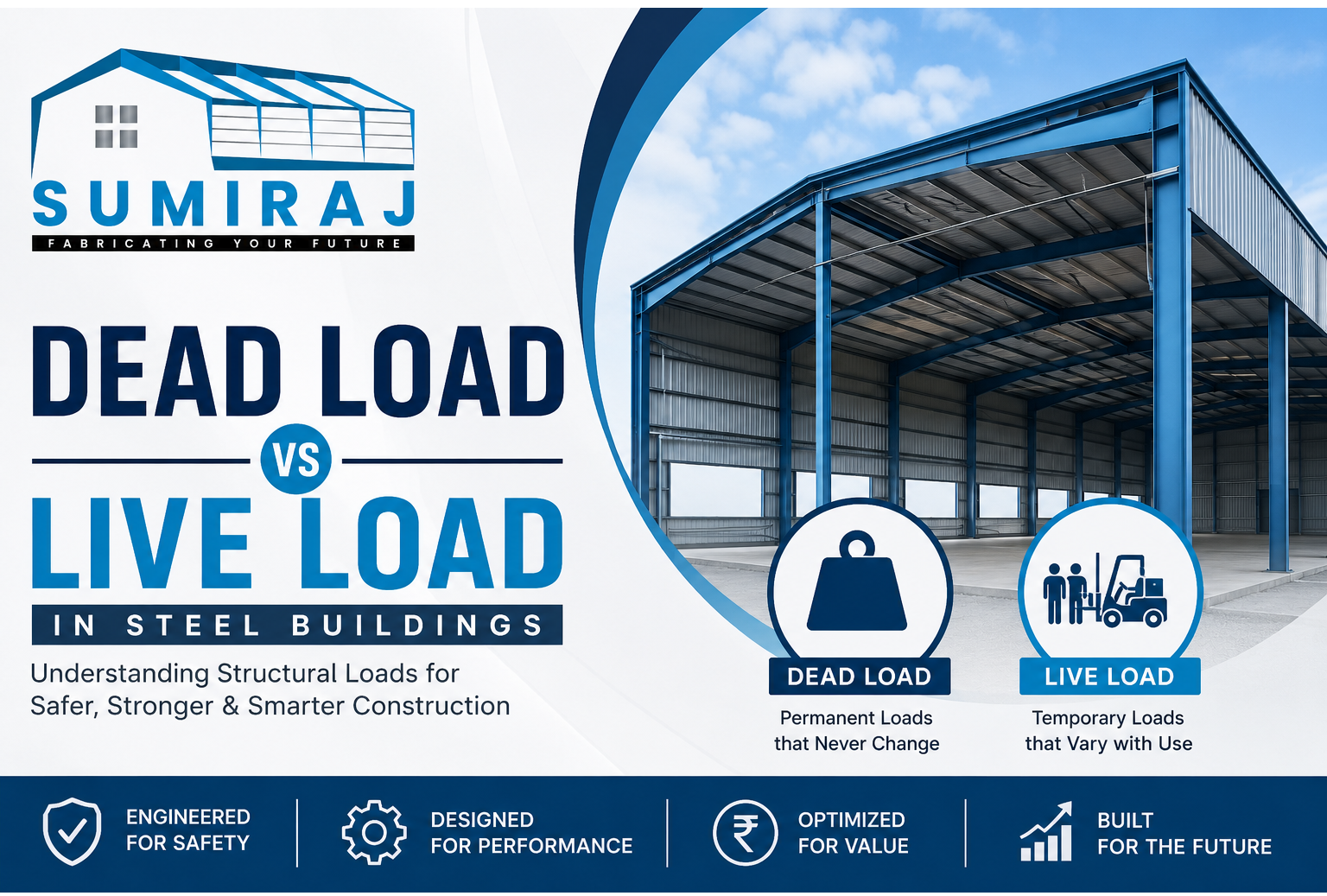
Dead load refers to the permanent weight of everything that forms part of the building structure. These loads remain constant throughout the life of the building unless structural modifications are made.
Typical dead loads include:
Steel columns
Rafters
Roof purlins
Wall girts
Roofing sheets
Wall cladding
Insulation systems
Fixed platforms
Permanent equipment attached to the structure
Solar mounting structures (when permanently installed)
Since these components remain fixed, engineers can accurately calculate dead loads during the design stage.
Why Dead Load Matters
Dead load determines the permanent stress experienced by the structural members. It directly influences:
Steel section sizes
Foundation design
Connection detailing
Structural stability
Overall building weight
Accurate dead load calculations help optimize steel consumption without compromising safety.
What Is Live Load?
Definition of Live Load
Live load represents temporary or movable loads that vary during the building's operation.
Unlike dead loads, live loads change frequently depending on building usage.
Examples include:
Workers
Maintenance personnel
Stored materials
Moving equipment
Forklifts
Mobile machinery
Temporary installations
Maintenance tools
Roof maintenance activities
Since these loads are not permanent, engineers use standardized values based on the intended use of the building.
Why Live Load Is Important
Live load calculations ensure that the building remains safe under varying operational conditions.
Proper assessment helps prevent:
Excessive deflection
Structural overstressing
Serviceability issues
Premature structural damage
For industrial buildings, live load assumptions often vary between warehouses, manufacturing plants, logistics centers, and commercial facilities.
Dead Load vs Live Load in Steel Buildings
| Parameter | Dead Load | Live Load |
|---|---|---|
| Nature | Permanent | Temporary or variable |
| Source | Structural components | People, equipment, stored goods |
| Variation | Constant | Changes over time |
| Predictability | Highly predictable | Depends on building usage |
| Design Purpose | Supports permanent structure | Supports operational activities |
| Examples | Steel frame, roof sheets, cladding | Workers, forklifts, inventory, maintenance |
Understanding both load types allows engineers to create structures that are economical while maintaining the required level of safety.
How Engineers Calculate Dead and Live Loads
Professional PEB designers follow recognized engineering procedures and Indian standards when calculating structural loads.
The design process generally includes:
Building Geometry
The dimensions, roof slope, bay spacing, and structural layout determine the initial load distribution.
Material Properties
The weight of structural steel, roofing sheets, insulation, and cladding contributes to the dead load.
Building Usage
A warehouse storing palletized goods requires different live load assumptions than a manufacturing plant with heavy machinery.
Applicable Design Standards
Indian structural engineers typically follow relevant provisions of IS codes for load calculations and structural steel design to ensure compliance and safety.
Safety Factors
Appropriate load combinations and safety factors are applied to account for different operating conditions throughout the building's life.
Why Accurate Load Calculations Matter in PEB Projects
Many industrial buyers focus only on the visible steel structure, but the accuracy of structural calculations has a significant impact on project performance.
Proper load assessment offers several advantages:
Improves structural safety
Prevents overdesign and unnecessary steel consumption
Reduces project costs
Supports future building expansion
Ensures compliance with Indian standards
Enhances long-term durability
Minimizes maintenance issues
Improves operational reliability
A professionally engineered PEB balances safety, functionality, and cost efficiency without using excessive material.
Practical Example
Consider a warehouse designed for industrial storage.
The dead load includes:
Steel frame
Roofing sheets
Wall cladding
Insulation
Permanent lighting fixtures
Fixed ventilation systems
The live load includes:
Warehouse personnel
Forklifts
Pallet racks
Stored inventory
Maintenance activities
If future storage requirements increase, engineers may need to review the original live load assumptions before additional loading is introduced. This highlights the importance of designing a building based on its intended operational use from the outset.
Benefits of Understanding Dead Load vs Live Load
Industrial project owners who understand these concepts can make better construction decisions.
Key benefits include:
Better communication with structural consultants
Improved project budgeting
Safer industrial facilities
Reduced risk of structural modifications later
More efficient material utilization
Better planning for future expansion
Increased confidence during project execution
Even a basic understanding of structural loads helps stakeholders evaluate design proposals more effectively.
Applications
Understanding dead and live loads is important for nearly every steel building project, including:
Manufacturing plants
Industrial sheds
Warehouses
Logistics parks
Cold storage facilities
Distribution centers
Automobile workshops
Food processing units
Agricultural storage buildings
Engineering industries
Each application has unique operational requirements, making accurate load calculations essential for reliable structural performance.
Industrial Construction in Noida
Industrial development continues to grow across Noida, with increasing demand for warehouses, production facilities, and logistics infrastructure. As businesses expand, selecting a properly engineered steel building becomes an important investment decision.
Whether constructing a new factory, expanding warehouse capacity, or developing a logistics hub in Noida, structural load assessment should always be completed by experienced engineers. A well-designed PEB improves operational efficiency while supporting long-term business growth.
Why Choose Sumiraj
Choosing the right PEB manufacturer is about more than steel fabrication—it is about dependable engineering and project execution.
Sumiraj focuses on delivering practical, code-compliant steel building solutions through:
Experienced engineering teams for structural design
Quality structural steel and building components
Customized PEB solutions based on project requirements
Cost-efficient designs that optimize material usage
Timely manufacturing and project delivery
Designs developed in accordance with applicable Indian standards
Technical support throughout design, manufacturing, and execution
This engineering-led approach helps industrial clients achieve durable and efficient building solutions suited to their operational needs.
Frequently Asked Questions
1. What is the difference between dead load and live load in steel buildings?
Dead load is the permanent weight of the structure and fixed components, while live load consists of temporary loads such as people, equipment, stored goods, and movable machinery.
2. Why are live load calculations important?
Live load calculations ensure that the building can safely handle changing operational conditions without excessive stress or structural damage.
3. Does warehouse storage affect live load?
Yes. Warehouses storing heavier inventory generally require higher live load design values than facilities with lighter operational requirements.
4. Are dead loads the same for every PEB?
No. Dead loads vary depending on building dimensions, roofing systems, cladding materials, insulation, and permanently installed equipment.
5. Which Indian standards are used for load calculations?
Structural engineers generally follow applicable Indian Standards (IS Codes) for load determination and steel structure design to ensure safety and compliance.
6. Can a steel building be expanded later if load requirements change?
In many cases, expansion is possible, but engineers should evaluate the original structural design and load capacity before any modifications are undertaken.
Conclusion
Understanding dead load vs live load in steel buildings enables industrial buyers to make better decisions during project planning and construction. Accurate structural load calculations improve safety, optimize steel usage, reduce unnecessary costs, and support long-term operational performance. Whether developing a factory, warehouse, or logistics facility, investing in a professionally engineered PEB provides a strong foundation for reliable industrial infrastructure.
Discuss Your Project
Planning an industrial building or warehouse? Connect with Sumiraj to discuss your project requirements with our engineering team. Reach out through WhatsApp or phone to explore customized PEB solutions designed for your operational needs.
Subscribe to our updates and stay informed about the latest trends, innovations, and cost-saving solutions in PEB construction, industrial buildings, and warehouse development.