Introduction
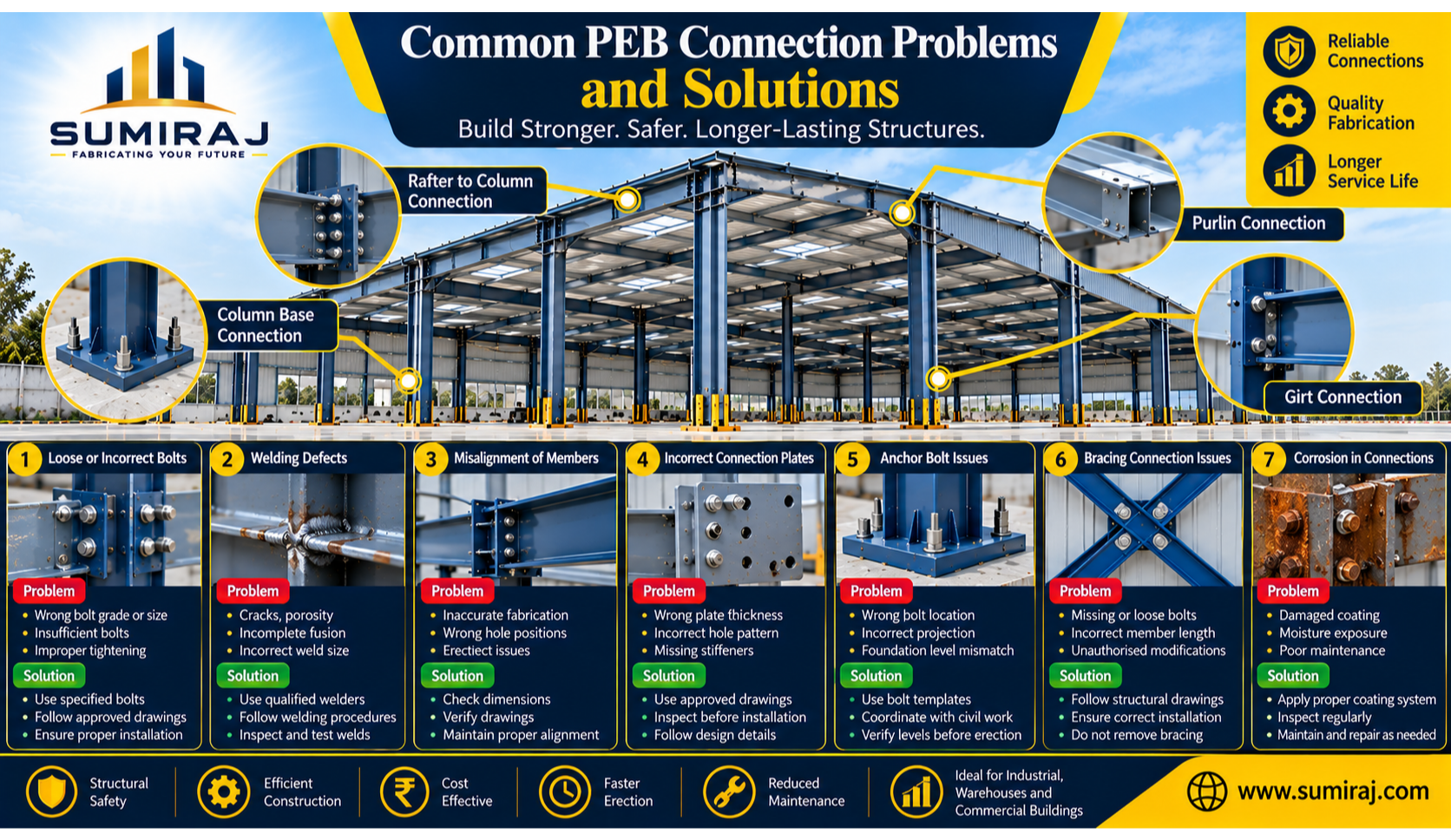
A pre-engineered building depends on properly designed and fabricated connections to maintain structural stability and transfer loads safely. Common PEB connection problems can arise from incorrect bolt installation, welding defects, dimensional inaccuracies, poor alignment, or inadequate coordination between structural components. If these issues are not identified and corrected, they can delay construction and affect the building's intended performance.
For factory owners, warehouse developers, and industrial investors in Noida, understanding these problems is important when planning a new steel structure. Connection quality affects fabrication, site erection, inspection, and long-term maintenance.
At Sumiraj, connection requirements are an important part of planning and fabricating pre-engineered buildings. Understanding potential connection failures helps project teams focus on engineering accuracy, suitable materials, controlled fabrication, and proper installation.
1. Incorrect Bolt Installation
Bolted connections are widely used in PEB construction because they allow structural components to be assembled efficiently at the site. However, incorrect installation can affect the connection's ability to perform as designed.
Common Causes
Using bolts of the wrong grade or diameter.
Installing fewer bolts than specified in the drawings.
Incorrect bolt-hole positioning or alignment.
Inadequate tightening where a specified tightening procedure is required.
Using damaged or unsuitable nuts, bolts, or washers.
Failing to follow the specified installation procedure for pretensioned connections.
For example, a rafter-to-column connection may be difficult to assemble if the bolt holes do not align correctly. Forcing bolts through misaligned holes can damage the connection or indicate a fabrication problem that requires investigation.
Solutions
Always follow the approved structural and fabrication drawings. Verify the bolt grade, diameter, quantity, and arrangement before installation.
Where pretension or a particular installation method is specified, use the required procedure and inspection method. If holes do not align, investigate the cause rather than enlarging them or modifying the connection without engineering approval.
2. Welding Defects in PEB Connections
Welding is commonly used to manufacture built-up columns, rafters, stiffeners, and connection plates. Poor welding quality can reduce the reliability of a joint and create difficulties during inspection.
Common Welding Problems
Cracks: These may develop due to welding conditions, material characteristics, restraint, or other factors. Cracks require assessment and should not be accepted without following the applicable criteria.
Undercut: This occurs when the parent metal near the weld toe is melted away and not adequately filled, creating a groove.
Incomplete fusion: The weld metal does not properly fuse with the base metal or an adjacent weld pass.
Porosity: Gas pockets form within the weld metal and may affect weld quality, depending on their size, distribution, and the applicable acceptance criteria.
Incorrect weld size: A weld that does not match the approved dimensions may fail to provide the required connection capacity.
Solutions
Use approved welding procedures, suitable consumables, and appropriately qualified welders where required by the project specifications.
Joint preparation, welding parameters, material condition, and distortion control should be managed during fabrication. Visual inspection should be performed, with additional non-destructive testing where specified.
Defective welds should be assessed and repaired through an approved procedure. Repairs must be inspected according to the applicable requirements before the component is accepted.
3. Misalignment Between Structural Components
Misalignment is another common challenge during PEB fabrication and erection. Columns, rafters, purlins, girts, and bracing members must fit together according to the approved structural arrangement.
Common Causes
Inaccurate fabrication dimensions.
Incorrect positioning of connection plates.
Misplaced or incorrectly installed anchor bolts.
Improper handling or storage of structural members.
Inadequate control of column plumbness during erection.
Differences between the latest approved drawings and the drawings used for fabrication.
Misalignment may become apparent when a rafter is connected to a column or when a bracing member cannot reach its specified connection point.
Solutions
Carry out dimensional inspections during fabrication and verify the positioning of connection plates and holes before dispatch.
At the construction site, check foundation levels, anchor-bolt locations, and column alignment before completing the frame connections. Temporary supports and erection procedures should be used as specified to maintain stability during assembly.
If components do not fit, identify whether the problem originates in fabrication, foundation work, or erection. Any corrective action affecting structural geometry must be reviewed by the responsible engineer.
4. Incorrect Connection Plate Dimensions
Connection plates transfer forces between structural members. Their thickness, dimensions, hole locations, and weld details must match the approved design.
Common Causes
Cutting plates to incorrect dimensions.
Drilling holes in the wrong locations.
Using an incorrect plate thickness.
Omitting specified stiffeners.
Fabricating components from outdated drawings.
Failing to inspect plates before assembly.
A connection plate that is too small or incorrectly detailed may not provide the required capacity. Incorrect hole positioning can also make installation difficult.
Solutions
Use controlled fabrication drawings and verify revisions before manufacturing begins. Check plate dimensions, thickness, hole spacing, edge distances, and other specified details during inspection.
Components should be identified and inspected before they move to the next production stage. Any deviation from the approved drawing should be evaluated before the component is used.
Do not replace a plate with a different thickness or change the hole arrangement without engineering approval.
5. Column Base Plate and Anchor Bolt Problems
Column base connections transfer forces from the steel frame to the foundation. They typically include a base plate, anchor bolts, and other specified components.
Problems at this interface can create significant erection difficulties.
Common Causes
Anchor bolts installed in the wrong positions.
Incorrect bolt projection or embedment.
Base plates with incorrect dimensions or hole patterns.
Foundation levels outside the specified tolerances.
Poor coordination between structural and civil drawings.
Inadequate preparation for the specified grouting arrangement.
Solutions
Coordinate the structural design and foundation drawings before concrete is poured. Anchor-bolt templates and appropriate surveying checks can help maintain the required bolt positions.
After foundation work, verify anchor-bolt locations and foundation levels before erecting the columns.
If the anchor bolts do not match the base plate, do not bend, cut, relocate, or otherwise modify them without an approved engineering solution. The responsible engineer should assess the discrepancy and determine an appropriate corrective method.
6. Bracing Connection Problems
Bracing helps transfer lateral forces and contributes to the stability of a PEB structure. Its connections must perform according to the intended structural system.
Common Causes
Incorrect bracing member lengths.
Misaligned gusset plates.
Missing or incorrectly installed bolts.
Incorrect connection plate details.
Unauthorised removal or modification of bracing.
Interference with doors, openings, or building services.
For example, removing a bracing member to create additional access space can disrupt the intended load path and compromise stability.
Solutions
Verify bracing locations, member sizes, connection details, and bolt arrangements against the approved drawings.
Coordinate openings and building services with the structural design before fabrication and erection. If a bracing member conflicts with the operational layout, consult the responsible engineer for a revised design.
Never remove or modify a structural bracing member without an approved engineering assessment.
7. Purlin and Girt Connection Issues
Purlins support roof sheeting, while girts support wall cladding. Their connections transfer relevant loads to the primary frame and help maintain the intended alignment of the building envelope.
Common Problems
Incorrect bolt sizes or missing fasteners.
Misaligned cleats or connection holes.
Incorrect purlin or girt orientation.
Missing specified restraint components.
Connection details that do not match the approved drawings.
Damage to members during transportation or handling.
These problems can complicate cladding installation and may affect the structural performance of the secondary framing system.
Solutions
Check purlin and girt identification, orientation, connection details, and fastening requirements during installation.
Verify that the required restraints and connection components are installed according to the drawings. Before cladding begins, inspect the alignment of the secondary framing and resolve any discrepancies.
Changes to member sizes, spacing, or connection details should be assessed by the responsible engineer.
8. Corrosion and Deterioration of Connections
Steel connections may deteriorate when protective coatings are damaged or environmental conditions are more aggressive than anticipated.
Corrosion can affect bolts, connection plates, and welded areas, particularly where moisture or industrial contaminants accumulate.
Common Causes
Damaged protective coatings.
Inadequate surface preparation.
Incorrect coating selection for the exposure conditions.
Water accumulation around connection details.
Poor maintenance in corrosive environments.
Incompatible materials or unsuitable fasteners for the specified conditions.
Solutions
Select a protective coating system appropriate for the project's environment and follow the specified surface preparation and application procedures.
Inspect vulnerable connection areas periodically, especially in facilities exposed to moisture, chemicals, or industrial pollutants. Repair damaged coatings using suitable methods and investigate any significant corrosion before deciding on corrective work.
The maintenance plan should reflect the building's exposure conditions and the requirements of its structural system.
Benefits of Preventing PEB Connection Problems
Preventive quality control helps reduce the risk of connection-related delays and supports the intended performance of a steel building.
1. Improved Structural Reliability
Correctly designed and installed connections help transfer loads through the structural system as intended.
2. Reduced Rework
Early detection of incorrect dimensions, misplaced holes, and fabrication defects can prevent costly corrective work during erection.
3. More Efficient Installation
Accurate components and clear connection drawings help erection teams assemble the steel frame with fewer avoidable interruptions.
4. Better Quality Assurance
Documented inspection procedures support consistent checks of materials, welds, bolts, and connection dimensions.
5. Lower Maintenance Risks
Appropriate corrosion protection and planned inspections help identify deterioration before it becomes more serious.
6. Improved Project Coordination
Communication between engineers, fabricators, civil contractors, and erection teams helps resolve interface issues before they affect the construction schedule.
Applications: Where Connection Quality Matters Most
PEB connection quality is important across several industrial applications.
Manufacturing plants: Connections must suit the primary frame and any specified equipment or crane loads.
Warehouses: Roof, wall, and bracing connections support the building's structural system and envelope.
Logistics centers: Accurate connections help coordinate structural framing with loading bays and operational openings.
Industrial sheds: Properly fabricated joints support efficient erection and long-term serviceability.
Crane-equipped buildings: Specialized connections must account for the loads and requirements identified during engineering.
The design and inspection requirements should be tailored to the intended use of each building.
PEB Connection Quality for Projects in Noida
Industrial projects in Noida benefit from clear structural drawings, coordinated fabrication details, and documented quality checks.
Before fabrication begins, project teams should confirm the approved drawings, material specifications, bolt requirements, welding procedures, coating specifications, and inspection criteria.
During construction, the PEB manufacturer, structural engineer, civil contractor, and erection team should coordinate foundation interfaces, connection alignment, and the installation sequence.
Applicable Indian standards and project-specific specifications should guide structural design, fabrication, erection, and inspection.
Any connection defect that may affect structural safety should be assessed by a qualified professional. Site teams should not make unapproved modifications to bolts, welds, plates, bracing, or other structural components.
Why Choose Sumiraj for PEB Construction?
Choosing a PEB manufacturer involves evaluating engineering coordination, fabrication practices, material quality, and technical support.
Sumiraj considers these factors when planning structural components for industrial buildings.
Engineering expertise: Connection requirements are coordinated with the intended structural system and approved drawings.
Quality steel: Materials are selected according to project specifications.
Customized designs: Structural components are planned around building dimensions and operational needs.
Cost efficiency: Fabrication planning and suitable connection details help manage material use and avoid unnecessary rework.
Timely delivery: Coordination of drawings, fabrication, and dispatch supports project scheduling.
Indian standards: Applicable standards and project-specific requirements are considered during engineering and quality planning.
Technical support: Clients can discuss connection requirements, component specifications, and fabrication-related considerations.
A coordinated approach helps identify potential connection issues before they become more difficult to resolve at the construction site.
Frequently Asked Questions
1. What are the most common PEB connection problems?
Common problems include incorrect bolt installation, welding defects, misaligned components, incorrect connection plate dimensions, anchor-bolt positioning errors, bracing connection issues, and corrosion.
2. What causes bolt connection failure in PEB structures?
Potential causes include incorrect bolt specifications, insufficient bolt quantity, damaged fasteners, unsuitable hole geometry, incorrect installation, and connection designs that do not meet the required loads. The actual cause must be established through engineering assessment.
3. How can welding defects in PEB components be prevented?
Welding defects can be reduced through suitable joint preparation, approved welding procedures, appropriate consumables, qualified personnel where required, controlled welding conditions, and inspection according to the project quality plan.
4. What should be done if PEB connection holes do not align?
Stop and investigate the cause. Check the fabrication dimensions, component orientation, foundation interfaces, and approved drawings. Do not enlarge holes or modify structural components without engineering approval.
5. Why are anchor bolts important in PEB construction?
Anchor bolts connect column base plates to the foundation system. Their location, size, embedment, and arrangement must match the approved structural design.
6. Can PEB connections be repaired at the construction site?
Some issues can be corrected on-site, but the method depends on the defect and its structural significance. Repairs or modifications affecting connection performance must be approved by the responsible engineer and inspected as required.
7. How often should steel connections be inspected?
Inspection frequency depends on the building's use, environmental exposure, maintenance plan, and applicable requirements. Connections in corrosive or demanding environments may need more frequent attention.
Conclusion
Common PEB connection problems and solutions should be understood before fabrication and erection begin. Incorrect bolt installation, welding defects, dimensional inaccuracies, foundation interface issues, and corrosion can affect construction efficiency and the intended performance of a steel building.
For factory owners, warehouse developers, and industrial investors in Noida, prevention starts with approved engineering drawings, accurate fabrication, appropriate installation procedures, and documented quality inspections. Any structural defect or proposed modification should be assessed by a qualified professional before corrective work proceeds.
Sumiraj supports industrial building projects by focusing on coordinated engineering requirements, fabrication planning, and quality considerations for PEB structural components.
Discuss Your Project With Sumiraj
Planning a factory, warehouse, or industrial shed? Contact Sumiraj via WhatsApp or phone to discuss your PEB requirements, structural connections, and project specifications.
Subscribe to our updates and stay informed about the latest trends, innovations, and cost-saving solutions in PEB construction, industrial buildings, and warehouse development.