Introduction
The stability of a steel building depends on how effectively its structural system resists lateral forces and transfers loads to the foundations. Cable bracing vs rod bracing in steel buildings is an important comparison when designing pre-engineered buildings (PEBs), industrial sheds, and warehouses. Although both systems can provide tension bracing, they differ in construction, flexibility, connection arrangements, and installation requirements.
For factories, warehouses, and logistics facilities in Noida, selecting the appropriate bracing system helps address structural stability, practical installation, and long-term maintenance requirements. At Sumiraj, bracing should be considered as part of the complete PEB design, with member selection and connection details based on the building's geometry and loading conditions.
Understanding the differences between cable and rod bracing helps industrial buyers ask the right questions before finalising their building specifications.
What Is Bracing in Steel Buildings?
Bracing is a structural arrangement that helps a building resist lateral forces, including those caused by wind. It provides a defined load path through the structural frame towards the foundations.
In a PEB, bracing may be installed in selected roof bays and vertical wall bays. The complete system works with the primary frame, secondary members, and connections to maintain stability.
Cable bracing and rod bracing are two options used in suitable applications. Both can be designed as tension-only systems, meaning the members resist tension but are not relied upon to carry compression. The structural designer must establish the intended behaviour rather than assume that every cable or rod can resist loads in both directions.
What Is Cable Bracing?
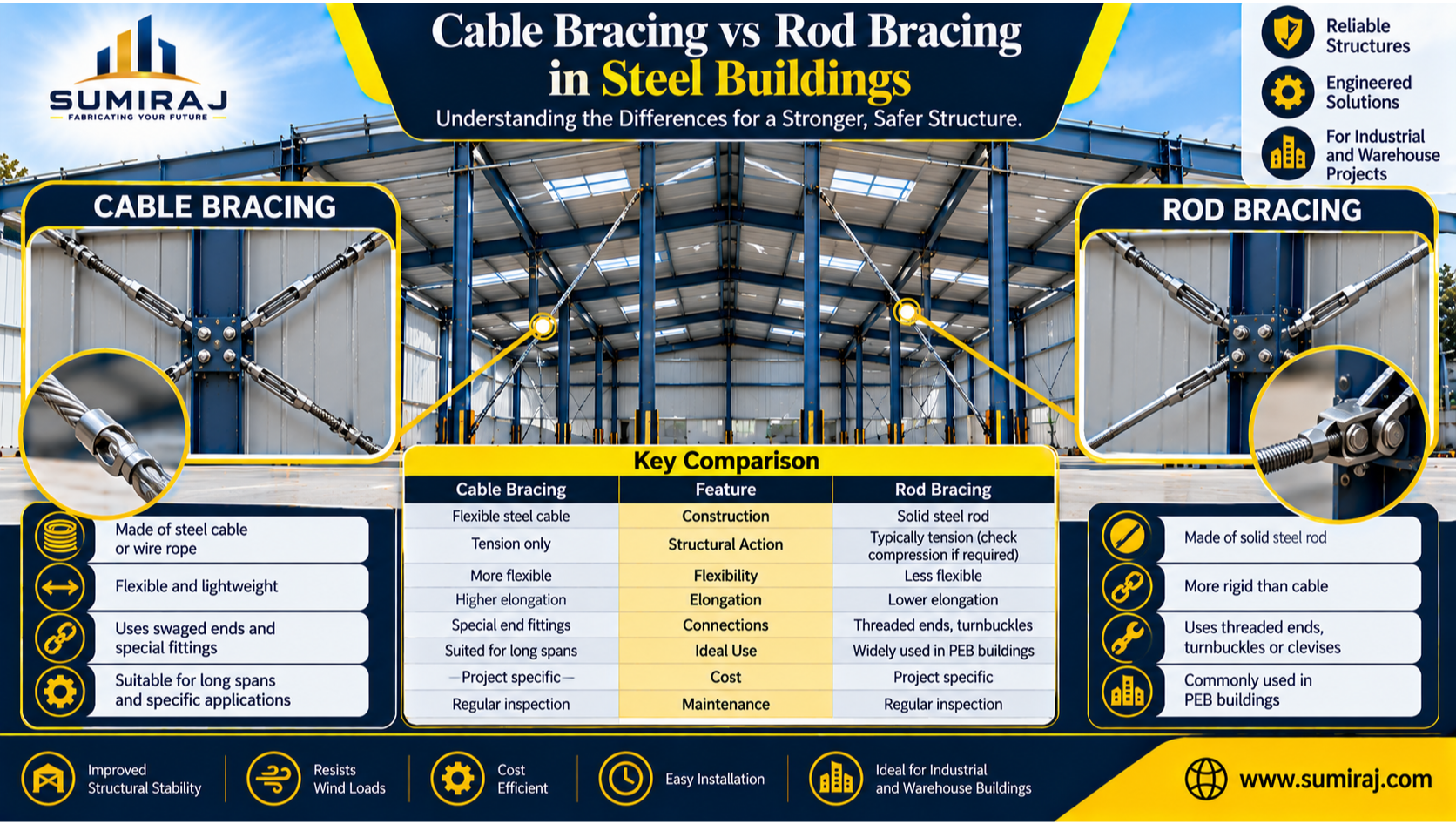
Cable bracing uses flexible steel cables, wire ropes, or strands connected diagonally between designated points in a structural frame.
These members are well suited to applications where tensile resistance is required without using a heavier rigid section. Cable systems commonly use specialised end fittings, anchorage details, and tension-adjustment arrangements.
Key Characteristics of Cable Bracing
Flexible construction: Cables can accommodate layouts where a flexible tension member is suitable, but their elongation and flexibility must be considered in the structural design.
Tension resistance: Cables are normally used as tension members and should not be relied upon to resist compression.
Specialised connections: Cable terminations, fittings, anchors, and supporting plates must be suitable for the design force.
Tension adjustment: Some cable systems incorporate adjustable fittings that help achieve the required installation tension.
Cable flexibility can be advantageous in particular designs, but excessive elongation or slack can affect structural stiffness. These factors must be considered when evaluating the suitability of cable bracing.
What Is Rod Bracing?
Rod bracing uses solid steel rods installed diagonally between structural members. Depending on the design, rods may include threaded ends, clevises, turnbuckles, and bolted connections.
Rod bracing is commonly used in PEB roof and wall bracing systems where a suitable tension-member arrangement can provide the required stability.
Key Characteristics of Rod Bracing
Solid steel construction: Rods are generally solid members with defined dimensions and material properties.
Tension-based action: Slender rods in typical PEB bracing arrangements are often designed primarily for tension. They must not be assumed to resist compression unless their section properties, effective length, and connections have been designed for that purpose.
Adjustable connections: Turnbuckles or other specified fittings may allow adjustment during installation.
Straightforward detailing: Rod systems can be relatively simple to fabricate and install when the connection arrangement is properly designed.
The rod diameter, material grade, threaded-section capacity, and connection details must be determined through engineering calculations. Selecting a rod only by its nominal diameter is not sufficient.
Cable Bracing vs Rod Bracing
1. Strength and Load-Carrying Capacity
The load-carrying capacity of cable or rod bracing depends on its material properties, dimensions, effective length, connection details, and design forces.
For cable bracing, engineers must evaluate the rated capacity of the cable assembly and its end fittings. The strength of the cable alone does not establish the capacity of the complete connection.
For rod bracing, designers must consider the rod's tensile resistance, reduced area at threaded sections, and connection capacity. If compression resistance is required, buckling and other relevant limit states must also be checked.
In both systems, the bracing members, connections, and supporting structural elements must be assessed together.
2. Flexibility and Structural Movement
Cable bracing is generally more flexible than a comparable solid rod, so the effect of elongation on structural movement may be more significant.
Rod bracing may provide a less flexible tension-member arrangement, depending on its length, diameter, and connection details. However, a rod is not automatically a rigid brace simply because it is made of solid steel.
The required structural stiffness and permissible movement should guide the choice. This is particularly important for large warehouses, where excessive movement can affect cladding, doors, and connected structural components.
3. Installation and Connection Requirements
Both systems require properly designed connections and installation procedures.
Cable bracing needs compatible end fittings and anchorage details. Installation must prevent damage to the cable and ensure that the system achieves the specified tension and alignment.
Rod bracing requires accurate positioning, suitable end connections, and adjustment where specified. Turnbuckles should be installed and adjusted according to the approved procedure.
If either system does not fit the approved structural layout, installers should not force the connections or make unauthorised modifications. The cause should be investigated and referred to the responsible engineer.
4. Cost and Maintenance Considerations
The cost of a bracing system includes more than the member itself. Material, end fittings, fabrication, transport, installation, inspection, and maintenance all influence the total project cost.
Cable bracing may be suitable where its flexibility and system configuration meet the requirements. Rod bracing may be attractive where a straightforward solid-member arrangement is appropriate.
However, the lowest material price does not necessarily produce the most economical solution. The design should consider the cost and performance of the complete bracing assembly over the building's intended service life.
Maintenance requirements also vary with the environment. Both systems need suitable corrosion protection and inspection of their members and connections.
Benefits of Choosing the Right Bracing System
Selecting a suitable cable or rod bracing arrangement can provide several benefits.
Improved Structural Stability
A properly designed system helps resist lateral forces and maintain the intended stability of the building.
Efficient Load Transfer
Bracing provides designated load paths through the structural frame towards the foundations.
Practical Installation
Choosing a system suited to the fabrication and erection process can reduce avoidable adjustments at the construction site.
Cost-Conscious Engineering
Appropriate member and connection selection helps balance structural performance with material, installation, and maintenance costs.
Better Maintenance Planning
Clearly specified components, protective coatings, and accessible connections help project teams plan inspections and corrective work.
These benefits depend on correct engineering, fabrication quality, installation, and inspection rather than the choice of cable or rod alone.
Applications in PEB Construction
Cable and rod bracing can be considered for various steel-building applications when their characteristics suit the structural design.
Manufacturing plants: Bracing helps provide lateral stability while accommodating production layouts and equipment access.
Warehouses: Suitable roof and wall bracing helps address stability requirements in large storage buildings.
Logistics centres: Bracing layouts must work with loading bays, doors, and material-handling operations.
Industrial sheds: Rod or cable systems may be used in designated bays according to the design.
Commercial steel buildings: The appropriate arrangement depends on building geometry, loading conditions, and architectural requirements.
Where conventional diagonal bracing conflicts with a large opening, an alternative engineered system may be necessary. Bracing should never be removed simply to make space for a door or equipment.
Cable Bracing vs Rod Bracing for Projects in Noida
Industrial projects in Noida can differ in building dimensions, wind exposure, operational requirements, and site conditions. These factors influence the selection and placement of the bracing system.
Before fabrication begins, project teams should confirm the approved structural drawings, member specifications, connection details, corrosion-protection requirements, and installation procedures.
Bracing locations should be coordinated with wall cladding, roof openings, loading doors, and other building services. Applicable Indian standards and project-specific requirements should guide the structural design.
Early coordination between the PEB manufacturer, structural engineer, civil contractor, and erection team helps identify potential conflicts before they affect site work.
Why Choose Sumiraj for PEB Solutions?
Sumiraj recognizes that reliable PEB construction depends on a coordinated structural system and carefully defined fabrication requirements.
Key considerations include:
Engineering expertise: Bracing arrangements should be coordinated with the building's structural analysis and load paths.
Quality steel: Materials should meet the approved project specifications.
Customized designs: Bracing layouts should reflect building dimensions, openings, and operational needs.
Cost efficiency: Member and connection selection should balance structural requirements with practical material use.
Timely delivery: Coordinated drawings and fabrication planning support the project schedule.
Indian standards: Structural design should follow applicable Indian standards and project requirements.
Technical support: Clear communication helps coordinate engineering, fabrication, and erection requirements.
For each project, Sumiraj can help clients review their PEB requirements and understand the factors that influence the selection of structural components.
Frequently Asked Questions
1. What is the main difference between cable bracing and rod bracing?
Cable bracing uses flexible steel cables or strands, while rod bracing uses solid steel rods. Both can act as tension bracing, but their flexibility, elongation, connections, and installation requirements differ.
2. Is cable bracing stronger than rod bracing?
Neither is universally stronger. Capacity depends on the member dimensions, material properties, connections, and design requirements. The complete assembly must be checked through engineering calculations.
3. Can rod bracing resist compression?
Slender rods commonly used in PEB bracing are often designed primarily for tension. Compression resistance should only be relied upon when the rod's section, effective length, and connections have been specifically designed for it.
4. Why are turnbuckles used in rod or cable bracing?
Turnbuckles can provide adjustment where included in the design. They help achieve the required fit and tension, but must be suitable for the system's loads and installed according to the approved procedure.
5. Which bracing system is more cost-effective?
The answer depends on material, fittings, fabrication, installation, inspection, and maintenance costs. A project-specific comparison is more reliable than choosing solely by the price of the cable or rod.
6. Can cable or rod bracing be removed to create a larger opening?
Neither should be removed or relocated without an engineering review and an approved alternative solution. Changing a bracing member can interrupt the intended load path and compromise structural stability.
7. How should cable and rod bracing be maintained?
Inspection should follow the building's maintenance plan and the applicable specifications. Checks may include corrosion, damaged members, loose or deteriorated connections, and adjustment or tension where required.
Conclusion
Cable bracing vs rod bracing in steel buildings is a comparison of two different ways to provide tension bracing within a structural system. Cable bracing offers a flexible member arrangement, while rod bracing uses solid steel members that may provide a less flexible configuration. The suitability of either system depends on design forces, member properties, connection details, installation requirements, and maintenance conditions.
For factories, warehouses, and industrial facilities in Noida, the correct choice should be made through engineering calculations and coordinated design rather than a general assumption that one system is always superior.
Sumiraj can help industrial buyers evaluate their PEB requirements and coordinate bracing with the wider structural design.
Discuss Your Project With Sumiraj
Planning a factory, warehouse, or industrial shed? Contact Sumiraj through WhatsApp or phone to discuss your building dimensions, bracing requirements, and PEB project specifications.
Subscribe to our updates and stay informed about the latest trends, innovations, and cost-saving solutions in PEB construction, industrial buildings, and warehouse development.