Introduction
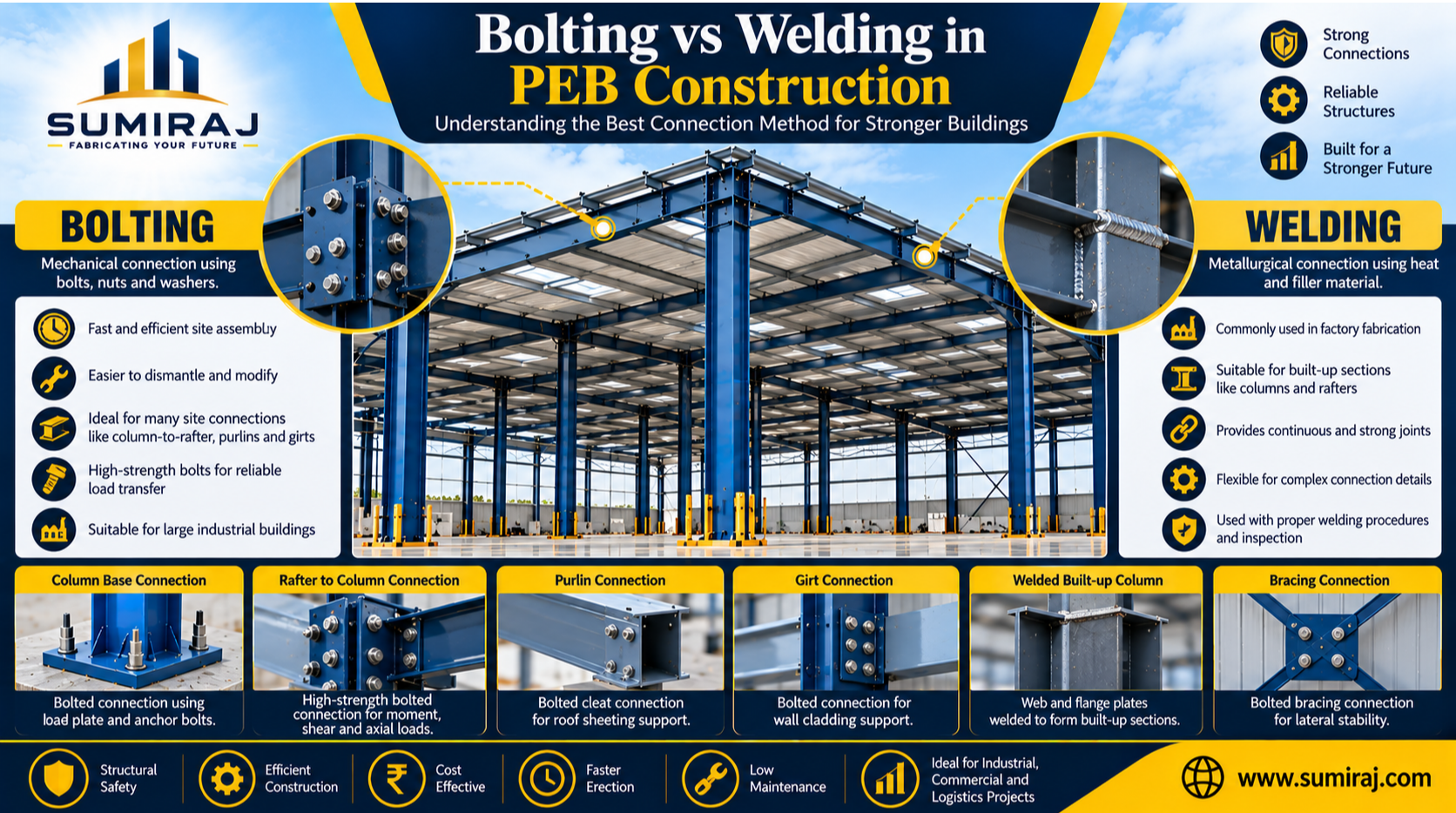
Every pre-engineered building depends on strong, reliable connections to maintain structural stability and transfer loads safely. When planning a factory, warehouse, or industrial shed, bolting vs welding in PEB construction is an important consideration because both methods influence fabrication quality, installation speed, maintenance, and overall project cost.
Bolting joins steel components using bolts, nuts, and washers, while welding connects them through a metallurgical bond created by heat. Each method serves a specific purpose in steel construction, and neither is universally better than the other.
For industrial businesses in Noida, understanding the difference helps project owners make informed decisions when evaluating a PEB manufacturer's fabrication methods and structural connection details. At Sumiraj, connection requirements are considered as part of the engineering and fabrication process to support the performance and practical installation of pre-engineered buildings.
What Is Bolting in PEB Construction?
Bolting is a mechanical connection method used to join two or more steel components with bolts, nuts, and, where required, washers. It is widely used in PEB structures because many components can be fabricated in a controlled factory environment and assembled at the construction site.
In a typical pre-engineered building, bolted connections may be used between columns and rafters, purlins and rafters, girts and columns, bracing members, and other structural components.
The connection type, bolt grade, diameter, quantity, spacing, and installation requirements depend on the structural design.
Types of Bolted Connections
Bearing-type connections: These transfer forces primarily through bearing between the bolt and the connected steel plates, together with the specified bolt shear mechanism.
Slip-resistant connections: These rely on friction between prepared contact surfaces created by the specified bolt pretension. They are used where connection slip must be controlled according to the design requirements.
High-strength bolted connections: These use bolts with specified mechanical properties and installation requirements. Depending on the design, they may be used in bearing-type or slip-resistant connections.
The correct connection category must be established by the structural engineer. Using high-strength bolts alone does not automatically make a connection slip-resistant.
What Is Welding in PEB Construction?
Welding joins steel components by creating a metallurgical bond between them. Heat is applied to the joint, with filler material used where required, to produce the specified connection.
Welding is commonly used during factory fabrication of PEB components. Built-up columns and rafters, for example, may be manufactured by welding web plates and flange plates together. Stiffeners, end plates, and other connection components may also be welded according to approved fabrication drawings.
Common Types of Welding
Fillet welding: Commonly used for joining intersecting steel surfaces, such as plates connected at an angle.
Groove welding: Used for joints prepared with a groove when the design requires a particular weld configuration or penetration.
Continuous welding: Applied along the specified length of a joint where the design requires a continuous weld.
Intermittent welding: Applied in specified segments where permitted by the design and applicable requirements.
The weld type, size, length, and location must be determined by the connection design. Weld quality also depends on joint preparation, the welding procedure, suitable consumables, and appropriate inspection.
Advantages of Bolting in PEB Structures
1. Faster Site Assembly
Bolted connections can help speed up steel-frame erection when the components arrive with accurately positioned holes and clearly identified connection details.
For a large warehouse, prepared bolted joints can allow erection teams to assemble columns, rafters, and secondary members efficiently without performing every connection through site welding.
Actual installation time depends on access, lifting arrangements, component size, and the required bolt installation procedure.
2. Easier Disassembly and Modification
Bolted joints can often be dismantled more easily than welded joints. This can be useful when a building requires alterations, relocation, or replacement of selected components.
However, any structural modification must be reviewed and approved by the responsible engineer.
3. Reduced Dependence on Site Welding
Using designed bolted connections for site assembly can reduce the amount of welding required at height or in exposed areas.
This can simplify some site operations and reduce the need for welding-related equipment and controls at those locations.
4. Easier Inspection of Fasteners
Bolted connections allow inspectors to check bolt types, quantities, positions, and installation requirements. Where pretension is specified, the required verification procedure must also be followed.
5. Consistent Factory Preparation
When connection plates and holes are prepared accurately in the factory, site teams can assemble components according to the approved drawings with fewer avoidable adjustments.
Advantages of Welding in PEB Structures
1. Suitable for Built-Up Steel Sections
Welding allows manufacturers to join web plates, flange plates, stiffeners, and other elements into customised structural sections.
This is particularly useful in PEB manufacturing, where the geometry of primary members may vary according to the building's design.
2. Efficient Factory Fabrication
Factory welding can be performed in a controlled environment with suitable equipment, fixtures, welding procedures, and inspection arrangements.
Repeatable fabrication processes can help maintain consistency across similar components.
3. Flexible Connection Geometry
Welding can accommodate many joint configurations that may be difficult or impractical to produce using bolts alone. The selected weld must still satisfy the required strength, ductility, and detailing criteria.
4. No Bolt Holes Required at the Welded Interface
Where a joint is designed to be welded, bolt holes may not be necessary at that interface. This can simplify certain fabrication details, although the overall member and connection must still be designed for all relevant failure modes.
5. Integration of Structural Details
Stiffeners, brackets, and connection plates can be welded to structural members in the factory according to the fabrication drawings, helping prepare components for subsequent assembly.
Limitations of Bolting and Welding
Understanding the limitations of both methods is as important as understanding their advantages.
Limitations of Bolting
Holes must be accurately positioned to suit the approved connection details.
Bolt grade, diameter, quantity, and arrangement must match the design.
Incorrect installation or tightening can compromise the intended connection performance.
Bolts, nuts, and washers must be suitable for the specified service environment.
Some connections may require specialised installation or inspection procedures.
Limitations of Welding
Welding requires suitable procedures, equipment, and trained personnel.
Heat input can create distortion and residual stresses if not properly controlled.
Site welding may be affected by wind, rain, access restrictions, and other environmental conditions.
Certain welds require additional inspection or non-destructive testing.
Separating welded components generally requires cutting or substantial rework.
These limitations do not make either method unsuitable. They highlight why connection design and quality control must guide the selection.
How to Choose Between Bolting and Welding
Selecting the appropriate method requires an engineering assessment rather than a decision based only on initial cost or convenience.
1. Consider the Structural Forces
Engineers evaluate the forces that must pass through the connection, including tension, compression, shear, and bending moment where applicable. The connection must be designed for the required load combinations.
2. Evaluate the Fabrication Process
Some components are best manufactured using welded assemblies in the factory, while other joints are more practical as bolted connections for site erection.
A combination of both methods is common in PEB construction.
3. Review Site Conditions
Access, working height, lifting arrangements, weather exposure, and the availability of suitable equipment can influence installation planning.
4. Assess Inspection Requirements
The connection method must allow the specified inspection and acceptance procedures to be carried out. Welding procedures, weld inspection, bolt installation, and any required testing should be planned before work begins.
5. Compare Total Project Cost
Cost evaluation should include materials, fabrication labour, equipment, transport, installation, inspection, rework risk, and maintenance considerations.
The cheapest connection at the fabrication stage is not necessarily the most economical solution for the completed building.
Benefits of Using the Right Connection Method
Choosing bolting, welding, or a combination of both according to the structural design offers several benefits.
Structural reliability: Connections are selected to transfer the required forces safely.
Efficient fabrication: Suitable methods help organise factory production and quality checks.
Faster erection: Properly prepared connections can reduce avoidable installation delays.
Quality control: Defined procedures help maintain consistency and identify defects.
Cost management: Appropriate connection details can reduce unnecessary material use and rework.
Long-term serviceability: Suitable fasteners, welds, coatings, and maintenance practices support the building's intended service conditions.
Applications in PEB Construction
Bolting and welding are used across many types of steel-framed industrial facilities.
Manufacturing plants: Welded built-up columns and rafters can be combined with bolted frame connections to support the building's structural layout.
Warehouses: Bolted connections are frequently used for site assembly of primary and secondary structural members, while welding is used where specified during fabrication.
Logistics centres: Connection details are coordinated with the building's spans, loading arrangements, and operational requirements.
Industrial sheds: Welded fabrication and bolted erection can be combined to create practical structural systems for workshops and storage facilities.
Crane-equipped buildings: Specialised connections must be designed for the applicable crane loads and supporting-structure requirements.
In every application, the design must reflect the intended building use and the applicable project specifications.
Bolting vs Welding for PEB Projects in Noida
Industrial projects in Noida may have different requirements depending on building size, site access, environmental exposure, and construction schedules.
Before fabrication begins, project owners should confirm the approved structural drawings, connection details, bolt specifications, welding requirements, and inspection criteria.
Coordination between the PEB manufacturer, structural engineer, civil contractor, and erection team is especially important for column base connections and foundation interfaces.
Applicable Indian standards and project-specific specifications should guide structural design, fabrication, welding, bolting, and inspection.
Why Choose Sumiraj for PEB Construction?
Selecting a PEB manufacturer requires attention to engineering coordination, fabrication quality, and practical installation requirements.
Sumiraj considers these factors when planning structural components for industrial buildings.
Engineering expertise: Connection requirements are coordinated with the intended structural system and approved drawings.
Quality steel: Materials are selected according to project specifications.
Customized designs: Structural components are planned around building dimensions and operational requirements.
Cost efficiency: Fabrication and connection details are evaluated for appropriate material use and practical assembly.
Timely delivery: Coordination of fabrication and dispatch requirements supports project scheduling.
Indian standards: Applicable Indian standards and project-specific requirements are considered during engineering and quality planning.
Technical support: Clients can discuss connection requirements and structural component specifications with the Sumiraj team.
A coordinated approach helps ensure that connection details are considered before fabrication and installation begin.
Frequently Asked Questions
1. Is bolting better than welding in PEB construction?
Neither method is universally better. Bolting is widely used for site assembly, while welding is commonly used for factory fabrication. The appropriate choice depends on structural forces, joint configuration, fabrication methods, and installation conditions.
2. Are PEB structures made entirely with bolted connections?
No. Many PEB structures combine welded fabrication with bolted site connections. Built-up columns and rafters may be welded in the factory, while the main frame is assembled using designed bolted joints.
3. Does welding make a steel connection stronger than bolting?
Not automatically. Both methods can provide adequate strength when properly designed and executed. Connection capacity depends on the joint geometry, materials, weld or bolt specifications, and the forces being transferred.
4. Why are bolted connections common at PEB construction sites?
Bolted connections can support efficient site assembly because components can be prepared in the factory and joined using the specified fasteners. Their suitability depends on the approved structural design and installation requirements.
5. Can welded PEB connections be inspected?
Yes. Inspection may include visual examination and additional non-destructive testing where specified. The required methods and acceptance criteria depend on the weld type, structural requirements, and project quality plan.
6. Do bolted connections require maintenance?
They may require periodic inspection according to the building's maintenance plan and service conditions. Where particular tightening or pretension requirements apply, inspection should follow the specified procedure.
7. Which connection method is more cost-effective?
The answer depends on the complete project. Material, fabrication, installation, equipment, inspection, transport, and maintenance costs should be evaluated together rather than comparing bolt and welding costs in isolation.
Conclusion
Bolting vs welding in PEB construction is not a choice between a universally superior and inferior method. Both play important roles in creating reliable steel buildings. Bolting is particularly useful for many site-assembled connections, while welding is essential for numerous factory-fabricated components and specialised joints.
For industrial projects in Noida, the right approach depends on structural forces, connection geometry, fabrication quality, erection conditions, and applicable standards. A combination of bolted and welded connections is often the practical solution for pre-engineered buildings.
Sumiraj supports industrial building projects by considering engineering requirements, material specifications, fabrication processes, and connection coordination as part of the overall PEB system.
Discuss Your Project With Sumiraj
Planning a factory, warehouse, or industrial shed? Contact Sumiraj via WhatsApp or phone to discuss your project requirements, structural connection details, and PEB construction needs.
Subscribe to our updates and stay informed about the latest trends, innovations, and cost-saving solutions in PEB construction, industrial buildings, and warehouse development.