
Introduction
A steel column may carry substantial loads, but those forces must ultimately reach the foundation safely and efficiently. This is where base plates in steel structures become critical. Installed between the bottom of a steel column and the concrete foundation, a base plate distributes structural forces and provides a stable interface between steel framing and the foundation system.
For factories, warehouses, logistics facilities, and industrial buildings in Noida, base plate design is an important part of reliable PEB engineering. At Sumiraj, base plates are considered as part of the complete structural system, with column loads, foundation conditions, anchor bolts, connections, and erection requirements coordinated during design.
What Is a Base Plate in a Steel Structure?
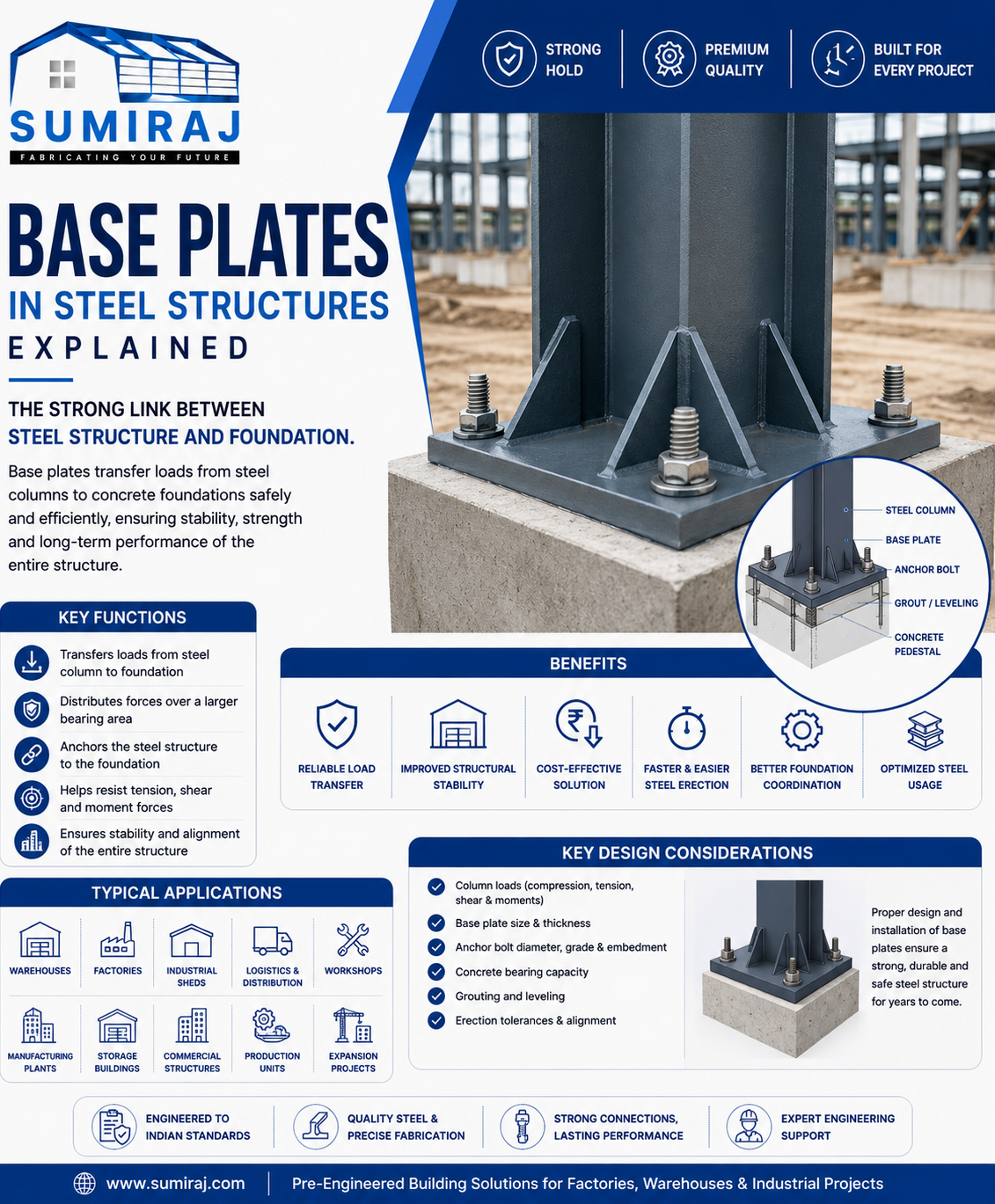
A base plate is a fabricated steel plate connected to the bottom of a structural steel column. It is generally supported on a concrete pedestal or foundation and works together with anchor bolts and other connection components.
The plate provides a larger bearing area than the column section alone. This helps distribute the forces from the steel column to the concrete below while maintaining a secure connection between the superstructure and foundation.
A typical steel column base may include:
Steel column
Base plate
Anchor bolts
Nuts and washers
Grout or bedding material
Concrete pedestal or foundation
The dimensions and thickness of the base plate are not universal. They depend on the forces in the column, column section, foundation arrangement, connection design, and applicable structural requirements.
How Do Base Plates Work?
The basic function of a base plate is to transfer forces from the steel column to the concrete foundation.
A column can transmit compression, tension, and shear, while moments may also develop at the column base depending on whether the connection is designed as nominally pinned, partially restrained, or moment-resisting.
The base plate spreads compressive forces over a larger area of concrete. Anchor bolts help secure the column assembly and can be particularly important where uplift, shear, or moment effects need to be resisted.
This makes the column base a critical transition point between the steel superstructure and civil foundation.
Load Transfer Through a Base Plate
Consider an industrial PEB frame subjected to wind. Wind pressure can create lateral forces and uplift in addition to the building's gravity loads. These forces travel through the primary frame and eventually reach the column bases.
The base plate and its connection must be capable of transferring the applicable combination of loads into the foundation without excessive bearing pressure, plate deformation, bolt distress, or connection failure.
This is why base plate design should be based on structural calculations rather than simply selecting a plate based on column dimensions.
Key Design Considerations for Base Plates
Column Loads
The first consideration is the forces delivered by the steel column. Compression, tension, shear, and bending moments influence the required plate dimensions, thickness, anchor bolts, and connection arrangement.
Plate Size and Thickness
A larger plate can provide a greater bearing area, while adequate thickness helps the plate resist bending under the applied load. The final dimensions must be established through engineering calculations.
Anchor Bolt Arrangement
Anchor bolts secure the steel column to the foundation and can resist relevant tension and shear forces. Their number, diameter, grade, spacing, embedment, and positioning should be coordinated with the foundation and base plate design.
Concrete Bearing
The interaction between the base plate and concrete pedestal is an important design consideration. The concrete must be capable of supporting the transferred forces within the applicable design limits.
Grouting and Leveling
Proper installation beneath the base plate is important for achieving the intended load transfer and alignment. Depending on the construction method, non-shrink grout may be used to fill the space beneath the plate and provide uniform bearing.
Erection Tolerances
Industrial buildings require accurate column positioning. Anchor bolt locations, base plate holes, column alignment, and foundation levels should be coordinated carefully before steel erection begins.
Benefits of Properly Designed Base Plates
Reliable Load Transfer
A correctly designed base plate provides a controlled path for transferring column forces into the foundation. This is fundamental to the stability of the entire steel structure.
Improved Structural Stability
The column base forms an important part of the building's overall stability system. Proper coordination between the base plate, anchor bolts, foundation, and primary frame helps the structure respond appropriately to design loads.
Efficient Use of Steel
Base plates should be strong enough for the required forces without being unnecessarily oversized. Engineering optimization can help balance plate dimensions, thickness, fabrication effort, and structural performance.
Easier Steel Erection
Accurately fabricated base plates with correctly positioned bolt holes can make column installation more straightforward. Better dimensional control also reduces the risk of alignment problems at the site.
Better Foundation Coordination
Base plate requirements directly influence the concrete pedestal and anchor bolt arrangement. Coordinating steel and civil designs early can reduce clashes and avoid costly site modifications.
Applications of Base Plates in PEB Structures
Base plates are used wherever steel columns transfer loads into concrete foundations. Common applications include:
Pre-engineered warehouses
Manufacturing plants
Industrial sheds
Logistics and distribution centers
Workshops
Storage facilities
Commercial steel buildings
Production and assembly units
Industrial expansion projects
For large warehouses, the column base must also be coordinated with operational requirements such as loading bays, floor levels, equipment, and internal circulation.
Base Plates for Industrial Buildings in Noida
Industrial projects in Noida may differ significantly in building span, height, wind exposure, usage, foundation conditions, and operational requirements. These factors can affect the forces acting at the column base.
For example, a high-bay warehouse with large openings may have different structural demands from a smaller manufacturing unit. Similarly, buildings with cranes, heavy equipment, or specialized operational loads require careful consideration of column reactions and foundation interfaces.
An experienced PEB manufacturer evaluates these requirements during engineering so that the base plate, anchor bolts, columns, and foundations function as one coordinated system.
Base Plate Installation: What Contractors Should Check
Good design must be supported by accurate site execution. Contractors should verify foundation levels and anchor bolt positions before installing steel columns.
The base plate should sit correctly on the prepared foundation interface, with appropriate leveling and grouting procedures followed according to the project specifications. Anchor bolts should be tightened as specified, and column plumbness should be checked before the structure progresses through erection.
Any significant deviation in anchor bolt location or foundation level should be addressed through proper engineering coordination rather than improvised modifications at site.
Why Choose Sumiraj for PEB Solutions?
Sumiraj understands that reliable PEB performance depends on the coordination of every major structural component, including column bases and foundation connections.
Engineering expertise: Base plates are designed in relation to column reactions, frame behaviour, anchor bolts, and foundation requirements.
Quality steel: Suitable structural steel and controlled fabrication processes help maintain dimensional consistency and component reliability.
Customized designs: Base plate dimensions, connection details, and anchor arrangements can be developed according to the project's structural and operational requirements.
Cost efficiency: Engineering-based optimization helps avoid unnecessary material while maintaining the required design capacity.
Timely delivery: Coordinated detailing and fabrication help ensure that base plates and associated steel components are available according to the planned erection sequence.
Indian standards: Structural design and detailing are developed with applicable Indian Standards and project-specific requirements in consideration.
Technical support: Sumiraj can support coordination between clients, consultants, contractors, fabrication teams, and site personnel throughout the project lifecycle.
Frequently Asked Questions About Base Plates in Steel Structures
1. What is the purpose of a base plate in a steel structure?
A base plate connects a steel column to its concrete foundation and distributes the column forces over an appropriate bearing area. It also works with anchor bolts to secure the column base.
2. Are base plates used in PEB buildings?
Yes. Steel columns in PEBs are typically connected to concrete foundations through engineered column base assemblies that include base plates and anchor bolts.
3. How is base plate thickness determined?
Base plate thickness depends on factors such as column loads, bending moments, plate dimensions, concrete bearing conditions, and the connection arrangement. It should be established through structural design calculations.
4. What are anchor bolts used for with base plates?
Anchor bolts secure the steel column to the foundation and can transfer relevant tension and shear forces. Their design depends on the structural forces and type of column-base connection.
5. Why is grouting required below a base plate?
Grouting can provide uniform bearing between the underside of the base plate and the concrete foundation, helping achieve the intended load-transfer condition and maintain proper column alignment.
6. Can base plates be customized?
Yes. Base plates are designed according to the column section, structural reactions, foundation configuration, anchor bolt arrangement, and project-specific requirements.
Conclusion
Base plates in steel structures are small compared with the overall building, but their structural role is fundamental. They provide the critical interface through which steel column forces are transferred safely into concrete foundations. Proper plate sizing, anchor bolt design, concrete bearing, connection detailing, and installation all contribute to dependable structural performance.
For factories, warehouses, and industrial facilities in Noida, a well-coordinated PEB design should address the column base from the early engineering stage. With its focus on engineering expertise, quality steel, customized solutions, and technical coordination, Sumiraj can help industrial businesses develop practical and efficient PEB solutions suited to their project requirements.
Discuss Your Project
Planning a factory, warehouse, logistics facility, or industrial steel building? Contact Sumiraj via WhatsApp or phone to discuss your project requirements and explore the right PEB solution for your structure.
Subscribe to our updates and stay informed about the latest trends, innovations, and cost-saving solutions in PEB construction, industrial buildings, and warehouse development.