
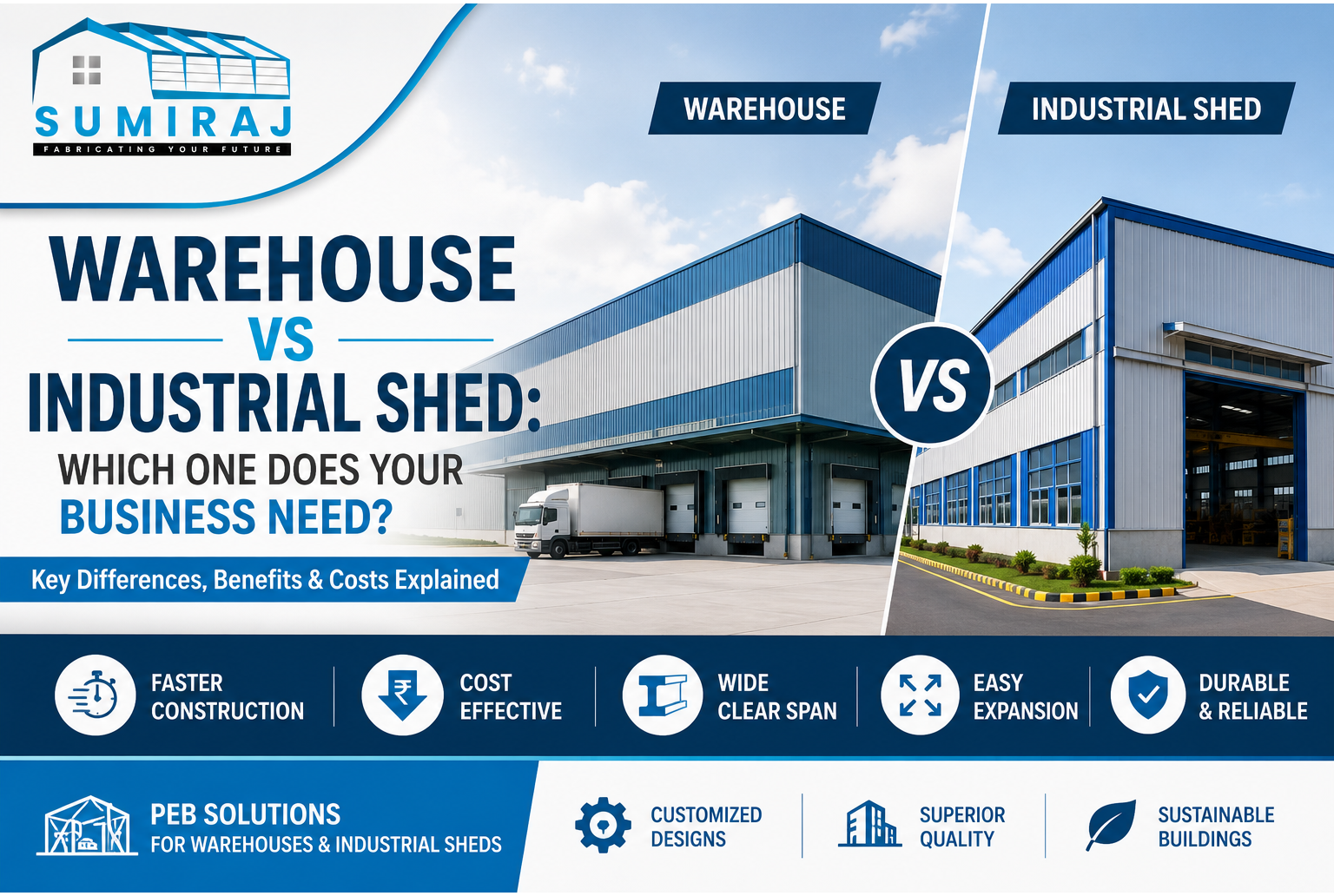
Warehouse vs Industrial Shed: Which One Does Your Business Need?
As India's manufacturing, logistics, e-commerce, and infrastructure sectors continue to expand, businesses are increasingly investing in industrial facilities to support their operations. However, one question frequently arises before construction begins:
Should you build a warehouse or an industrial shed?
Although these terms are often used interchangeably, they serve different purposes. Each structure has unique design requirements, operational advantages, and cost implications. Choosing the wrong facility can affect productivity, increase operational costs, and create challenges when expanding in the future.
For factory owners, warehouse developers, industrial investors, logistics companies, and contractors, understanding the difference between a warehouse and an industrial shed is essential before making a construction investment.
Today, both warehouses and industrial sheds are increasingly being built using Pre-Engineered Building (PEB) technology due to its cost-effectiveness, speed of construction, flexibility, and long-term durability.
In this comprehensive guide, we compare warehouses and industrial sheds, discuss their applications, benefits, costs, and help you determine which option best suits your business needs.
What Is a Warehouse?
A warehouse is a building specifically designed for storing, managing, and distributing goods.
The primary purpose of a warehouse is inventory management. Products are received, stored, organized, and dispatched whenever required.
Warehouses are essential for businesses involved in supply chain management and logistics operations.
Common Uses of Warehouses
Inventory storage
E-commerce fulfillment
Distribution centers
Logistics operations
Retail stock management
Cold storage facilities
Spare parts storage
Industries That Commonly Use Warehouses
E-commerce companies
Logistics providers
FMCG businesses
Pharmaceutical companies
Retail chains
Agriculture and food storage companies
What Is an Industrial Shed?
An industrial shed is a structure designed primarily for manufacturing, fabrication, processing, assembly, or industrial operations.
Unlike warehouses, industrial sheds accommodate machinery, production lines, workers, and industrial equipment.
The focus is on production efficiency rather than storage capacity.
Common Uses of Industrial Sheds
Manufacturing facilities
Fabrication workshops
Engineering plants
Automobile component manufacturing
Food processing units
Packaging industries
Textile production facilities
Industries That Commonly Use Industrial Sheds
Engineering companies
Steel fabrication businesses
Automobile manufacturers
Food processing industries
Packaging companies
Industrial equipment manufacturers
Warehouse vs Industrial Shed: Key Differences
1. Purpose
Warehouse
The primary purpose of a warehouse is storing goods and managing inventory.
Products arrive, remain stored for a period, and are dispatched when needed.
Industrial Shed
The primary purpose is production and manufacturing.
Raw materials enter the facility and are converted into finished products.
2. Internal Layout
Warehouse Layout
Warehouse designs focus on:
Storage racks
Loading docks
Wide aisles
Material handling equipment
Forklift movement
The objective is to maximize storage efficiency.
Industrial Shed Layout
Industrial sheds focus on:
Production lines
Machinery placement
Worker movement
Utility infrastructure
Material flow
The objective is to maximize operational efficiency.
3. Floor Load Requirements
Warehouses generally require flooring capable of supporting:
Inventory loads
Storage racks
Material handling equipment
Industrial sheds often require stronger flooring because of:
Heavy machinery
Industrial equipment
Manufacturing operations
Overhead crane systems
4. Utility Requirements
Warehouses
Typically require:
Lighting systems
Ventilation
Fire safety systems
Loading and unloading facilities
Industrial Sheds
Usually require:
Heavy electrical infrastructure
Compressed air systems
Process-specific utilities
Ventilation systems
Machinery support systems
5. Workforce Requirements
Warehouses generally employ personnel involved in:
Inventory management
Logistics operations
Material handling
Industrial sheds require:
Machine operators
Production staff
Supervisors
Technical personnel
Can a Warehouse and Industrial Shed Be Combined?
Yes.
Many modern businesses require both manufacturing and storage operations under one roof.
Examples include:
Food processing facilities
Packaging units
E-commerce assembly centers
Engineering manufacturing plants
Automobile component manufacturers
A customized PEB building can efficiently accommodate both functions within a single structure.
This flexibility makes PEB construction highly attractive for growing businesses.
Why PEB Structures Are Preferred for Warehouses and Industrial Sheds
Across India, PEB construction is rapidly replacing conventional RCC construction for industrial projects.
Here are the key reasons.
Faster Construction
PEB components are manufactured in a controlled factory environment and assembled on-site.
This significantly reduces project timelines.
A project that may take several months longer using conventional RCC construction can often be completed much faster with a PEB structure.
Faster completion means businesses can start operations sooner and generate revenue earlier.
Lower Construction Cost
PEB structures help reduce construction costs through:
Optimized steel usage
Reduced material wastage
Lower labor requirements
Faster installation
Reduced foundation costs
For industrial projects, these savings can be substantial.
Large Column-Free Spaces
Warehouses and industrial sheds require maximum usable space.
PEB structures can achieve large clear spans without multiple internal columns.
Benefits include:
Better storage capacity
Easier forklift movement
Improved production flow
Efficient machinery placement
Easy Future Expansion
Business requirements often change over time.
PEB structures are designed for scalability.
Additional bays and extensions can be added with minimal disruption, making expansion easier and more economical.
Better Quality Control
Since most components are manufactured in factories, quality remains consistent throughout the project.
Benefits include:
Precise fabrication
Better structural performance
Reduced construction errors
Reliable project outcomes
Improved Sustainability
Steel is one of the most recyclable construction materials available.
PEB construction generates less waste compared to traditional methods and supports sustainable industrial development.
Cost Considerations: Warehouse vs Industrial Shed
Many investors ask whether warehouses are cheaper than industrial sheds.
The answer depends on multiple factors.
Building Size
Larger buildings often achieve lower construction costs per square foot due to economies of scale.
Intended Usage
Industrial sheds may require:
Heavy-duty flooring
Machinery foundations
Crane systems
Additional utilities
These requirements can increase project costs.
Warehouses may require:
Storage racking systems
Docking stations
Material handling infrastructure
Actual costs depend on operational needs.
Location
Construction costs vary across India based on:
Land prices
Labor availability
Transportation costs
Local regulations
Industrial corridors and metropolitan regions may have higher development costs.
Expansion Plans
Businesses expecting future growth should consider expansion during the design stage.
PEB structures make future expansion significantly more cost-effective compared to conventional construction.
Real-World Examples from India
Example 1: E-Commerce Fulfillment Center
An e-commerce company serving North India requires inventory storage, order sorting, packaging, and dispatch operations.
A warehouse is the ideal solution because storage and logistics are the primary functions.
Example 2: Steel Fabrication Facility
A fabrication company requires machinery, overhead cranes, production areas, and raw material storage.
An industrial shed is the better choice because manufacturing activities are central to operations.
Example 3: Food Processing Plant
A food processing company needs production space along with finished goods storage.
A customized PEB facility can successfully combine warehouse and industrial shed functions under one roof.
Example 4: Automobile Component Manufacturer
An automotive supplier requires assembly lines, machinery, worker areas, and inventory storage.
A PEB industrial shed provides flexibility, scalability, and operational efficiency.
Benefits of Choosing the Right Structure
Selecting the correct facility type provides several advantages.
Improved Operational Efficiency
The right design supports smoother daily operations and better workflow.
Better Space Utilization
Facilities can be optimized according to actual business requirements.
Reduced Operating Costs
Efficient layouts lower handling, maintenance, and operational expenses.
Faster Business Growth
Scalable facilities support future expansion without major reconstruction.
Higher Return on Investment
Proper planning improves productivity and accelerates profitability.
Warehouse vs Industrial Shed: Quick Comparison
| Parameter | Warehouse | Industrial Shed |
|---|---|---|
| Primary Purpose | Storage & Distribution | Manufacturing & Production |
| Machinery Usage | Limited | Extensive |
| Floor Load Requirement | Moderate | High |
| Utility Infrastructure | Basic | Advanced |
| Internal Layout | Storage-Oriented | Production-Oriented |
| Workforce Requirement | Moderate | Higher |
| Expansion Potential | High | High |
| Preferred Construction Method | PEB | PEB |
Frequently Asked Questions (FAQs)
What is the main difference between a warehouse and an industrial shed?
A warehouse is designed for storage and distribution, while an industrial shed is designed for manufacturing, processing, fabrication, or production activities.
Which is more cost-effective?
The answer depends on operational requirements. Warehouses may require less utility infrastructure, while industrial sheds may require additional systems for production operations.
Can PEB buildings be used for both warehouses and industrial sheds?
Yes. PEB structures can be customized for storage, manufacturing, or a combination of both functions.
Why are PEB warehouses becoming popular in India?
PEB warehouses offer faster construction, lower costs, easy expansion, and large clear-span spaces that improve storage efficiency.
Are industrial sheds suitable for future expansion?
Yes. PEB industrial sheds are specifically designed to accommodate future growth and expansion.
Which option is best for a manufacturing business?
Most manufacturing businesses benefit from industrial sheds because they provide adequate space for machinery, production lines, utilities, and workforce operations.
Conclusion
Choosing between a warehouse and an industrial shed depends entirely on your business operations. If your primary requirement is inventory storage, distribution, and logistics management, a warehouse is the ideal solution. If your focus is manufacturing, processing, fabrication, or production activities, an industrial shed is typically the better choice.
In many cases, businesses benefit from a customized facility that combines both functions under one roof. This is where PEB construction provides a significant advantage. With faster construction, lower costs, superior flexibility, large clear spans, and easy future expansion, PEB structures have become the preferred choice for warehouses and industrial sheds across India.
Whether you are planning a logistics hub, manufacturing plant, e-commerce fulfillment center, or industrial facility, investing in the right PEB solution can improve operational efficiency, reduce long-term costs, and support future business growth.