
Introduction
India's manufacturing, logistics, and e-commerce sectors are experiencing rapid growth, creating a strong demand for modern warehouses and industrial facilities. Whether you are a factory owner, warehouse developer, logistics company, industrial investor, or contractor, understanding warehouse construction costs is essential before starting a project.
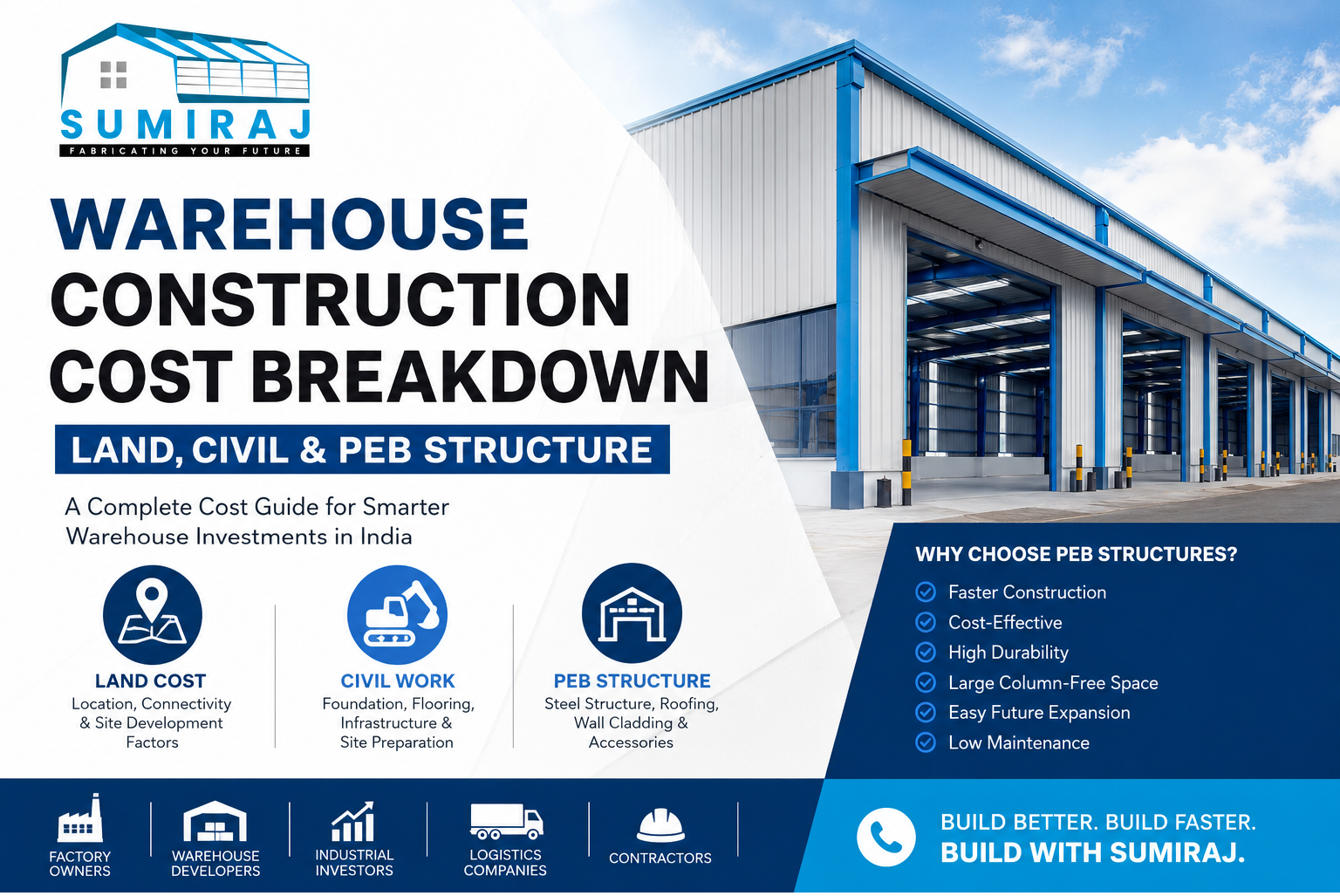
A warehouse project generally consists of three major cost components:
Land Cost
Civil Construction Cost
PEB Structure Cost
Today, most industrial developers prefer Pre-Engineered Building (PEB) solutions because they offer faster construction, lower maintenance requirements, and better long-term value than conventional RCC construction.
This guide provides a detailed breakdown of warehouse construction costs and explains why PEB structures have become the preferred choice for industrial and logistics developments across India.
Understanding Warehouse Construction Costs
Warehouse construction costs vary based on location, soil conditions, building size, specifications, and operational requirements.
A typical warehouse project involves:
Land acquisition
Site development
Civil foundation work
PEB construction
Roofing and wall cladding
Industrial flooring
Utilities and infrastructure
Finishing works
Each component contributes differently to the overall project budget.
Land Cost: The First Major Investment
Land acquisition is often the largest expense in warehouse development.
Factors Affecting Land Cost
1. Location
Land prices vary significantly across India.
Examples include:
Delhi NCR industrial zones
Mumbai logistics corridors
Chennai industrial belts
Pune manufacturing hubs
Ahmedabad industrial parks
Warehouses located near highways, ports, airports, and industrial corridors generally command higher land prices due to superior connectivity.
2. Connectivity
Sites located near:
National highways
Dedicated freight corridors
Railway terminals
Inland container depots
offer better logistics efficiency and long-term operational advantages.
3. Zoning and Approvals
Industrial land with proper approvals and zoning can significantly reduce project delays and compliance costs.
4. Site Development Requirements
A challenging site of construction may require:
Land leveling
Earth filling
Soil stabilization
Drainage development
These activities increase costs before actual construction begins.
Civil Construction Cost
Civil work forms the foundation of every warehouse project.
Although a PEB building uses less concrete than conventional structures, civil work remains a significant cost component.
Major Civil Cost Components
Site Preparation
This includes:
Excavation
Filling
Compaction
Site grading
Foundation Work
The foundation design depends on:
Soil bearing capacity
Building dimensions
Crane requirements
Wind load conditions
Plinth and Flooring
Industrial floors are designed to support:
Forklifts
Heavy machinery
Storage racks
Container handling operations
High-quality flooring improves warehouse productivity and durability.
Drainage and Infrastructure
Additional civil costs may include:
Stormwater drainage
Utility trenches
Internal roads
Parking areas
Boundary walls
For many projects, civil work accounts for approximately 20%–35% of the total warehouse construction budget.
PEB Structure Cost Breakdown
The PEB structure is the backbone of a modern warehouse.
A Pre-Engineered Building is manufactured using factory-fabricated steel components that are assembled at the construction site.
Unlike conventional construction, where structural members are fabricated on-site, pre engineered buildings are precision-designed and manufactured under controlled conditions.
Components of a PEB Structure
Primary Steel Members
These include:
Columns
Rafters
End frames
They carry the primary structural loads.
Secondary Members
These include:
Purlins
Girts
Eave struts
They provide support to roofing and cladding systems.
Roofing System
Modern warehouses commonly use:
Galvalume sheets
Insulated roofing panels
Sandwich panels
Wall Cladding
Quality wall cladding improves:
Building appearance
Weather resistance
Thermal performance
Energy efficiency
Fasteners and Accessories
These include:
Bolts
Bracings
Flashings
Gutters
Downpipes
Typical PEB Construction Cost Factors
Several factors influence PEB construction costs.
Building Span
Larger clear spans require heavier structural sections.
Common warehouse spans include:
20 meters
30 meters
40 meters
60 meters
Building Height
Higher structures require stronger framing systems and increased steel consumption.
Wind Load Requirements
Warehouses in coastal and high-wind regions often require additional structural strengthening.
Crane Systems
Industrial facilities equipped with EOT cranes require specially designed structures and foundations.
Roofing and Cladding Specifications
Premium roofing and wall cladding systems increase initial costs but provide long-term savings through improved durability and energy performance.
Why PEB Structures Are Preferred Over Conventional Construction
Modern industries increasingly choose PEB structures instead of traditional RCC buildings.
Faster Construction
A Pre-Engineered Building (PEB) can be completed significantly faster than conventional construction.
Because components are pre-manufactured, installation at the construction site is quick and efficient.
Many industrial buyers searching for a pre engg building solution ultimately choose modern PEB systems because of their speed and cost efficiency.
Lower Project Cost
Reduced labor requirements and shorter project timelines help lower overall construction costs.
Better Quality Control
Factory fabrication ensures:
Consistent quality
Accurate dimensions
Superior structural reliability
This is where precision engineering plays a critical role.
Large Column-Free Spaces
Warehouses benefit from clear-span designs that maximize storage and operational efficiency.
Easy Expansion
Future expansion is simpler with a pre structured building approach, allowing additional bays to be added with minimal disruption.
Lower Maintenance
Modern steel structures require less maintenance than conventional construction methods, resulting in lower lifecycle costs.
The Role of Steel Structures in Industrial Development
India's industrial growth depends heavily on efficient steel structures.
A modern steel company uses advanced manufacturing technologies to produce:
Structural steel members
Roofing systems
Cladding systems
Industrial building components
The use of industrial steel enables engineers to design stronger, lighter, and more efficient structures.
As a result, industrial facilities achieve:
Better structural performance
Faster construction schedules
Greater design flexibility
Improved lifecycle value
The term steel industrial is also commonly used in online searches related to industrial steel building solutions.
Cost Comparison: PEB vs Conventional Construction
Conventional Construction
Common challenges include:
Longer construction timelines
Higher labor costs
Increased material wastage
Greater maintenance requirements
Limited flexibility for expansion
PEB Building Construction
Key advantages include:
Faster project completion
Lower overall costs
Better quality control
Easier future expansion
Sustainable construction practices
For warehouse projects, the total lifecycle cost of a PEB building is often significantly lower than that of conventional construction.
Example: Warehouse Construction Cost in India
Consider a 50,000 sq. ft. warehouse project.
A typical cost distribution may be:
Land Cost
30%–50% of total investment
Civil Work
20%–35% of total investment
PEB Structure
25%–40% of total investment
Utilities and Miscellaneous
5%–15% of total investment
Actual costs vary depending on:
Location
Soil conditions
Design specifications
Material selections
Project timelines
Benefits of Choosing a Professional PEB Manufacturer
Selecting an experienced PEB manufacturer provides several advantages.
End-to-End Project Support
From design and manufacturing to erection and commissioning, professional teams manage every stage of the project.
Engineering Expertise
Advanced structural engineering and architectural planning ensure optimal performance, safety, and long-term durability.
Custom Design Solutions
Every warehouse has unique operational requirements.
Professional manufacturers develop customized solutions based on:
Storage capacity
Material handling systems
Logistics operations
Future expansion plans
Reduced Project Risk
Experienced contractors help minimize:
Construction delays
Design errors
Material wastage
Budget overruns
How Sumiraj Delivers High-Performance PEB Solutions
At Sumiraj, we specialize in delivering high-quality Pre-Engineered Building (PEB) solutions for warehouses, factories, logistics centers, and industrial facilities.
Our capabilities include:
Design and engineering
Manufacturing of steel structures
Roofing systems
Wall cladding solutions
Project management
Installation support
By combining advanced technology, precision engineering, and industry expertise, we help clients achieve faster project completion and better returns on investment.
Frequently Asked Questions (FAQs)
What is a PEB building?
A PEB building is a factory-fabricated steel structure designed and manufactured before being assembled at the construction site.
Is a Pre-Engineered Building cheaper than conventional construction?
In most industrial applications, yes. A Pre-Engineered Building typically offers lower lifecycle costs and faster construction.
How long does PEB construction take?
Depending on project size and specifications, PEB construction can be completed significantly faster than conventional building methods.
Are steel structures durable?
Yes. Modern steel structures are engineered for long-term performance and can withstand demanding industrial environments.
Can a warehouse be expanded later?
Yes. One of the major advantages of a Pre-Engineered Building is its ability to accommodate future expansion with minimal disruption.
What affects warehouse construction costs the most?
Major factors include:
Land cost
Civil work requirements
Building dimensions
Roofing specifications
Wall cladding systems
Location-specific regulations
Material selection
Conclusion
Understanding the complete warehouse construction cost breakdown is essential for making informed investment decisions. Land acquisition, civil work, and the PEB structure each contribute significantly to the overall project budget.
For modern warehouses, factories, and logistics facilities, Pre-Engineered Buildings (PEB) offer clear advantages over conventional construction methods. Faster project execution, lower maintenance costs, superior quality control, and future expansion flexibility make PEB structures the preferred choice across India's industrial sector.
At Sumiraj, we specialize in designing and manufacturing high-performance PEB solutions tailored to industrial, commercial, and logistics requirements. Our expertise in steel structures, wall cladding systems, and precision engineering helps clients complete projects faster while maximizing return on investment.
Contact Sumiraj
Phone: +91-7065539408
Email: info@sumiraj.com
Planning a warehouse, factory, or logistics facility? Contact Sumiraj today for a customized PEB solution and a detailed project cost estimate.