
PEB Construction Process: Step-by-Step Guide
Introduction
This guide explains the complete PEB construction process step-by-step, including design, fabrication, and erection. Pre-Engineered Buildings (PEBs) offer faster, cost-effective, and durable construction solutions for modern industrial needs.
In today’s fast-paced environment, delays in construction directly impact business operations and profitability. This is why industries are shifting towards PEB structures.
At Sumiraj, we follow a structured and engineering-driven approach to deliver high-quality PEB buildings with precision and speed.
What Is a Pre-Engineered Building (PEB)?
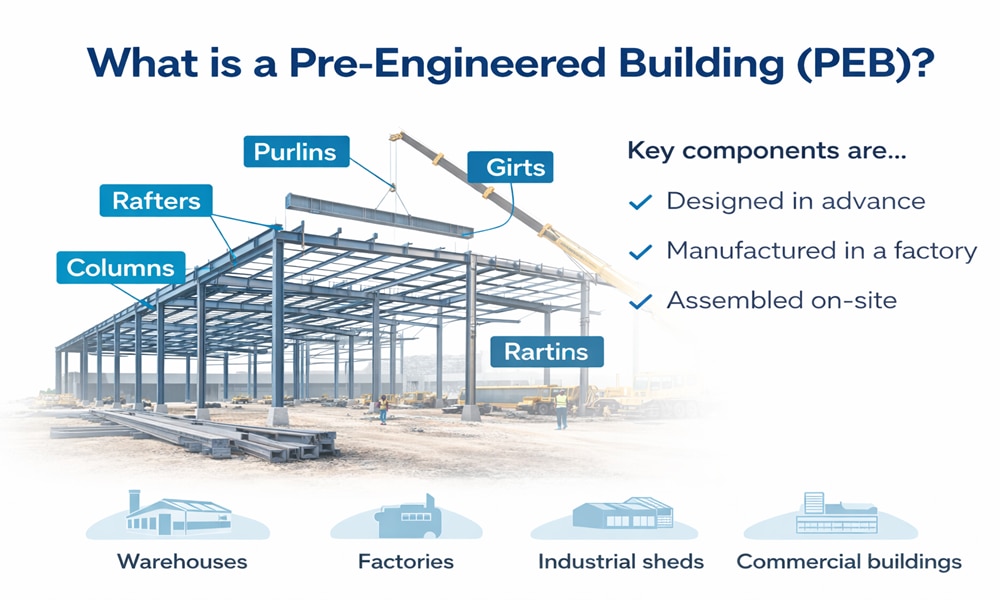
A Pre-Engineered Building (PEB) is a steel structure where components are:
- Pre-designed using advanced engineering
- Manufactured in a factory
- Assembled efficiently at the site
Key Advantages
- Faster construction
- Lower cost
- High durability
- Easy expansion
Applications
Warehouses | Factories | Industrial Sheds | Commercial Buildings
Step-by-Step PEB Construction Process
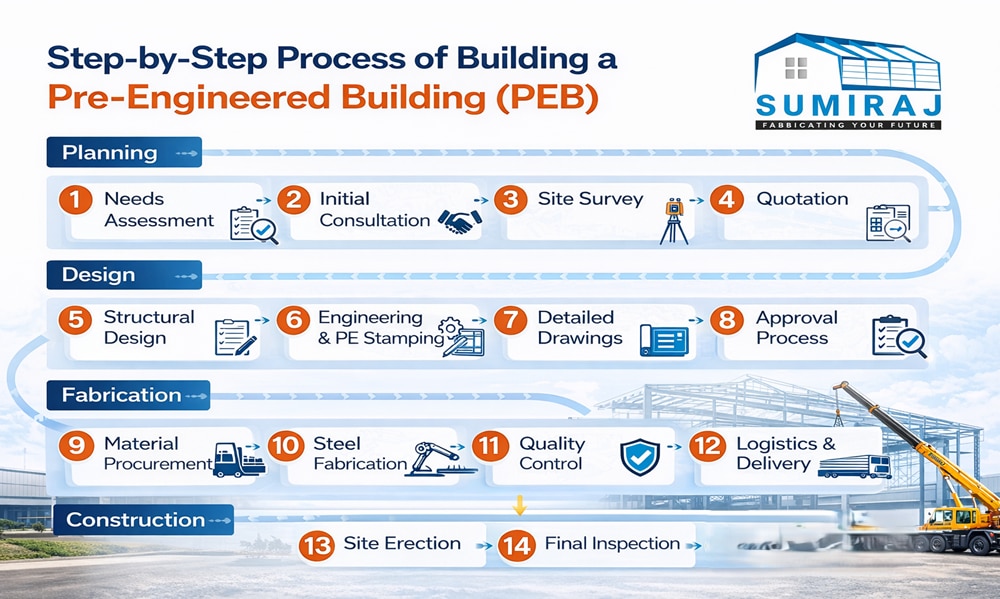
1. Requirement Analysis
We understand:
- Building purpose
- Size, span, and height
- Load requirements
- Future expansion needs
Outcome: Design aligned with business requirements.
2. Site Study
We evaluate:
- Soil condition
- Accessibility
- Drainage
- Environment
Outcome: Safe and efficient planning.
3. Concept Design
We prepare:
- Layout planning
- Column spacing
- Roof structure
Outcome: Optimized building layout.
4. Engineering Design
This is the core stage where we finalize:
- Structural design
- Load calculations
- Connection detailing
Outcome: Strong and cost-efficient structure.
5. Approval & Finalization
We provide:
- Layout drawings
- Anchor bolt plans
- Structural details
Outcome: Clear execution plan.
6. Fabrication
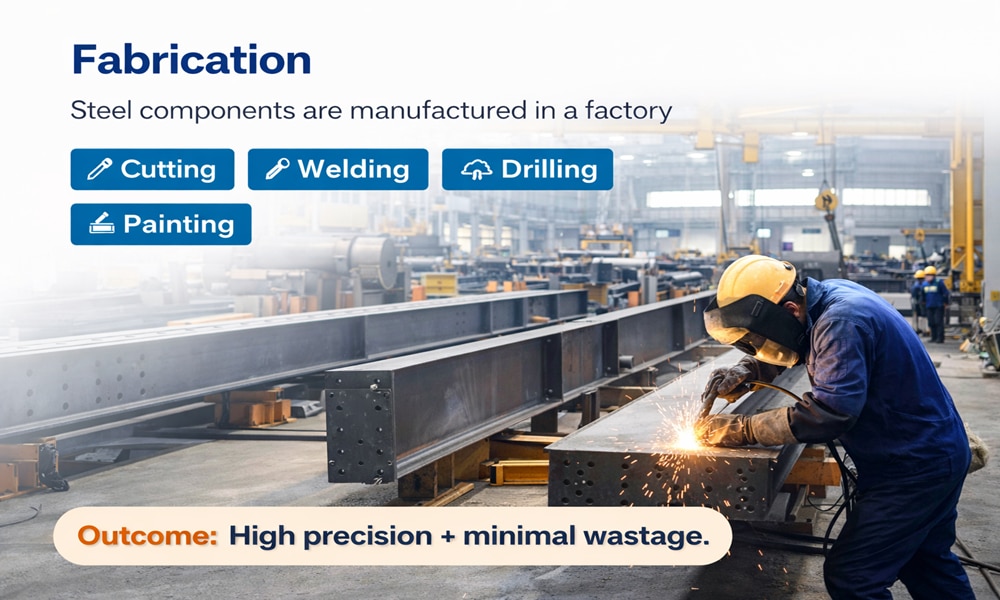
Manufacturing in factory includes:
- Cutting
- Welding
- Drilling
- Painting
Outcome: High precision with minimal wastage.
7. Quality Check
Inspection of:
- Dimensions
- Weld quality
- Coating
Outcome: Reliable components.
8. Foundation Work
Parallel execution:
- Excavation
- RCC work
- Anchor bolts
Outcome: Time-saving execution.
9. Transportation
Materials are delivered with:
- Proper sequencing
- Damage protection
Outcome: Smooth site workflow.
10. Erection
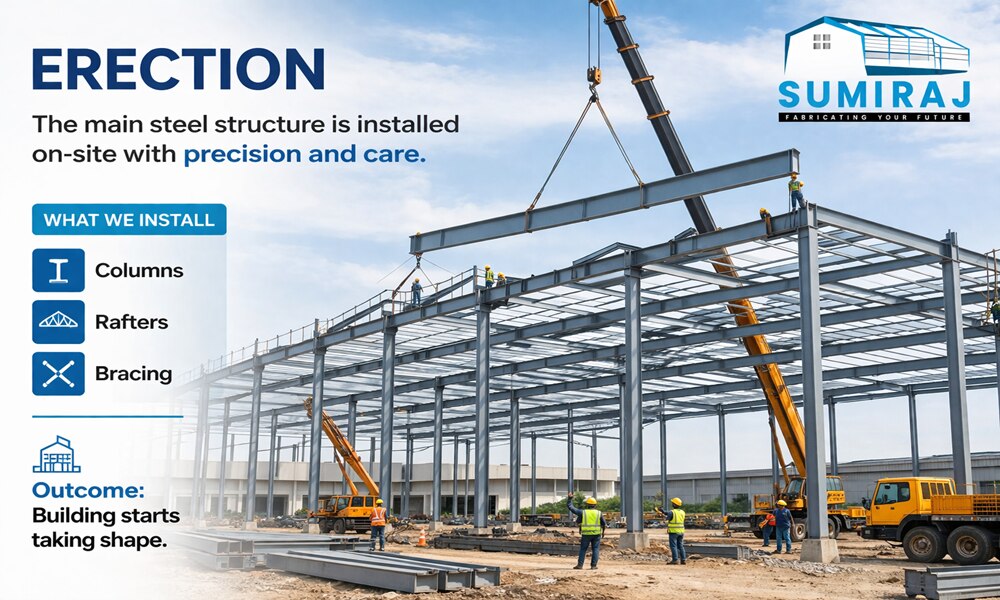
Installation of:
- Columns
- Rafters
- Bracing
Outcome: Structure takes shape.
11. Secondary Members
Includes:
- Purlins
- Girts
Outcome: Structural stability.
12. Cladding & Roofing
- Roof sheets
- Wall panels
- Insulation
Outcome: Fully enclosed building.
13. Finishing
Final additions:
- Doors and windows
- Ventilators
- Mezzanine
Outcome: Ready-to-use facility.
14. Handover
Final inspection:
- Alignment
- Fastening
- Finishing
Outcome: Project ready for operations.
Why Choose PEB Construction?
✔ Faster project completion
✔ Better cost control
✔ High-quality construction
✔ Easy future expansion
Start early = Better ROI
Real Example
For a 25,000 sq. ft. warehouse:
- PEB: 10–12 weeks
- Conventional: 5–7 months
👉 Result: Business starts months earlier.
FAQs
1. What is PEB construction?
It is a method where steel buildings are designed, fabricated, and assembled efficiently.
2. Why is PEB faster?
Because fabrication and foundation work happen simultaneously.
3. Can PEB be expanded?
Yes, expansion is easy.
4. Where is PEB used?
Warehouses, factories, industrial sheds, and commercial buildings.
5. How long does it take?
Typically 40–60% faster than conventional construction.
Conclusion
The PEB construction process is designed for speed, efficiency, and performance. It helps businesses reduce construction time, control costs, and start operations faster.
For modern industrial projects, PEB is not just an option—it is a smart investment.
Get Expert Consultation
Planning a warehouse, factory, or industrial shed?
Partner with Sumiraj for reliable and customized PEB solutions.
