
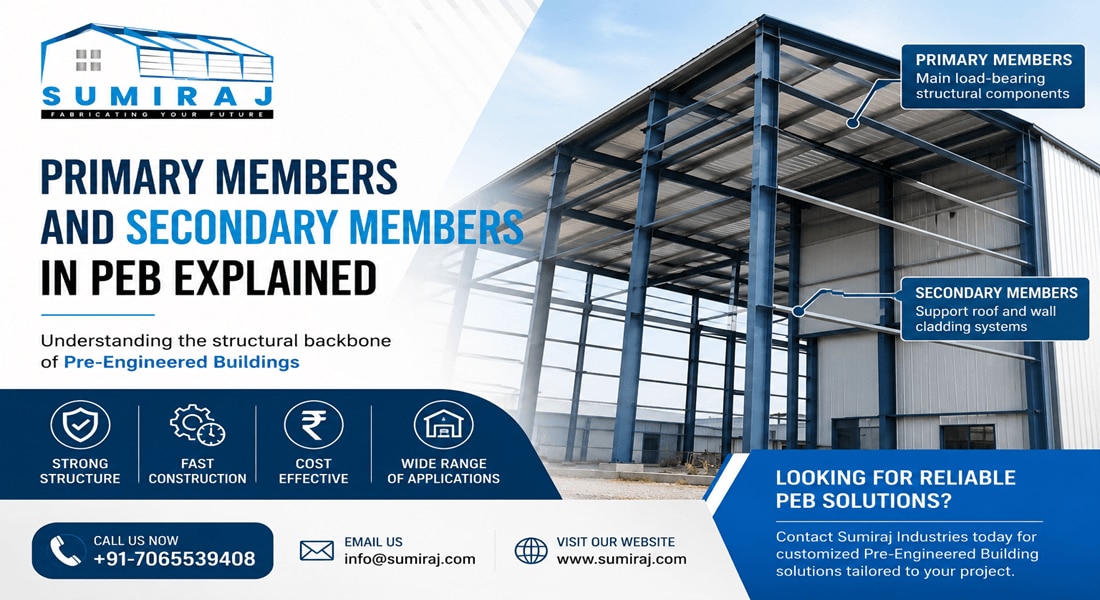
Primary Members and Secondary Members in PEB Explained
Understanding Primary and Secondary Members in Pre-Engineered Buildings (PEB)
The demand for Pre-Engineered Buildings (PEB) is increasing rapidly across industrial, commercial, and warehouse construction projects due to their speed, durability, flexibility, and cost efficiency.
However, many clients, contractors, and engineers often get confused between Primary Members and Secondary Members in a PEB structure.
Understanding these components is essential because both play a critical role in the strength, stability, and performance of a steel building system.
In this blog, we will explain:
- What primary members are in PEB
- What secondary members are in PEB
- Their functions and applications
- Key differences between them
- Why both are important in industrial building construction
What Are Primary Members in PEB?
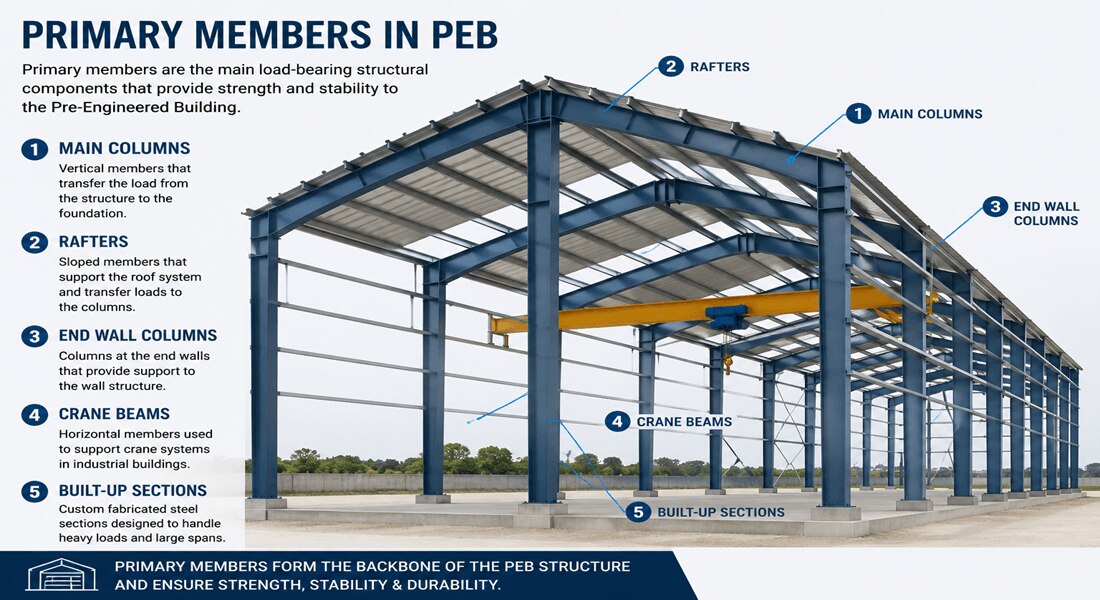
Primary members are the main load-bearing structural elements of a Pre-Engineered Building.
These members carry the major structural loads and transfer them safely to the building foundation.
Main Functions of Primary Members
- Support the complete building framework
- Carry dead loads and live loads
- Resist wind and seismic forces
- Transfer structural loads to foundations
- Maintain overall structural stability
Common Primary Members in PEB
1. Main Columns
Vertical structural members that transfer building loads to the foundation.
2. Rafters
Roof-supporting members connected to columns.
3. End Wall Columns
Provide support to end-wall framing systems.
4. Crane Beams
Used in industrial buildings with EOT cranes.
5. Built-Up Sections
Fabricated steel sections designed for optimized load distribution.
Materials Used for Primary Members
Primary members are generally manufactured using:
- High-strength steel plates
- Welded built-up sections
- Tapered steel sections
Advantages of Primary Members
- High structural strength
- Efficient steel utilization
- Better load management
- Suitable for large-span industrial sheds
- Enhanced building durability
What Are Secondary Members in PEB?
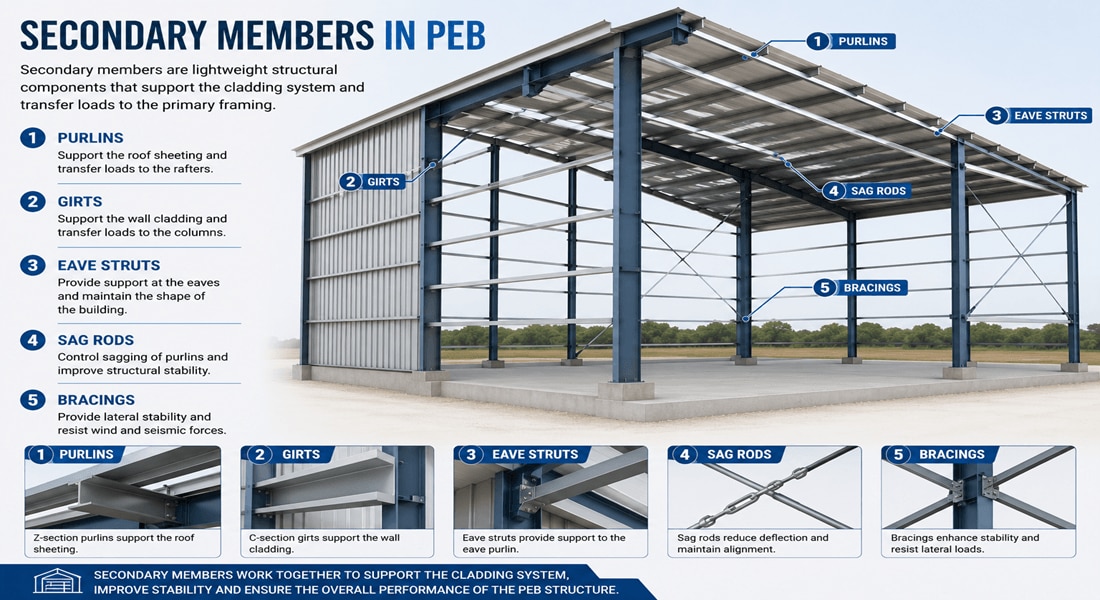
Secondary members are lightweight structural components that support roof and wall cladding systems while transferring loads to the primary framing system.
Although they do not carry the main building load, they are essential for maintaining structural integrity and alignment.
Main Functions of Secondary Members
- Support roofing and wall sheets
- Transfer localized loads
- Improve lateral stability
- Prevent buckling in primary members
- Strengthen the overall PEB framework
Common Secondary Members in PEB
1. Purlins
Support roof sheeting and distribute roof loads.
2. Girts
Horizontal members used to support wall cladding.
3. Eave Struts
Located at roof edges for additional support.
4. Sag Rods
Improve alignment and structural stiffness.
5. Bracings
Provide lateral support and improve stability.
Materials Used for Secondary Members
Secondary members are usually manufactured using:
- Cold-formed steel sections
- Z-sections
- C-sections
Advantages of Secondary Members
- Lightweight construction
- Faster installation
- Reduced structural weight
- Cost-effective support system
- Improved structural efficiency
Difference Between Primary Members and Secondary Members in PEB
| Basis | Primary Members | Secondary Members |
|---|---|---|
| Function | Main load-bearing structure | Supportive structural components |
| Load Capacity | Carries major structural loads | Carries localized loads |
| Section Size | Heavy steel sections | Lightweight steel sections |
| Material Type | Built-up steel sections | Cold-formed steel sections |
| Examples | Columns, Rafters | Purlins, Girts |
| Importance | Main structural stability | Load transfer and support |
Why Both Primary and Secondary Members Are Important
A well-designed PEB structure depends on the proper coordination between primary and secondary members.
Primary members provide the main structural strength, while secondary members ensure proper support for roofing and cladding systems.
Problems Caused by Weak Secondary Members
- Roof sheet failure
- Uneven load transfer
- Reduced structural stability
- Increased maintenance issues
Problems Caused by Weak Primary Members
- Structural deformation
- Safety risks
- Foundation stress
- Reduced building lifespan
For a durable and efficient industrial building, both systems must be properly designed and fabricated.
Applications of PEB Structures
PEB systems with optimized primary and secondary members are widely used in:
- Industrial Sheds
- Warehouses
- Manufacturing Units
- Logistics Parks
- Commercial Buildings
- Poultry Farms
- Cold Storage Facilities
- Factory Buildings
- Agricultural Structures
Why Choose Sumiraj Industries for PEB Solutions?
At Sumiraj Industries, we specialize in high-quality Pre-Engineered Building (PEB) solutions for industrial and commercial projects.
Our Expertise Includes
- Industrial Shed Construction
- Warehouse PEB Solutions
- Structural Steel Fabrication
- Custom PEB Design
- Turnkey PEB Projects
Why Clients Choose Us
- High structural quality standards
- Cost-effective PEB solutions
- Fast project execution
- Experienced technical team
- Durable steel structures
- Customized industrial building solutions
Contact Sumiraj Industries Pvt Ltd
Looking for reliable and cost-effective PEB structure solutions for your next industrial project?
Get in Touch
- Phone: +91-7065539408
- Email: info@sumiraj.com
- Website: www.sumiraj.com
Contact our team today for customized Pre-Engineered Building solutions tailored to your project requirements.
