
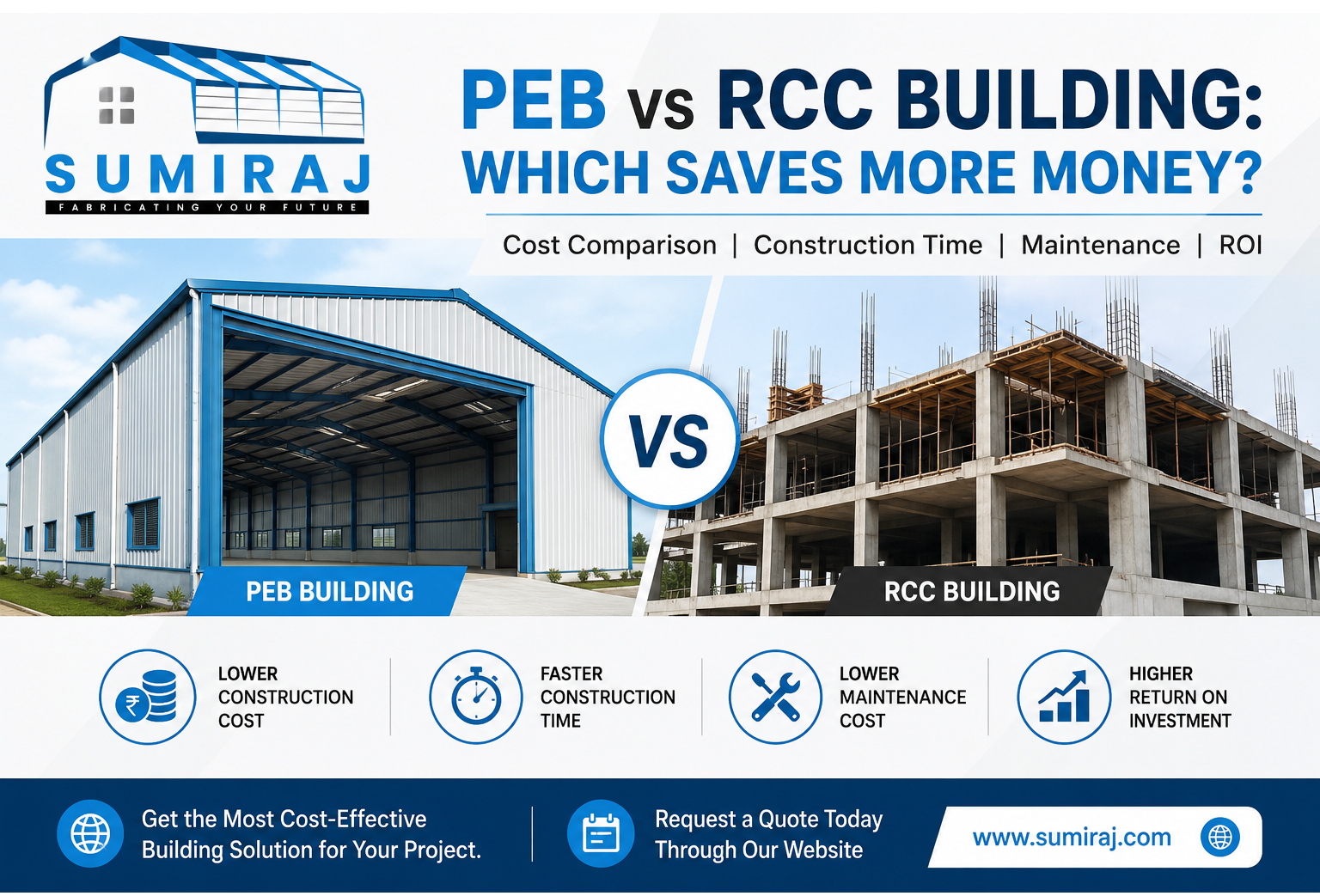
PEB vs RCC Building: Which Saves More Money?
When planning an industrial, warehouse, factory, commercial, or logistics project, one of the most important decisions is choosing between a Pre-Engineered Building (PEB) and a Reinforced Cement Concrete (RCC) structure.
While both construction methods have their advantages, the biggest concern for most project owners is simple:
Which option saves more money?
The answer depends on factors such as construction cost, project timeline, maintenance expenses, future expansion requirements, and long-term return on investment.
In this article, we compare PEB and RCC buildings in detail to help you make an informed decision.
What is a PEB Building?
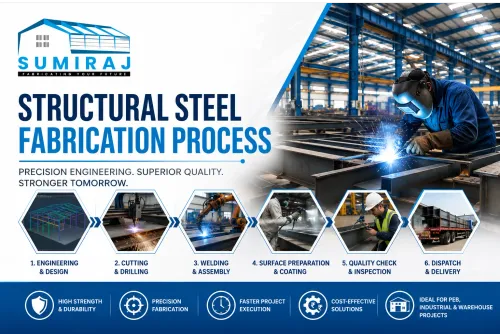
A Pre-Engineered Building (PEB) is a steel structure that is designed, fabricated, and manufactured in a factory before being assembled at the project site.
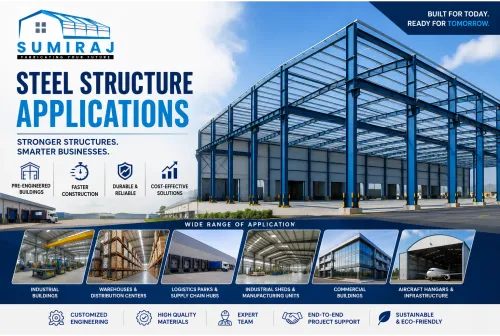
PEB structures are commonly used for:
Industrial sheds
Manufacturing units
Warehouses
Logistics centers
Cold storage facilities
Commercial buildings
Aircraft hangars
Sports complexes
At Sumiraj, we manufacture and supply high-quality PEB solutions tailored to the specific requirements of industrial and commercial projects.
What is an RCC Building?
An RCC (Reinforced Cement Concrete) Building is constructed using concrete reinforced with steel bars. RCC construction is widely used for residential, institutional, and multi-story buildings.
RCC structures require significant on-site construction activities, including:
Formwork
Reinforcement work
Concrete pouring
Curing
Finishing
This process generally increases construction time and labor requirements.
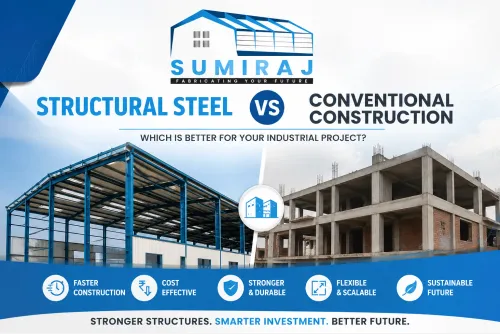
PEB vs RCC Building: Cost Comparison
1. Initial Construction Cost
PEB structures are designed using optimized steel sections, reducing material wastage and overall construction costs.
| Factor | PEB Building | RCC Building |
|---|---|---|
| Material Optimization | High | Moderate |
| Material Wastage | Low | Higher |
| Foundation Cost | Lower | Higher |
| Labor Requirement | Lower | Higher |
| Construction Cost | Generally Lower | Generally Higher |
Winner: PEB
For large-span industrial structures, PEB buildings typically offer better cost efficiency than RCC buildings.
2. Construction Time
Time is money in any construction project.
Since PEB components are manufactured in a controlled factory environment, site work and fabrication can occur simultaneously.
Typical Construction Duration
| Building Type | Construction Time |
|---|---|
| PEB Building | 6–12 Weeks |
| RCC Building | 4–8 Months or More |
A faster project completion means:
Earlier business operations
Reduced labor expenses
Faster return on investment
Winner: PEB
3. Foundation Cost
PEB buildings are significantly lighter than RCC structures.
Because of the reduced structural weight:
Smaller foundations are required
Excavation costs decrease
Concrete consumption reduces
This results in noticeable savings during project execution.
Winner: PEB
4. Maintenance Cost
Modern PEB structures use protective coating systems that provide excellent resistance against corrosion and weather exposure.
With proper maintenance, steel structures can perform efficiently for decades.
RCC structures may require:
Crack repairs
Waterproofing
Surface restoration
Concrete rehabilitation
over their service life.
Winner: PEB
5. Future Expansion Cost
Businesses often expand as production and storage requirements increase.
PEB structures are designed for easy expansion.
Additional bays can often be added with minimal disruption to ongoing operations.
RCC structures usually require:
Demolition work
Structural modifications
Additional reinforcement
which can significantly increase expansion costs.
Winner: PEB
6. Space Utilization
PEB buildings can achieve large clear spans without internal columns.
Benefits include:
Better equipment movement
More storage capacity
Efficient warehouse layouts
Improved operational flexibility
RCC structures often require additional columns that reduce usable floor space.
Winner: PEB
Long-Term Return on Investment (ROI)
When evaluating total ownership cost, PEB buildings generally provide:
Lower construction costs
Faster completion
Reduced maintenance expenses
Easier expansion
Better operational efficiency
These advantages translate into a higher return on investment over the life of the building.
For industrial and warehouse projects, PEB often becomes the more economical choice.
When Should You Choose RCC?
RCC may be suitable when:
Multi-story construction is required
Residential projects are being developed
Complex architectural designs are needed
High-rise structures are planned
For industrial applications, however, PEB is often the preferred solution due to its speed, flexibility, and cost-effectiveness.
Why Choose Sumiraj for PEB Solutions?
At Sumiraj, we specialize in manufacturing and supplying high-quality Pre-Engineered Building solutions for industrial and commercial projects across India.
Our strengths include:
Custom-engineered PEB designs
Quality-controlled manufacturing
Cost-effective solutions
Timely project execution
Expert technical support
Durable and efficient steel structures
Whether you need a warehouse, factory shed, logistics facility, or industrial building, Sumiraj delivers reliable PEB solutions designed for long-term performance.
Conclusion
When comparing PEB vs RCC Building, the overall winner for most industrial and commercial applications is the Pre-Engineered Building (PEB).
PEB structures offer:
✓ Lower construction costs
✓ Faster project completion
✓ Reduced foundation expenses
✓ Lower maintenance costs
✓ Easy future expansion
✓ Better return on investment
If your goal is to maximize savings while maintaining structural performance and durability, a PEB building is often the smartest choice.
Frequently Asked Questions (FAQs)
1. Is a PEB building cheaper than an RCC building?
Yes. In most industrial and warehouse applications, PEB buildings are generally more cost-effective due to optimized steel usage, lower foundation requirements, and faster construction.
2. Which building lasts longer, PEB or RCC?
Both can have long service lives when properly designed and maintained. Modern PEB structures with protective coatings can provide excellent durability for decades.
3. How much time can a PEB building save compared to RCC?
PEB projects can often be completed in weeks rather than months, significantly reducing overall project timelines.
4. Can PEB buildings be expanded later?
Yes. One of the major advantages of PEB structures is the ease of future expansion with minimal disruption.
5. Are PEB buildings suitable for warehouses and factories?
Absolutely. PEB buildings are widely used for warehouses, manufacturing units, logistics facilities, and industrial sheds due to their cost efficiency and large clear-span capabilities.
6. Why are industrial companies choosing PEB over RCC?
Industrial businesses prefer PEB because of lower costs, faster construction, reduced maintenance, and greater flexibility for future growth.
Contact Sumiraj
Looking for a cost-effective PEB solution for your next project?
Sumiraj – Fabricating Your Future
📞 Phone: +91-7065539408
📧 Email: info@sumiraj.com
Contact our team today to discuss your industrial building requirements and get a customized PEB solution.